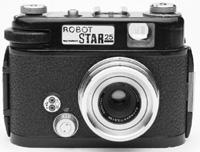
Robots are probably the most underrated and underpriced world class cameras on the used market today. They are built to at least the same standards as Leicas and Contaxes--actually, they're tougher and more reliable--and yet you can...
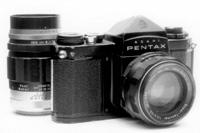
Just hold a Pentax. That was the slogan, 30 and more years ago--and very clever it was. The light, svelte, elegant SV (also sold as the H3V) was so lovely that if you did hold one, you wanted it. Next to its...
Mechanical precision has an almost sensual pleasure of its own. Think of the buttery wind-on of a 1950s Leica M3, or the way that the lens panel of an Alpa 12 glides into place, then fits solid as a rock. Recently...
"Contrast" means a surprising number of things in photography: at least six. Made to do so many jobs, it is not surprising that confusion reigns, plenty of contrast is a Good Thing in some...
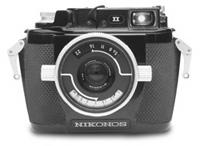
One of the joys of classic cameras, indeed, of classic anything--is the absence of "me-too" design; and the Nikonos II illustrated is about as far from "me too" as you can get.
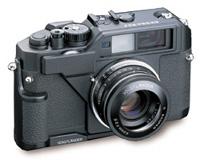
The Bessa-R2C and R2S are both variants on the superb R2. Instead of the Leica bayonet mount of the R2, however, the new cameras have the original 1932-1961 Contax mount (R2C) and the original 1948-1963...
Bob Shell was covering medium format cameras and high-end digital; Peter Burian got 35mm SLRs and point-and-shoots; Joe Farace had other digital cameras. And I was the one who got lucky, with rangefinder cameras, large format, and Weird Stuff. ...
Let's be honest: tripods are worthy but dull, so I'll dive straight in with the Weird Stuff--that is, with the products that defy ready categorization, but are either highly desirable or extremely unusual or sometimes both. Let's start at...
Beware: heresy is about to be spoken. It is that you might care to take one of the most sublimely constructed and complex of all mechanical cameras, and butcher it.
The sacrificial victim is a Linhof Technika 70, which entered production (as far as I know) in the early 1960s: certainly...
Few people realize that photographic spot meters date back some 2/3 of a century. The very first was built by Arthur Dalladay, editor of The British Journal of Photography, in about 1935; he described it in the BJP Almanac of 1937 on pages 127-138. This meter still exists, in the possession of a...