| |
The
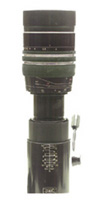
Pan-Tele-Kilar on a Nikon F (or, a Nikon F on a Pan-Tele-Kilar)
at infinity.
|
|
Mechanical precision has
an almost sensual pleasure of its own. Think of the buttery wind-on
of a 1950s Leica M3, or the way that the lens panel of an Alpa 12 glides
into place, then fits solid as a rock. Recently, I came across one of
the finest pieces of mechanical precision that I have ever encountered:
one that would, I fear, be quite impossibly expensive to emulate today.
It is the 300mm f/4 Pan-Tele-Kilar from Kilfitt of Munich, introduced
in the late 1950s and probably continued in production for a decade
or more; it is the acme of German fine engineering.
The specification of the four-glass lens is nothing to write home about:
neither the focal length nor the aperture is remarkable, and the diaphragm
(to f/32, with full-stop detents only) is preset, not automatic.
But the focusing mount; ah, the focusing mount...
|
| |
The business end of the lens, at full extension. You can
see two helicals, upper and lower, and the rack portion.
|
|
Two-Touch Focusing
Most people are familiar with the terms "one touch" and "two
touch" as applied to zoom lenses. With a one touch, there's
a single ring that you twist to focus and push pull to zoom, while a two
touch has two separate twist rings. Well, how about a two touch focusing
movement?
Built into the forward tripod shoe of the lens (I'll come back to
the other tripod shoe later, but suffice it to say that this is not a
lens you use without a tripod) there's a focusing rack with knobs
such as you might expect on a large format camera. Interchangeably affixable
to either knob is a long (90mm, 33/4") focusing lever. Twiddle it
through no less than 13/4 turns, and the index mark on the lens moves
smoothly--so incredibly smoothly--out along a scale that is
marked in meters on one side, and feet on the other: in meters, 50-15-10-8-6-5-4-3.5,
in feet, 165-50-33-26-20-18-16-14-12. There are separate engraved indices
for these: they are not approximations on either side of the same line.
Once you have wound the focusing lever as far as it will go, start focusing
conventionally with the helix. This is the longest and smoothest acting
I have ever used, and it is engraved with its own (complex and detailed)
focusing scales. The first full turn takes you down to about 1.85 meters
or 6 ft; the second to just over 1.4 meters, or 4'8"; and
the last 1/6 of a turn or so to rather under 1.4 meters, a bit over 4
ft. At this distance, the image size on the film is slightly bigger than
4/10 life size: helpfully marked in red are the reproduction ratios of
1:5, 1:4, 1:3, and 1:2.5 (the closest marked) and in green "2x"
which I take to be the required exposure compensation at the closest focusing
distance. Remember, this lens antedates through lens metering.
The versatility of this focusing arrangement is astonishing. For focusing
in the normal range, the lever is very quick indeed, and by the time you
are in the near macro range--you can fill the frame with a butterfly
at 4 ft or so--it is unparalleled for rapid focus adjustments.
What is more, at full extension (or anywhere else), there is no play anywhere,
despite the enormous focusing movement and the fact that it is a mass
of adapters and detachable parts. These include the lens shade (82mm thread);
the main focusing mount with its click-in filter holder near the rear;
the focusing lever; the intermediate tube (engraved "WE")
with a subsidiary accessory foot; a threaded T-mount adapter; then a
T-mount, both the tube and the T-mount adapter held in place by threaded
rings so that the mating surfaces are flat to flat (with locating pins
to stop unwanted rotation). The gel filter holder takes 45mm square gels
and has its own little ball catch to lock it in place. The whole thing
is an absolutely stunning piece of equipment.
The basic lens, with gel filter holder but without intermediate tubes,
adapters, focusing arm, or lens shade, weighs about 1.7 Kg, a fraction
under 33/4 lbs. Bolting on all the goodies (except the T-mount, which
can vary in size and weight) adds about another quarter-kilo or 9 oz.
The basic length of the stripped lens is 187mm (73/4") at infinity
but 304mm, over 12" long, at the closest focusing distance. The
rear tube (without T-mount) adds about 40mm (near enough 15/8")
to this, and the shade another 40mm or so.
|
| |
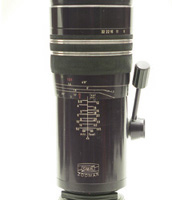
A
close-up of the focusing scale. At this point, the helical
focusing scales have just moved off the end of the main
scale: there is about 75mm (3") more extension available.
|
|
Medium Format Charmer
The Pantie-Killer (as its owner affectionately calls it) is impressive
enough with 35mm, but with the right adapters it will cover 6x6cm at infinity
and 6x7cm at anything much closer, so with a camera having a focal-plane
shutter it is a staggeringly desirable lens for medium format: a Pentax
6x7cm, say. With a 645 it would go all the way to infinity: if I had a
Mamiya 645, I would be desperate for this lens.
The lens is engraved "Zoomar" under the Kilfitt logo, as Zoomar
actually bought out Kilfitt in (as far as I know) the early 1960s, though
production continued in Germany. Performance is more than adequate, without
being stunning: optically, I suspect that a modern design (with floating
elements and multi-coating) could be even better. But the point is, no
one would make a lens of this mechanical quality today: and if they did,
no one could afford to buy it. At a guess, you couldn't build it
to sell for much less than $5000. Today, it's so rare, but so relatively
unappreciated, that it's almost impossible to price. Someone who
really, really wanted it (and had the money) might cheerfully pay well
over $1000 for it; or it might languish unsold at a camera fair at $100.
For the user, it remains an extremely good lens. To a collector, it must
be even more desirable. It doesn't have Leitz or Zeiss engraved
on it, but it is rarer and (dare I say it) better made than many things
that do bear those desirable logos; so to the discerning collector, such
as the gentleman who loaned me this one on conditions of strict anonymity, it is a very great prize indeed.
|