| |
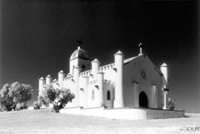
Church,
Minas Santos Domingos, Portugal. This shot appears very
contrasty because two big areas of widely differing tone
are right next to one another: the bright white of the
church and the (heavily filtered) sky. In reality, the
contrast range is well within the recording ability of
a "straight" print. Frances Schultz used a
Nikkormat and 35mm f/2.8 PC Nikkor, with Ilford SFX and
a true IR filter (T50 = 715nm), printed on Ilford Multigrade
IV.
|
|
Contrariwise, a misty day reduces
contrast. A faithful representation of the scene is easy enough, but often,
a faithful representation is not what you want: you want more contrast
than really existed. In this context, too little contrast is a Bad Thing.
You can, however, restore contrast in a subject that is "flat"
because of atmospheric haze by using a "sky" filter (yellow,
orange, or red, in ascending order of power).
It's not immediately obvious, but a long brightness range does not
always equate to a subject that looks contrasty. A landscape with deep
shadows may have an enormous brightness range, as much as 1000:1, but
if the darkest shadows occupy only a tiny part of the image and aren't
important, you can ignore them, and the picture still won't look
contrasty. But if there are large dark areas next to large light areas,
even a subject with a small brightness range can look contrasty.
Print Contrast
Second, there's print contrast. A black and white print that is
too contrasty has plenty of blacks and whites, but not too many subtle
grays in the mid tones: it is what our ancestors used to call "soot
and whitewash." A print that is not contrasty enough is flat, dull,
and gray, like shades of cigarette ash. Similar effects can be seen in
color, with the rider that in an overly contrasty print the colors are
likely to be garish, while in an insufficiently contrasty print they will
be flat, dull, and degraded. In this context, too much contrast is definitely
a Bad Thing. So is too little.
|
| |
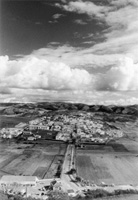
Aljezur,
Portugal. This was a very hazy scene. If it had been shot
with a lens that lacked contrast, and no filter, it would
have been no picture at all. But a contrasty lens and
a red (Wratten 29) filter, plus Ilford SFX, restored all
the contrast you could ask for without looking unnatural:
it printed very well on Grade 2.
|
|
Film & Paper Contrast
Overall print contrast isn't the same as either film contrast or
paper contrast, which are our third and fourth uses. Even if you start
out with a film of optimum contrast, you can make a print that is too
contrasty or too flat by using the wrong paper grade; and conversely,
if you stick with a middling grade of paper, your prints can be too contrasty
or too flat if your negative is less than ideal.
Let's start with black and white film. More development means more
contrast: less development means less contrast. A film that is developed
to the optimum contrast should print on average on a middling paper contrast
grade, usually 2 or 3.
If there are mixed subjects on the film, the contrastier ones may require
a softer grade of paper, and the less contrasty ones may require a harder
grade. The simple rule is this: negatives with more contrast require paper
with less contrast (Grades 2-1-0) and negatives with less contrast require
paper with more contrast (Grades 3-4-5).
If your films regularly require
hard grades more often than soft, you are underdeveloping them, and you
should increase your development times in one-minute or half-minute increments
until you get films that print on average on 2 and 3. If your films regularly
require soft grades more often than hard, you are overdeveloping them,
and you should decrease your development times in one-minute or half-minute
decrements until you get films that print on average on 2 and 3.
|
| |
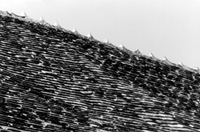
Barn
roof, Touraine. Deficiencies in negative contrast can
be remedied by appropriate paper choice. This was part
of a series of experiments in "gamma infinity"
development coupled with grievous underexposure: I rated
Ilford Pan F Plus (ISO 50) at EI 200 and tripled the development
time. On Grade 2 Ilford Multigrade IV, the print was hopelessly
flat; on Grade 4 (as here), there is plenty of subtlety
and "sparkle." I shot the 200-year-old roof
of my barn with a Nikon F and 200mm f/3 Vivitar Series
1 plus orange filter.
|
|
With color negatives, film
development times are fixed, which means that contrast is fixed. Also,
there are far fewer paper grades to choose from: often just "normal"
and "contrasty" and sometimes not even that. Even so, contrast
problems in conventional silver halide photography are rarer in color
than in black and white--not least because people are much more willing
simply to sacrifice the shadows in color, and let them block up to a featureless
black.
In digital photography, print contrast is simply a question of turning
the color and contrast up or down at the postproduction stage until it
looks right to you.
Lens & Camera Effects
Although you can have too much or too little contrast in conventional
prints or negatives and in ink jet or other digital prints, contrast is
pretty much a one-way bet when it comes to lenses and cameras: you can't
have too much of it.
This is our fifth use of the term "contrast." All scenes lose
contrast when they are projected by a lens onto the film (or image sensor)
inside a camera, because of non-image forming light bouncing around inside
the lens and indeed the camera itself: that is why contrast depends on
both the camera and the lens together, not just on the lens.
|
| |
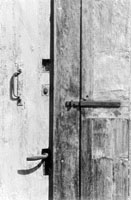
Door,
Loches (Touraine). The importance of film acutance can
be overestimated: lens contrast and sharpness are at least
as important. This was shot on Ilford XP2, which is not
as sharp as (say) Ilford Delta 100, and which cannot be
developed in trick developers to increase acutance. But
the staggeringly sharp lens (90mm f/3.5 Voigtländer
Apo Lanthar, with B+W 2x orange filter, on a Bessa-R)
gives all the microcontrast you need.
|
|
Some of this non-image forming
light is reflected back out of the front of the lens, reducing the amount
of light available to take the picture; some is absorbed by the various
light baffles; and some ends up on the film, where it "fills"
the shadows and reduces the contrast range.
The way that this sort of contrast is measured is as a "flare factor."
If the brightness range of the original scene is (say) 128:1, seven stops,
and the brightness range of the projected image is 64:1, six stops, then
the flare factor is 2. This would not be unusual for a modern 35mm SLR,
but a box camera with an uncoated lens might have a flare factor of 4,
so that 128:1, seven stops, becomes 32:1, five stops at the image plane.
A view camera with a top-flight multi-coated lens might have a flare factor
of little more than 1, implying no significant degradation of the brightness
range: the 128:1, seven stops, of the subject would be projected with
effectively the same brightness range.
Old, flary lenses can however be useful when you are trying to reproduce
the effects of the past, when lenses were uncoated. For example, I use
an uncoated 21" (533mm) f/7.7 Ross for shooting 8x10" Hollywood
style portraits. The low contrast of the lens means that I have to develop
the film longer in order to regain contrast. This gives a different tonality
from using a modern, contrasty lens and developing the film for less time.
Acutance
Then there is a sixth use of the word "contrast," this time
in a compound: "microcontrast." Also known as "acutance"
and "sharpness," microcontrast is a measure of the rapidity
of the transition between light and dark in an image.
Imagine an image of a backlit razor blade. The dark side is black: around
it is light. In a perfect imaging system, there would be an immediate
transition between dark and light. In the real world, there is literally
a "gray area," a transition zone between the two. The smaller
the gray area, the better the microcontrast--and as with lens/camera
contrast, more microcontrast is better, unless you are specifically trying
for an
old-fashioned effect.
For obvious reasons, microcontrast is more important with 35mm than with
roll film, and more important with roll film than with large formats.
Microcontrast is affected by the lens (including flare); by the film;
by exposure; and by development. It's not the same as resolution,
incidentally. A lens can have high resolution and low contrast: you'll
be able to see the finest lines on a resolution chart, but only as faint
shades of gray. A lens with lower resolution and higher contrast will
often look "sharper": you won't be able to see the finest
lines at all, but the ones you can see will be crisper and contrastier.
Much the same is true of film. Increased exposure will always reduce microcontrast,
principally because of light diffused by the thickness of the emulsion:
for maximum microcontrast, keep exposure to a minimum.
High Acutance Developer
The effect of development on microcontrast is particularly interesting,
though principally relevant to black and white. "Acutance"
developers are specifically designed to increase microcontrast, always
at the expense of fine grain: that is to say, fine-grained developers
show lower acutance, one of many tradeoffs that exist in photography.
And with most developers, more agitation means lower acutance, so for
maximum acutance, keep agitation to the minimum necessary for even development:
typically, 5-10 seconds agitation every minute, on the minute. Minimum
agitation will however reduce film speed for a given contrast level: another
tradeoff.
At the beginning, I said that "contrast" can mean at least
six things. Some of the others include color contrast, contrast of scale,
and even contrast of subject matter (old and new, young and old, that
sort of thing). But the six mentioned here are all related.
|