|
Bob Shell was covering medium
format cameras and high-end digital; Peter Burian got 35mm SLRs and point-and-shoots;
Joe Farace had other digital cameras. And I was the one who got lucky,
with rangefinder cameras, large format, and Weird Stuff.
Hirofumi Kobayshi supplied the hits of the show, as ever: not one but
two new variants on the Voigtländer Bessa R2, the R2S (Nikon S mount)
and R2C (Contax mount). This is the old mechanical Contax mount, 1931-1961
or thereabouts, not the new autofocus G-mount. All new Voigtländer
products should be available in the spring.
Although they are superficially very similar, the main difference between
the R2S and R2C is the total angle of rotation of the inner lens mount,
which explains the slight incompatibilities of the two lens systems. Both
have through-lens metering and selectable viewfinder frames for 35mm,
50mm, and 85mm: the last is of course the "canonical" focal
length for Contax/Nikon, instead of the 90mm of Leica.
|
|
To go with the R2S, there is
an all-new 85mm f/3.5 Apo-Lanthar, and many more lenses are now available
in Nikon S mount, including even the 50mm f/1.5 Nokton. Anyone who owns
an S-series Nikon can now integrate the new Voigtländers seamlessly
with his existing cameras and lenses. The R2C is intended mainly for those
whose Contaxes are too old or too fragile to stand up to regular use,
but who want to continue to use their Zeiss lenses: Kobayashi-san had
a 21mm f/4.5 Biogon on his R2C. I have the same lens: I was going to sell
it, but now I'm seriously tempted to buy an R2C. Mine lacks the
rangefinder coupling, but Kobayashi-san had removed the coupling on his,
too. Apparently, it's a choice between rangefinder coupling, and
through-lens metering, and as you don't really need a rangefinder
with a 21mm, the metering wins.
For the R2 in Leica M-mount, there's a new lens, too: a 35mm f/1.2
with three aspheric surfaces. This is the fastest 35mm lens ever built
for a series-production camera, and even though it's quite bulky,
I think I'll have to own one. I'll then have four 35mm lenses
in Leica fit (f/2.5, f/1.7, and f/1.2 Voigtländer, f/1.4 Leica) so
I think that my old (non-aspheric) 35mm f/1.4 Summilux will have to go.
The 35mm f/1.2 is only in M-mount as the rear glass is too big to fit
through a 39mm x 26tpi Leica-type screwmount.
|
If you don't want
"Voigtländer" written on your camera, how about "Rolleiflex"?
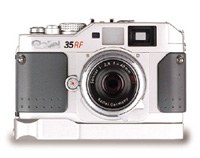
There's now a Rollei version of the R2, the RF35, in silver, with
a thicker, grippier body covering and a choice of three Rollei (Zeiss-design)
lenses: 40mm f/2.8, 50mm (which wasn't there, so I don't
know the speed), and 85mm f/2.8. Like the R2S/R2C, there are three selectable
frames for the three lenses. Opinions were divided (sometimes quite
fiercely) as to which looked better, the silver Rollei or the olive
drab R2. The thick body covering of the Rollei means that the Voigtländer
trigger base won't fit (I tried mine) but there is a special Rollei
version that will. The lens mount is still Leica M-compatible and if
I bought one I'd be looking for the old 40mm f/2 Summicron and
Minolta lenses from the CL of fond memory, for the extra speed over
the Sonnar. But I think I'd rather have the 35mm f/1.2 anyway...
And if you insist on Leica M-lenses, the Apo-Summicron-M 90mm f/2 is
now available in silver; in order to make the finish stick, there's
a lot more brass in the lens and it is about 125 gm (41/2 oz) heavier,
giving it a lovely "heft."
On the subject of lenses, the 12mm f/5.6 and 15mm f/4.5 from Voigtländer
are now available in Nikon F mirror-up (!) mount. For those too young
to remember such things, this is a means of using non-Retrofocus ultra
wides on reflex cameras, with a separate finder. With the mirror locked
up, of course, there is no problem with the rear of the lens crashing
into the mirror. The 21mm f/4 Nikkor (originally a rangefinder lens)
is perhaps the most famous "mirror up" but from memory there
was also a 19mm f/3.5 from Canon and a 21mm f/3.4 Super Angulon for
Leicaflexes.
The 12mm or 15mm finders can be fitted in the increasingly hard-to-find
Nikon accessory shoe that fits over the rewind, or on a plastic dummy
prism which replaces the regular item on an F or F2. To obtain double
(or triple) mileage from these highly specialized lenses, adapters are
available to allow them to be used on Leica-compatible and Contax-compatible
cameras.
|
| |
|
 |
Large Format
In large format, my cup ran over: a table had been prepared in the sight
of mine enemies. Sinar's P3 was hardly news--it had been announced
well before the show--but it was of the standard one expects from
Sinar, who in addition offer the world's highest-resolution digital
back.
Also in the digital field there was an all-new Silvestri (the Bikam 7000K,
from Bromwell Marketing) which Bob Shell is covering, and a "baby"
Gottschalt, a wonderfully compact mini-view camera for lenses from 28mm
upward. Both the Silvestri and the Gottschalt are designed mainly for
use with digital backs but are also compatible with halide backs if you
like. Then there was the motorized digital mini-view camera from Horseman,
the X-Act D, with motorized switch between ground glass and digital back.
A very simple digital Horseman, the ISS CompactCam, is little more than
a Nikon F lens mount, a Hasselblad back mount, and a shutter in between.
How much more do you need?
A new digital back adapter from my good friends at NPC allows the use
of lenses from 35mm cameras on a chip slightly larger than 24x36mm, all
on 4x5" cameras. They had a 14mm Sigma on a Cambo but I'd
really like to try a 12mm Voigtländer (see earlier) with my Linhof
Technikardan. This certainly removes the objection that you can't
get wide angles for digital cameras!
Another digital delight was the Roundshot VR-Drive, which can be used
either for motorized panoramic VR photography or (with the rotary drive
and the camera separated) for 360Þ photography of an object on a
turntable, allowing it to be seen from all sides. But again this is Shell's
parish.
Besides, my heart lies in "real" (halide) photography, and
here I saw three new 4x5" cameras; one new 5x7"; and one new
8x10". Not bad for a "dying" breed!
Starting with the biggest, Keith Canham's all-metal 8x10 looks like
a very competent, very light (just over 9 lbs) 8x10" camera when
it is erected, but when it is collapsed (which can be done very quickly)
its true beauty becomes apparent: it looks like a piece of sculpture.
Part of this is because of extensive drilling for "added lightness"
and part of it is simply because anything that is very well designed is
likely to be beautiful as well. A particularly clever trick, which is
also very simple, is a strap around the base so that when the camera is
folded for carrying, it can't fall open. It features Canham's
trademark monster extension (864mm, an impressive 34", with a minimum
of 69.5mm), full front movements, back tilt only, and costs $2650 from
KB Canham Cameras Inc. or their dealers.
The 5x7 comes from Mike Walker (imported by Ted Bromwell) who shared a
stand with Canham. It uses the same sort of polycarbonate construction
as his existing 4x5 models. This makes it light, tough, and highly resistant
to climatic adversity. Mere humidity is as nothing: you can boil this
camera (once you have removed the bellows and the lens) and you won't
affect its dimensional stability. It is also one of the first non-Canham
cameras to incorporate a removable (Graflok-type) ground glass to permit
the use of a Canham 6x17cm back, which at last is in production: I have
been promised an early sample for review. Canham himself reckons that
Walker's camera may be better for his 6x17cm back than his own Canhams!
|
|
At 4x5", Arca-Swiss
showed their lightest full-feature monorail camera yet at 2 kg (4.4 lbs).
On the front, there is tri-axial yaw-free tilt--as Arca said, yaw-free
may not be quite as important as some people like to maintain, but it
is better than non-yaw-free, so why not supply it--and focusing is
at the rear only. It is superbly made, like all Arca-Swiss stuff, and
it is compatible with the vast majority of the Arca-Swiss systems. It
collapses very quickly and a particularly fine accessory is a saddle-leather
"ever-ready" case which looks like a 19th century hat box.
If I didn't already own far too many 4x5" cameras, I'd
want this one, even at $3000 or so.
Then there was a whole family of Cambo Wide cameras, the DS series, with
an elegant wooden handle, vertical and horizontal shift, and a choice
of six lenses from the 38mm Schneider Super Angulon XL through 47mm, 58mm,
72mm, and 90mm to a (hardly wide) 150mm. All save the 38mm model have
a rotating back; all can be converted quickly and easily from one focal
length to another. Again, if I weren't already hooked on Alpa wide
angles, I'd fancy one of these, though I'd use a rollfilm
back rather than 4x5". They are from Calumet.
I'm not so sure that I'd want the other new 4x5", the
CD-1 from CamDynamics GmbH. It's not just the price tag of just
under $18,000 that puts me off: it's also very heavy and staggeringly
complicated. It offers multi-point autofocus and even automation of Scheimpflug
corrections for the control of focus on receding planes; if it doesn't
think it can deliver optimum quality as configured, it recommends a different
camera position or a lens change or both! Even so, I was not alone in
suspecting that if you can't handle this sort of thing manually,
you aren't likely to do any better if it is automated. Twenty years
ago, in a furniture or even automobile studio, it might have had its place;
but today, where few people shoot larger than 6x7cm and more and more
use digital, I'm not sure where the market is for this camera. I
wish them well, and it's a technical tour de force, but that doesn't
mean that it's going to sell. The same company did however have
some extremely clever software, which corrects vignetting and distortion
and even color, whether in scanned images or digitally captured pictures.
Large Format Lenses
There were also several new large format lenses: that is, they had been
announced, but I had not seen them before. One of the most useful is the
Compact Super-Anglon 90mm f/6.8 from Schneider, which offers smaller dimensions
and lower cost than the current generation of state of the art wide angles,
at the expense of a smaller aperture and slightly less coverage (it only
just covers 5x7") but still with first-class performance. Next come
two big teles: the Apo-Tele-Xenar 600mm f/9 and 800mm f/12. The front
cell is common; the focal length is chosen by selecting the rear cell.
Both cover 8x10". And the Apo-Symmar series, from 120-480mm, has
now been redesigned as Apo-Symmar-L lenses with improved performance and
(in most cases) increased coverage. In the digital field, Schneider showed
ultra-wide angle Apo-Digitars, a 24mm f/5.6 covering 100Þ and a
35mm f/5.6 covering 88Þ.
Weird & Wonderful
Now it's "Weird Stuff" time: the cameras that don't
fit into anyone else's categories. Leader of the pack, as ever,
were Herr Doktor Gilde's wonderful machines which are so versatile
as to defy belief. You want 6x9cm stereo macro? No problem (and there's
a beautiful new viewer for the stereo pairs). Or the former 6x17cm maximum
format was too restrictive? All right: fit the new 6x23cm accessory back...
These cameras are staggeringly expensive, even before you start fitting
weird lenses (720mm teles? Sure!) and they are really suitable for ground-glass
focusing only, but the multi-format computer-controlled autowind back
seen at photokina 2000 is now fully operative and there is quite simply
nothing else on earth like them.
Also in the staggering expensive realm are Alpas. There's a new
body for tripod use only: it's significantly cheaper than the other
models, and is ideal for digital. And the 38mm f/4.5 Zeiss Biogon is now
definitively back in production: Zeiss themselves say that it offers significantly
better edge definition than the earlier version, at a slight loss of central
definition--though as the central definition still exceeds what any
film can capture, the latter is hardly a significant sacrifice. The reason
for the redesign was that Zeiss was the only remaining customer for a
particular glass melt, so the choice was between a redesign and paying
for an entire melt, which would have sufficed for rather over a decade's
worth of Biogons.
|
|
And there is another staggering
expensive camera, a direct competitor for Alpa, the Wica. Built in Wetzlar
by Heiland of densitometer and enlarger-head fame, this was designed by
Matthias Schneege of Ilford. It incorporates an extremely clever lens
decentering mechanism which allows tilt, shift, or any combination thereof.
Current backs are Mamiya (up to 6x8cm) but a Linhof adapter (up to 6x9cm)
is on the way. Depending on the lens, these cameras run around $8000.
The camera on display was a prototype: the production version will apparently
have prettier grips (the ones on display were rather plain wood) and other
detail changes. I have been promised an early production sample for review;
there is no US distribution as yet.
Then there were swing-lens cameras. The long-awaited 120-format Horizont
205PC seems at last to be entering production--essentially, a 120Þ,
rollfilm version of the 35mm camera, with dual-range shutter speeds (slow
series and fast series, controlled by lens rotation speed) and a Tessar-type
lens that moves up and down for perspective control. Format is 55x110mm,
or 6-on-120. For further details, check www.zenit-foto.ru.
More expensive, but even more impressive, was its brand-new competitor,
the German-built 125Þ Eyescan at $5900. Delivering just three 50x223mm
exposures on a roll of 120 film, and offering a full range of shutter
speeds from 1 sec to 1/250 sec, it is fully motorized, and runs off eight
AA batteries.
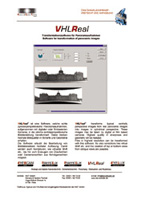
A particularly fascinating option from Eyescan's makers (KST GmbH)
is software called VHLReal that takes a scanned, swing-lens image, and
automatically corrects the cigar-shaped perspective so that you have the
illusion of a rectilinear image with up to 125Þ horizontal field
of view. Scanning such large images at high resolution results in seriously
large file sizes, though, so you will need a fast processor and lots of
memory if you want to do this sort of correction quickly and easily. If
you do, it's a simple set-it-up-and-press-the-button system, a lot
easier to use than the equivalent sequence of Adobe Photoshop commands.
The software costs 430 Euros, which are about the same as US dollars.
At the end of it all, I'd say this. These are the good old days.
What else can they be, after all, when NPC introduced a new, leather ever-ready
case for the NPC 195 Polaroid camera, as classically vintage an accessory
as you could wish for? New large format cameras; new rangefinder cameras
and lenses; swing-lens panoramas; and plenty of other High Weirdness;
and (for those who like it) digital. On top of all this, there's
150 years of photographic technology to plunder from the past: I've
scanned negatives made with a 100-year-old lens on a 40-year-old camera
and printed them on a brand-new ink jet printer. Go on: tell me the past
was better!
Manufacturers/Distributors
|