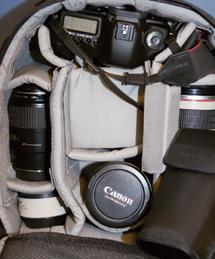
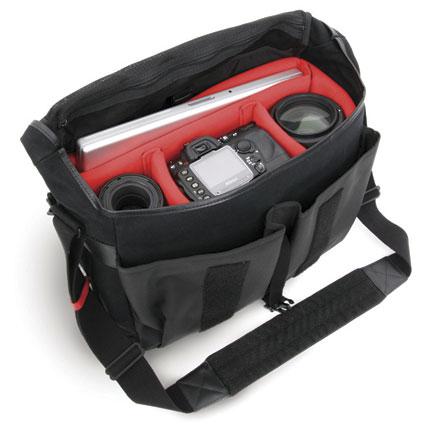
I love photo backpacks. They support the load by means of a shoulder harness system, usually aided by a chest (sternum) strap and often a waist belt so you arrive at your destination no worse for wear. They're great for nature hikes as well as general travel.
I decided to test out a number of them to see how they would fit and perform for the traveling...
The expansive coverage of a 14mm lens may be more than you think you need. But you'd be surprised to discover that it reveals a world of possibilities that might otherwise escape you. While it certainly is ideal when shooting in open country, a super-wide lens can do wonders in tight quarters. To check out this lens, and along the way explore the potential of this focal...
The Canon EF-S 10-22mm f/3.5-4.5 USM (16-35mm equivalent in 35mm parlance) was designed to cover the APS-C format, specifically the EOS 20D and both EOS Digital Rebels (plus future APS-C models). Canon's EF-S lenses (S = Short Back Focus) are physically matched to these cameras. This design also results in a smaller and lighter lens (3.5" long and less than 14 oz).
If I could, I'd spend all my time hunting down bugs and lizards and any other critters small enough to fit inside a macro lens. Simply stated, I love macro. So I couldn't wait to put the new EF-S 60mm f/2.8 Macro lens through its paces on my Canon EOS 20D digital SLR.
As you may already know, EF-S is Canon's designation for APS-C-dedicated lenses...
I've been a long-time proponent of Canon Speedlites, and also an avid follower of Metz flashes. I always liked the Metz for its sturdy quality and reliability--I'd owned a Metz potato masher (handlemount, in the old vernacular). But when I switched to the Canon EOS system, I became a devout Canon shoe-mount advocate, finding these flashes dependable and robust. I...
These days, with security tight and carryon bag restrictions even tighter, all photographers face a dilemma. In the old days you could check your cameras, albeit in very strong and secure cases, and even lock them up so no one could get their hands on your...
Changing lenses on a digital SLR subjects the interior to invasion by dust and other airborne particles. While we can avoid the problem with prudent handling, eventually we'll have to face the facts: dust will get on the sensor. The imaging sensor, whether CCD or CMOS, is a dust magnet. As soon as the camera is turned on the sensor becomes electrostatically charged. Any...
Gitzo turned the tripod world upside down—literally—when the company first introduced the Traveler, a true travel tripod. This lightweight carbon-fiber support was unusual for its inverted, contortionist-like design, where the legs fold back 180 degrees on themselves and the leg tips hug the ball head, making it more compact.
It wasn’t too long ago when the use of a CMOS chip in a digicam was a sign of a cheapie camera. Well, the tide has changed, with CMOS today reflecting the highest level of capture in our newest digital point-and-shoots. Yes, there continue to be CCD holdouts even in innovative designs, but the writing is on the wall, spelling an eventual fade-out of the Charge-Coupled Device. And today, the Backside Illuminated (BSI, or simply “backlit”) CMOS sensor is slowly but surely moving into center stage—at least among small-sensor point-and-shoots, for improved light reception at the sensor, hence clearer, tonally fuller, and more detailed images. We’re also seeing quite a few long-zoom models and more GPS-enabled cameras, with a digital compass to boot, mostly in travel/outdoors-oriented designs. The “rugged” category continues to grow, as well as features such as sweep panorama mode (just swing around with your finger continually on the button) and touchscreen displays. But perhaps the new feature that stands out most is Wi-Fi capability. One camera is even Android-powered. The latter may not be smartphones, but they certainly appear to be the smart way to go for the wireless generation. With those trends in mind here’s our roundup of the digicam class of 2012. (Please note that this report contains both cameras on the market as of spring 2012 and those announced to be available when this article goes to press. Check with the various manufacturers for current availability.—Editor)