| |
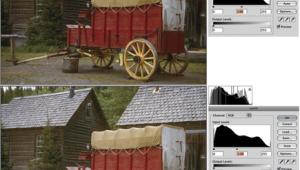
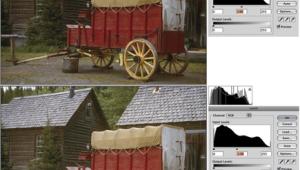
(Above) After. (Below) Before.
Photos © 1999, Darryl Nicholas, All Rights Reserved
|
|
My wife, Faye, and I started
our "mom and pop" photographic studio in the early 1980s.
We did it all. We shot weddings, kids, models, dogs, and the occasional
commercial job. One friend called it the "brides, brats, and bimbos"
business! Our basic bread-and-butter work, however, was weddings. We
shot over 60 weddings in one year when we were at the height of our
wedding shooting activities.
As our business grew, we raised our prices and became more selective
about the clients we would accept. In the beginning I did all of our
lab work in-house. I became allergic to the color chemicals and started
having headaches and skin rashes unless I was very careful. As we became
busier, we started sending out some of the lab work. We then used our
in-house lab capabilities to reprint the pictures that the outside lab
messed up, forgot to print, or printed wrong.
Over the years, Faye watched me struggle with wet-dye retouching of
things like eyeglass glare, closed eyes, dust spots, and pimples. Yes,
I could retouch all of those things, but it was time consuming and the
results were not always as good as I would have liked them to have been.
Finally, about five years ago, Faye came to me and said that she thought
she would like to learn how to do digital retouching and restoration.
We talked about it, and a few weeks later I started building our first
PC computer from scratch. I had been a computer hobbyist since the late
'70s when the Atari computer was the hot thing to have. Later,
when Commodore introduced the Amiga computer in the early '80s
I bought one and started publishing a monthly newsletter on it in which
I offered darkroom technical help to other photographers.
We soon had our first Pentium-based computer up and running under Windows
95. That was the easy part. The hard part was learning how to use it
to do the digital things that we wanted to do. Faye sat down with the
Adobe Photoshop tutorial and started studying. I started reading everything
that I could find about PC computers and their operating systems.
We both took workshops on how to use Adobe's Photoshop. I took
special workshops offered by Microsoft in the technology of their operating
systems.
Today, Faye has a successful retouching and restoration business that
is all hers. Our once busy photography studio has turned into a busier
digital imaging studio. I custom-build computer workstations for other
photographers and then teach them how to use the equipment. All of our
clients receive three years of free technical support from us when they
buy their computer from us.
Of course, there's nothing very remarkable about receiving free
technical support from the company that sells you your computer. What
I offer, however, is my lifetime of photographic knowledge combined
with my computer technical support. When a client calls me and tells
me that his pictures are coming out 5cc too magenta, not only do I know
what magenta means, I know which buttons to press to solve the problem.
I remember several years ago having the occasion of calling a tech support
person to ask for help in getting my monitor calibrated with my ink
jet printer. When I explained the problem, I was told not to worry about
it, because "the printer" would fix that before the job
was sent to press. When I explained that "the printer" was
on the desk next to the computer, the tech support person almost hung
up on me. You see, the tech support person thought that a "printer"
was a company on the other side of town that would take my electronic
file and print thousands of copies on a lithographic press. The idea
that someone would actually expect an ink jet printer to produce a saleable
product was just not included in the 30-day training that they had received
from their company before becoming a telephone tech support person.
Well, things have gotten a little better since then. But, even today,
you've got to look pretty hard to find help with photographic
related computer problems.
For example, few computer gurus know that ink jet printers have advanced
so much that they now can produce pictures that are the equal of the
finest dye sublimation prints at a fraction of the cost. Even fewer
gurus know that archival ink, which is stable for 50-75 years, is now
available for ink jet printers.
Recently, our local volunteer fire company approached us and asked if
we would help them create a poster that they could sell as a fundraiser.
They brought in five slides and two color negatives and wanted them
made into a poster. Faye put it all together, and produced the poster
on Page 164. A local lithographic company then printed several thousand
copies for the fire company.
Another client recently brought in an old black and white print of a
hydroelectric power dam that had been hand-tinted. The print was 26x38"
and had been rolled up and stored away for many years. Now, they wanted
it restored so they could hang it in the lobby of the hydroelectric
power company. Usually, when Faye is asked to retouch photos, the client
wants electric wires taken out of the image. However, this client, being
a power company, wanted to be able to see the electric wires! Retouching
the sky was easy compared to restoring those thin little electric wires
as shown below.
Besides using our digital equipment to restore old photos, we frequently
are asked to save new photos. For example, when slides or negatives
have been damaged in automatic processing equipment, or when an error
was made in the exposure on the camera.
We still use C-41 film and shoot over a thousand preschool children
every year. Unfortunately, not every picture is a keeper!
A few weeks ago, the mother of one of the preschool children asked us
if we could retouch the picture of her son because he had a bad bruise
on his cheek. When the picture came back from the out-lab that we use,
we saw that not only did the child have a bad bruise, he also had held
his mouth crooked at the moment the camera flash fired. With our computer
equipment, it was an easy task to not only remove the bruise, but to
straighten out his smile as well.
In a wet darkroom, there is little that I can do about a poorly exposed
slide or color negative without doing some pretty complex, costly, and
time-consuming masking techniques. How many of you have almost given
up on trying to get good shadow detail in a direct R-print of your favorite
slide? How many of you have almost given up on getting a lab to make
good quality internegatives?
With my digital darkroom (or lightroom as one of my clients calls it),
I can easily adjust the contrast, color saturation, density, and color
balance--all independently of each other. I can raise the contrast in
the highlights while lowering the contrast in the shadows--without endless
trial and error test printing. I can increase the color saturation without
increasing the contrast. In a wet darkroom it is impossible to dodge
or burn-in on a color print without causing a shift in the color balance
from the reciprocity failure of the print's emulsion. However,
with the computer it is actually easy to burn-in or dodge without any
color balance shift whatsoever.
If the negative is a little soft focused, it is possible to sharpen
parts of the image a little to help with the problem. For example, with
a portrait, by simply making the eyes a little sharper, it gives the
illusion that the entire picture is a little sharper. And when you want
a soft, misty, look, that can also be done on the computer. Did you
forget to use the star filter on the wedding shot at the alter? No,
problem, add the effect later with the computer. Do you have a great
scenic shot that would have been even better if you had gotten up early
enough to have shot it at sunrise? No problem. Sleep late tomorrow,
and when you get up, add the sunrise in with the computer.
Is your favorite photo a little dull and lifeless because you shot it
on a cloudy, overcast day? Put some snap back in it! The computer can
make the sun shine again.
Did you take a great shot while on vacation, only to notice an unwelcome
tourist showing up in the background of the print? The problem is easily
solved with a digital darkroom. Are you a stock photographer who has
lost hundreds of precious slides because the company you sent them to
went out of business and never returned them? If you had first scanned
them onto CD-ROM disks, you'd now be able to replace them. Have
you had trouble using your grain focuser with your enlarger lately because
your eyesight isn't what it used to be? No problem. There is no
grain focuser in a digital darkroom!
How about all of those slides you have that are stored away and are
slowly being eaten up with fungus while their color fades? No problem.
Scan them into the computer, re-adjust the color balance to correct
for the fading, and store them on CD-ROM disks. The digital images will
not ever fade, and the fungus damage can be fixed anytime you want to
sit down and do it.
We still shoot with our regular cameras and use our regular films. But,
once the picture is captured, we send the film to an out-lab, or if
we want it done right--the first time--we print the film in-house with
our digital darkroom. You can, too. If you can learn all about f/stops
and shutter speeds, you can also learn all about hard drives and floppy
disks. They are just different tools for allowing you to do what you
do best--create great photographs.
If you'd like help or more information, write to me care of Shutterbug
or send me e-mail at: editorial@shutterbug.net.