


- REVIEWS
Camera Reviews 
More Reviews Mobile Reviews Photography Reviews - GALLERIES
- VIDEOS
- BUYER'S GUIDES

Photo Basics Kit Lights; All You Need and Tips Too
All Photos © 2006, George Schaub, All Rights Reserved |
It's simple enough to make very good lighting scenarios with the kit and the guides. This shot was made with two of the three lights, one 500 watt photoflood bounced into an umbrella and one background fill used to add some illumination to the overall room light. You can use the supplied educational materials to start and then branch out on your own.
The reflector cones slide in easily enough, as do the supplied umbrellas. An important advantage to this setup is that the heat is not transferred to the fixture itself. This is a marked improvement over the reflector/bracket setup, where you often had to work with an oven mitt to turn off the light. Here, the main heat risk is in the reflector cone and of course in the lamp itself.
One nit to pick is the set screw to fasten the umbrella to the fixture; once the rod is slid down the shaft and the screw tightened it is quite small and difficult to loosen. The weight of the rod pressing against it makes for difficult turning, so if you want to break it down quickly you should have a small set of needle nose pliers handy.
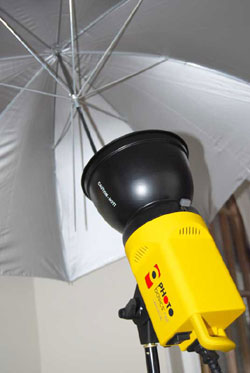 |
The kit I worked with had three lights, two of these that held the 500 watt photofloods and one the held a 100 watt "background light" bulb. The umbrella fits into a shaft on the fixture, and all throw a nice, even light over subjects.
The umbrella is made with a silver reflective interior, and all of heat resistant
fabric. The two supplied with the kit opened and closed with ease, though the
struts are thin and the rivets holding strut to fabbric frame are quite small,
causing me some concern for their future durability. But once opened and used
as instructed they throw a very pleasing, even light onto subjects. The supplied
5x8' background cloth is a mottled, neutral gray that can go light or
dark depending on how you light it. In addition, two 3M Command Hooks are enclosed,
with hook that fits the grommet size on the backdrop. This makes hanging on
any surface quite simple, and sure beats wrestling background paper. The floor
matt has positioning guides--dye-screened stones and pots--that allow
you to position the light according to the directions in the lessons.
The idea behind the Three Light Kit is that you will use two umbrellas for broad lights, left and right of the camera position toward the subject, and the third light, which is not a 500 watt photoflood but a 100 watt "bare" bulb, as the background light to add aura or hair glow to the subject or subjects. This is pretty straightforward, and those learning will master this quickly enough for people or objects they photograph. But the idea of these lights is to experiment, with one light or two or three, or just using the fill bulb for ambient illumination. And the kit and lessons walk you though it all.
When shooting you will find that 500 watt bulbs are pretty bright for close-ups, even when bounced into umbrellas, but fall off at any substantial distance from the subject. For the most part an ISO of 200 or even 400 will be required to get any useful depth of field for shots where the umbrellas are not looming over the subject. But aside from large groups this level of illumination should not be a problem. Note also that these are tungsten balanced lights so set your WB to the little light bulb, use tungsten balanced film or shoot in Raw format and custom WB the image later. I found the images came up a bit warm for a straight tungsten setting in the Nikon D40x I was shooting with and needed a bit of cooling in my Raw converter.
 |
The "background" fill light holds a 100 watt bulb that can be used as suggested, for a background "aura" light or as an ambient illumination. Note the highly reflective and specular surface on the interior, used to boost output.
The Three Light Kit contains three fixtures, two 500 watt photofloods, a 100 watt bulb for backlight, two 45" umbrellas, two long and one shorter light stand, a gray cloth background, a mat for the floor to help you with setups, the aforementioned DVD and a carry case for it all. The kit is priced at $599. The idea here is that you are buying a lighting setup that can work with many different scenarios and subjects plus lessons and a learning environment. Other kits are also available on the site at www.photobasics.net. Again, as the name implies, this is about as basic as you can get, albeit in a stylized, nicely packaged way that helps beginners learn as they work. Having this when I was a kid learning lighting would have brought me along a lot quicker, I suspect, than my cobbled together setup.
| ||
|
||






 FEATURED VIDEO


Get the Latest Photo Tips, News & Reviews from Shutterbug!






| Camera Reviews Other Reviews | |
Mobile Reviews Photography Reviews Columns | |
News | |
Features | |
How-To | |
Resources |
 © 2026 Shutterbug
AVTech Media Americas Inc., USA
All rights reserved