


- REVIEWS
Camera Reviews 
More Reviews Mobile Reviews Photography Reviews - GALLERIES
- VIDEOS
- BUYER'S GUIDES

Playing with Shutter Speeds
All Photos © 2006, George Schaub, All Rights Reserved |
Here's a typical fast shutter speed shot, one that we've come to accept as fairly commonplace, thanks to the sporting pages, high speed shutters and fast framing rates. To get this kind of shot first get a shooting position behind home plate, set the camera to high speed continuous recording and start banging away at 1/4000 sec. just as the pitcher begins a full windup.
 |
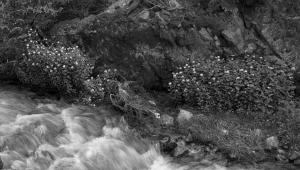
The classic slow shutter speed shot is falling water recorded at lower than 1/15 second. This kind of shot requires a tripod, a low ISO and perhaps even a neutral density or polarizing filter to cut down the light entering the lens. When you need to work in shutter priority, keep in mind that apertures have a fairly set and limited range, while shutter speeds can go from minutes to as fast as 1/8000 sec, or faster. So while you might have a six stop range in apertures to play with, shutter speeds can give you many times more, particularly on the slow side.
 |
When objects are moving quite fast, as is this whirling carnival ride, and you use a slow shutter speed (here 1/8 sec) a solid object composed of various parts can be turned into a continuous, fluid object. You can get this effect in traffic, with water and even with people moving through the frame.
 |
You can play with static and moving subjects combined by inserting another variable into the image--flash. This has the effect of both stopping motion, as you can see with the figures on the ride, and retaining the fluidity of the object in motion. Our eyes can see one or, if the object is moving fast enough, the other, but never the two in this way at the same time. The people on the road would be swirling as much as the ride that propels them.
So consider shutter speed as one image effect that can help alter a viewer's perception by working with super fast and super slow settings. Use shutter priority to set your preferred speed for image effects that simply cannot be seen by the unaided eye.
| ||
|
||








 FEATURED VIDEO


Get the Latest Photo Tips, News & Reviews from Shutterbug!






| Camera Reviews Other Reviews | |
Mobile Reviews Photography Reviews Columns | |
News | |
Features | |
How-To | |
Resources |
 © 2026 Shutterbug
AVTech Media Americas Inc., USA
All rights reserved