Jim Zuckerman

Sort By: Post Date | Title | Publish Date
Jim Zuckerman  |  Mar 25, 2014

I have long been intrigued with kaleidoscopic images, but it’s virtually impossible to photograph into a traditional kaleidoscope because the hole through which you look to see the beautiful designs is too small. Several years ago I figured out how to construct a kaleidoscope that would permit photography, and I’ve always had a lot of fun with it. The cost is around $5-$10, and it can be put together in just a few minutes.

Jim Zuckerman  |  Feb 24, 2014

On-camera flash is convenient and very fast to use, but it’s not a flattering type of light. It’s a flat type of lighting with seemingly no depth, it creates unattractive shadows, and any surface that has sheen to it will reflect the light back into the lens.

Jim Zuckerman  |  Feb 24, 2014
A failed flash photograph has an exposure in which the subject is too light or too dark. In addition, the foreground is too light—in fact, it’s lighter than the subject—and therefore distracting. In some circumstances, very dark or black backgrounds behind a subject are not desirable, and this can be considered a failure as well.
Jim Zuckerman  |  Jan 21, 2014
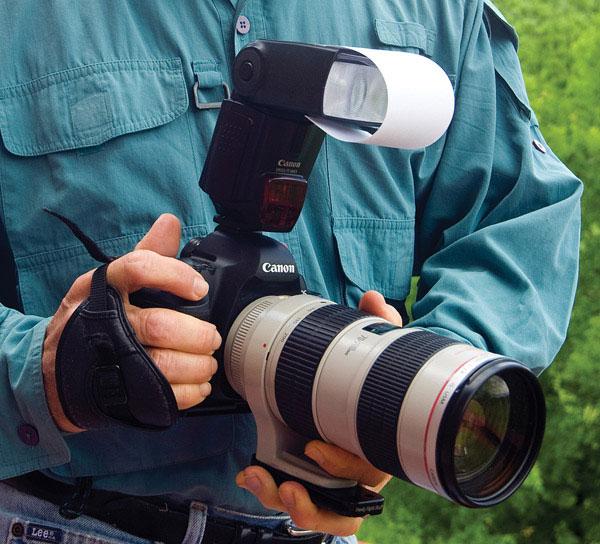
I have made the point that on-camera flash is not the most attractive artificial light for photography. In fact, I’d say it’s at or near the bottom of my list for choosing artificial light sources to illuminate the subjects I photograph. If I can’t take the flash off the camera and I’m forced to use on-camera flash, then the best approach is to diffuse the light. There are various ways to do this. Some diffusion techniques require a modest expenditure while others don’t cost anything.
Jim Zuckerman  |  Jan 21, 2014
To fully understand your flash, there are some basic principles and definitions I need to explain. When I start discussing how to be creative with your flash, you will know what I’m talking about with this information under your belt. Flash is not difficult once you understand some fundamental principles. I will start from the beginning and take you step by step to the point where it will seem like no big deal to get excellent flash pictures.
Jim Zuckerman  |  Dec 18, 2013
After I had been taking pictures seriously for two or three years, I realized that photography taught me to see things I had never noticed before I picked up a camera. I had been fairly oblivious to contrast, the shapes of shadows, details, texture, light, color, and graphic design. The camera helped me finally pay attention to all of these things. It is truly remarkable how much you can miss. For example, BP (Before Photography) I would have walked right past the overturned cart in a rural area of Missouri and not given it a second thought. It wouldn’t have occurred to me that this had any artistry or beauty. Similarly, BP I would have missed the bold graphic design, warm color, and rich texture in the detail of a cathedral door in Strasbourg, France.
Jim Zuckerman  |  Dec 18, 2013
This story is oriented to photographers who are serious about their photography, and who want to learn to use flash creatively. However, I know there are a lot of people who are very happy with their camera and who aren’t interested in buying sophisticated flash units. Admittedly, there is a lot to be said for being able to use one unit for both exposure and illumination. In this section I will address the issue of pop-up flash units and tell you how to get the most out of these small and convenient types of flash.
Jim Zuckerman  |  Dec 18, 2013
Many people think that professional looking portraits of either people or animals require a multiple light setup in a studio. The traditional configuration consists of a main light, a fill light, sometimes a hair light depending on the hair—or lack of hair—of the subject, and two lights on the background. You can see what this type of lighting looks like in where I used a 4-light setup. The background was black paper and the two subtle background lights made it look gray. I set the studio strobes to provide a 3:1 lighting ratio on the model’s face.
Jim Zuckerman  |  Nov 18, 2013
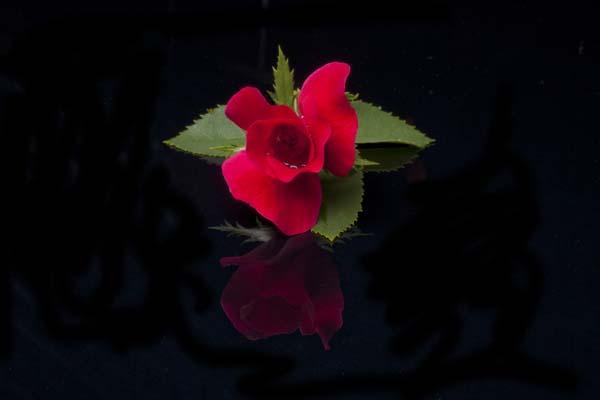
Studio photographers have used black acrylic glass to create subtle reflections in product shots and portraits for many years. It’s a wonder prop because it adds an elegant quality to the photographs of many different types of subjects, from people to glassware to flowers.
Jim Zuckerman  |  Nov 18, 2013
I have always found tree bark intriguing. It comes in myriad colors, patterns, designs and textures, and it reminds me of photographing abstract art. I am always looking at tree trunks and branches when I travel, and at home when I visit a botanical garden I know there will be a lot of photographic material. The abstract images you can photograph run the gamut from brilliant and saturated “works of art” to those that are much more subtle. The two images (#1 and #2) illustrate the tremendous range of subject matter available to you.

Pages

X