


- REVIEWS
Camera Reviews 
More Reviews Mobile Reviews Photography Reviews - GALLERIES
- VIDEOS
- BUYER'S GUIDES

A Field Test Of Panasonic’s Lumix DMC-FZ8 And DMC-TZ3
On vacation trips in the US, France, and Canada over a six-month period, I often left my D-SLR system behind and carried only two Panasonic digicams: the Lumix DMC-FZ8 with a 12x zoom and the very compact DMC-TZ3 with a 10x zoom lens. Like nearly all other tourists, I did not carry a tripod. Hence, I was particularly interested in digicam features intended for sharp, blur-free images of all types of subjects in a broad range of conditions. The Lumix models are well equipped in that respect, but that's true for some digicams of other brands as well. Thus, this report is not specifically a review of the two Lumix models but an evaluation of specific features that should be attractive to everyone.
 |
|
|
Compensating For Camera Shake
The most common cause of blurry pictures, camera shake is produced by our natural
hand and body tremors. The effect is aggravated when using a telephoto lens
that amplifies even the slightest shake while magnifying the subject. And of
course, blur can also be caused by subject movement, whether the motion of an
athlete or flowers swaying in a breeze. The solution to both problems is simple:
shoot at a fast shutter speed. That can often call for a higher ISO level, particularly
on dark overcast days or indoors, while touring cathedrals, castles, and museums,
for example.
Virtually all of the recent digicams include at least two ISO Selection modes,
and some are equipped with at least one additional option. Let's consider
each of these and the benefits they can provide.
Higher ISO Levels: Most of the digicams that I tested over the past five years
provided no ISO level higher than ISO 400. That was understandable, because
at higher ISO levels, digital noise--a grainy effect, with mottled color
specks--would have seriously degraded image quality. The reason is simple:
A digicam's CCD sensor is very small, so the pixels are smaller than you
find in a D-SLR chip. Hence, they're not very sensitive to light, making
"analog gain" necessary to amplify the signal--that's
what causes more obvious digital noise.
Over the past year or two, all of the manufacturers have solved that problem
to some extent with somewhat improved sensors and greatly enhanced processing
engines using incredibly sophisticated Noise Reduction algorithms. That combination
has made ISO 800, 1250, and even 1600 readily available. While image quality
is still best at a low ISO, it's great to have the option of selecting
a high ISO when fast shutter speeds are required for low-light or action photography.
For instance, both of the 7-megapixel Lumix cameras that I tested provide a
full range of selectable levels from ISO 100-1250, giving the user plenty of
versatility.
 |
|
|
Much higher ISO levels are listed in some digicams' specifications charts.
For example, the Lumix models claim an ISO 3200 option but a footnote indicates
that it's available only in a special High Sensitivity Program mode at
3-megapixel resolution. (A few cameras do offer ISO levels above 1600 at full
resolution.) It's worth being aware of any limitation at ultrahigh ISO
selection, although it's not really a drawback, in my view. A 3-megapixel
image is adequate for 5x7" prints, the uppermost size limit for fine quality
at ultrahigh ISO regardless of the resolution.
Note: Although a camera's default level for high ISO
Noise Reduction (NR) should work well, a few cameras, like the Lumix models
that I tested, provide other NR levels. At high ISO levels, the Low NR option
produces images with maximum resolution of detail but with a grainy, mottled
effect. The High NR option may sound more useful, and it does produce smoother
images, but the processor employs greater blurring, causing a somewhat "plasticky"
effect due to smearing of fine details.
Auto ISO: A common feature these days, Auto ISO allows the
camera to automatically set a "suitable" ISO level at full resolution,
as required by the lighting conditions. This feature is usually standard in
the fully automatic Scene modes; some cameras (like the Lumix models) provide
Auto ISO in other operating modes as well. Typically, these automated systems
are programmed with a logical goal: Set the ISO that's necessary to provide
an adequately fast shutter speed to prevent blurring caused by camera shake.
As you would expect, that means a low ISO on bright days, and a progressively
higher ISO as the light level drops. I found this to be useful while touring
castles and the Louvre Museum where the light level differed from room to room.
It was also valuable while shooting a theatrical performance where the level
of illumination changed frequently.
 |
|
|
Intelligent ISO Control: Now available with all current Panasonic Lumix cameras, and some of the latest Casio digicams, this feature provides evidence of thoughtful engineering. Each company uses its own technology, but basically, the cameras' processors include a motion detection circuitry that determines when a subject is moving and at what speed. If motion is detected, the camera automatically boosts the ISO level; the Lumix cameras allow the user to specify the highest ISO level that should be used. While Intelligent ISO mode will set a higher ISO in any low-light shooting, it's most valuable in action photography.
 |
|
 |
|
 |
|
 |
|
|
Since I often photograph cars, cyclists, horses, and other action, I was particularly pleased to discover this Program mode when testing the Lumix DMC-FZ8 and DMC-TZ3. (Both cameras also provide a remarkably effective Continuous Autofocus feature that also made it easy to get properly focused action shots.) As expected, the faster a subject was moving, the higher the ISO level that was set by the "intelligent" system, such as ISO 400 on dark days or ISO 1250 during a hockey game inside an arena. Although Intelligent ISO with motion detection is available only in a single, fully automatic Program mode, I found it to be very useful. In about 75 percent of my tests, the system allowed the camera to set an adequately fast shutter speed to freeze subject motion.
 |
|
|
Minimizing High ISO Levels
As discussed earlier, every digital camera produces better image quality at
a low ISO than a high ISO level. That's one reason why serious photographers
use a rigid tripod for landscape photography, for example. Even when shooting
at small apertures, when the shutter speed may be 1/8 sec at ISO 100, they do
not need to worry about blurry photos. Unless the subject is moving, the tripod
will ensure sharp images.
A three-legged accessory is great in many respects, but most folks prefer not
to drag one along when shooting people, places, and events. It's cumbersome
and can get in the way of others; for that reason, a tripod is prohibited in
many popular locations. As well, that accessory is of no great value when you
want sharp photos of moving subjects; a fast shutter speed is still required
to "freeze" motion. And that will call for a higher ISO level unless
the camera is equipped with one or both of the following features.
Image Stabilizer: An increasing number of digicams (in nearly every brand) now
incorporate some stabilizing mechanism that compensates for camera shake by
shifting optical elements. This feature may be identified with the term Anti-Shake,
Optical Stabilizer, Vibration Reduction, Super Steady Shot, or some similar
term. Panasonic uses their own MEGA OIS system, now available in all current
Lumix models. Any effective technology can provide sharp photos at moderately
long shutter speeds in handheld shooting, reducing the need for high ISO levels
that can degrade image quality.
 |
|
 |
|
|
On average, an Optical Image Stabilizer provides at least a two shutter speed
step advantage. Each manufacturer uses its own technology so the effectiveness
of a stabilizer can vary; as well, some shooters are simply steadier than others.
When using Panasonic's highly-rated MEGA OIS system, I selected Mode 2:
"Shoot-only," activated a split second before a photo is made. This
was the most effective in terms of the stabilization, providing roughly a three
shutter speed step advantage.
By compensating for camera shake, it enabled me to shoot at a 280mm equivalent
focal length at a 1/45 sec shutter speed instead of the 1/300 sec required with
non-stabilized cameras. When using a 50mm equivalent zoom setting, I was able
to consistently get sharp photos at a 1/8 sec shutter speed. Bracing the camera
against some firm support allowed for sharp photos at even longer shutter speeds.
That further minimized the need for ultrahigh ISO in some very dark locations,
ensuring that my images were cleaner, with less digital noise.
Note: Many cameras--including models from companies that
also make digicams with a true stabilizer--feature another type of system.
This may be an automatic "ISO boost" feature or some electronic
anti-blur sharpening. While that amenity may be labeled with some form of the
term "stabilization" or "Anti-Shake," neither is a true
stabilizing mechanism. When considering a digicam, be sure to check the manufacturer's
website carefully to determine whether it's actually equipped with a true
Optical Image Stabilizer.
Here's the bottom line on the benefit provided by the Panasonic Mega OIS
system: in handheld shooting, both Lumix cameras produced sharp images at much
longer shutter speeds than a conventional camera. The system was smooth and
quiet and it did not slow performance in any way. Even with the stabilizer on,
I was able to shoot a series of five full resolution JPEGs at a blazing 3 frames
per second. The only drawback? Any Optical Stabilizer consumes extra power;
even so, I was able to shoot all day without recharging the battery in either
camera.
Wide Aperture Lens: Any lens with very wide maximum apertures is described as
"fast" because it transmits more light to the sensor, allowing the
camera to set a faster shutter speed. That reduces the need for high ISO levels,
useful whether the subject is static or moving. Combined with an Image Stabilizer,
a fast lens is particularly valuable when shooting at long telephoto focal lengths,
increasing the odds of sharp photos that are not blurred by camera shake.
For example, the Lumix DMC-FZ8 is equipped with a Leica 36-432mm zoom with unusually
wide maximum apertures of f/2.8-3.1. That's impressive when compared to
the much smaller maximum apertures such as f/3.5-5.5 (or similar) that are more
common. The 28-280mm equivalent zoom in the DMC-TZ3 has maximum apertures of
f/3.3-4.9, a bit wider than average, particularly at the long focal lengths,
but it's not nearly as "fast."
 |
|
|
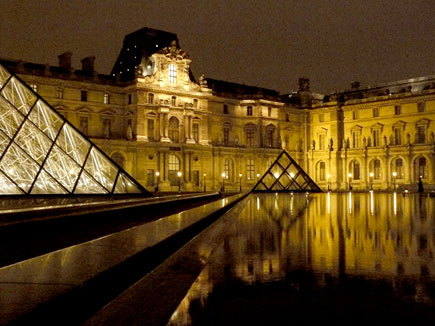
Any "faster" lens transmits more light to a camera's sensor.
While shooting with the DMC-FZ8, ISO 100 was fine for most outdoor travel photography.
The MEGA OIS stabilizer was necessary only when I wanted to shoot at small apertures,
for greater depth of field (range of acceptable sharpness). On dark, heavily
overcast days in France, I needed to boost the ISO, but only to ISO 200 when
I wanted fast shutter speeds. By comparison, the "slower" lens in
the DMC-TZ3 required me to use ISO 200 on cloudy days and ISO 400 in dark, overcast
conditions, producing images with more digital noise.
Note: As experienced photographers know, there's not much value in a "fast"
lens if it cannot produce fine image quality at a very wide aperture. That's
not an issue with the Panasonic Lumix DMC-FZ8 because its Leica DC Vario-Elmarit
36-432mm equivalent zoom includes three aspherical elements for great control
of optical aberrations. All camera companies make some models with high-grade
lenses and that is an important aspect when choosing a digicam for serious shooting.
When considering several models, read the manufacturers' comments about
lens design aspects; also check for any published reviews that discuss optical
performance.
Final Evaluation
After this lengthy discussion about shutter speed and ISO issues, let's
take a look at the level of image quality provided by the Lumix cameras. (Both
employ the same sensor and processor and a lens of similar quality.) My ISO
100 and 200 images exhibit a fine, tight grain pattern and high resolution,
suitable for 12x16" prints that look gorgeous when matted and framed.
Even ISO 400 made for outstanding 8.5x11" glossies and very good 12x16"
prints. As with any digicam, the best results were produced by images that were
well exposed or made in Raw Capture mode. While ISO 800 images exhibit a more
obvious noise pattern and slightly lower definition of fine detail, they still
made for very good letter-sized prints. Surprisingly, in the inkjet outputs--made
with an Epson Stylus Photo 1400--there's not nearly as much visible
"graininess" as in the images displayed on a computer monitor. As
expected, ISO 1250 was less impressive, but still produced very nice 5x7"
prints; even letter-sized prints from my technically best images are sharp,
though grainy. On the other hand, I didn't often need such a high ISO
level thanks to the MEGA OIS stabilizer.
In more general respects, these are both very fast, reliable, and remarkably
well equipped cameras, particularly the DMC-FZ8. The combination of Optical
Image Stabilizer, Intelligent ISO mode, user-adjustable Noise Reduction, Leica
zoom lens, and a superior autofocus system maximize the odds of sharp photos
in both low-light and action photography. Attractively priced, the Panasonic
Lumix DMC-FZ8 and DMC-TZ3 offer excellent value considering their versatility,
advanced technology, great speed, and potential for fine image quality.
The average street price for both models is $319 each.
For more information, contact Panasonic, One Panasonic Way, Secaucus, NJ 07094;
(800) 211-7262; www.panasonic.com.
A long-time "Shutterbug" contributor, Peter K. Burian (www.peterkburian.com) is a free-lance stock photographer and the author of three recent books: "Mastering Digital Photography and Imaging," "Magic Lantern Guide to the Sony A-100," and "Magic Lantern Guide to the Pentax K10D." He is also a digital photography course instructor with BetterPhoto.com.
| ||
|
||










 FEATURED VIDEO


Get the Latest Photo Tips, News & Reviews from Shutterbug!






| Camera Reviews Other Reviews | |
Mobile Reviews Photography Reviews Columns | |
News | |
Features | |
How-To | |
Resources |
 © 2026 Shutterbug
AVTech Media Americas Inc., USA
All rights reserved