


- REVIEWS
Camera Reviews 
More Reviews Mobile Reviews Photography Reviews - GALLERIES
- VIDEOS
- BUYER'S GUIDES

In Appreciation of Telephoto Lenses
|
All Photos © 2008, George Schaub, All Rights Reserved |
Tele really come in handy when you are presented with long views, as you can select areas that hold the elements of the scene you want to encompass within the frame. Wides will give you the "big picture" but a tele makes for more compositional potential. This shot was made from a rim road high in the Spanish Peaks.
Another benefit of teles is with architecture, which certainly is a great attraction when traveling through small towns where not every building is designed to sell fast food or plasma TVs. With a wide you have to stand close to structures to fill the frame, and then have to deal with the usual tilt that getting close imparts. Yes, you can stand back and crop later, or play with perspective control in software, but why bother? With a tele you can stand back, given you have the room, and get that X/Y axis square in the center of the frame. This really paid off when photographing some of the wonderful churches and shrines in the San Luis Valley.
 |
While a wide-angle lens allows for wonderful architectural studies, it takes a tele to get you the "straight up" shot where little or no perspective control is required, given you can get the distance from the main subject for the shot. I stood about 25 yards from the wonderful Capilla de Todos Los Santos in San Luis to make this shot and no perspective control was required.
But the greatest attraction for me is the visual effect called "stacking" the tele ranges supply. Just as I see in deep depth of field when I have a wide on the camera I see "compressed" with the tele. This flattening of space is quite the opposite of what my wide-angle point of view presents and it really sparks the imagination and certainly changes my point of view. I put this to work when photographing in the early morning in Trinidad, Colorado, a town with a wonderful mix of architecture that is certainly worthy of a stop.
 |
 |
The "stacking" effect compresses distances between subjects in the frame. It flattens the field, if you will, and allows you to stand back and find various elements to group together. These shots were made at the equivalent of 300mm with a Canon 30D and Sigma 70-200mm f/2.8 lens.
I do have to adjust my shooting technique a bit when working with a long-range tele. First I switch from my usual aperture-priority to Shutter Priority mode and always make sure that I am set at no less than 1/350 sec when working handheld, which I normally do when traveling through an area. If the light is low I work the aperture as best I can until I run out of light, then raise the ISO. The max ISO I work in during daylight hours is 800, and even then the contrast, and not necessarily the noise, is what I object to. I have a tripod handy just in case, but still prefer working handheld when exploring.
|
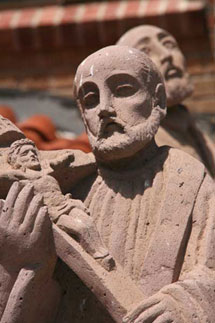
Of course teles allow you to make images with quite shallow depth of field. The Sigma lens I had with me focuses as close as 3.3 ft, which means I can stand close and using f/5.6 at 250mm get the foreground sharp and a nice soft background. I used this setup to photograph these figures outside the church in San Luis, Colorado.
I like a tele zoom because I can range around for different compositions and points of view; I have found that prime teles, while exciting lenses, are just too restrictive for the way I work. (Oddly, I prefer prime wides.) However, I make it a point to stop the zoom right before either the longest or shortest focal length. This might just be superstition, but I have always found that if I can work inside the ranges I get better results. The same goes with aperture, where I do my best, with all lenses, to keep away from the very widest or narrowest settings.
There's blessing and curses with every type of lens, but for this trip the tele zoom was ideal. In fact, even though I had a 24mm prime along it never left the safe confines of my camera bag.
| ||
|
||






 FEATURED VIDEO


Get the Latest Photo Tips, News & Reviews from Shutterbug!






| Camera Reviews Other Reviews | |
Mobile Reviews Photography Reviews Columns | |
News | |
Features | |
How-To | |
Resources |
 © 2026 Shutterbug
AVTech Media Americas Inc., USA
All rights reserved