


- REVIEWS
Camera Reviews 
More Reviews Mobile Reviews Photography Reviews - GALLERIES
- VIDEOS
- BUYER'S GUIDES
Bowens’ Esprit Gemini Flash System; In The Studio, And On The Go
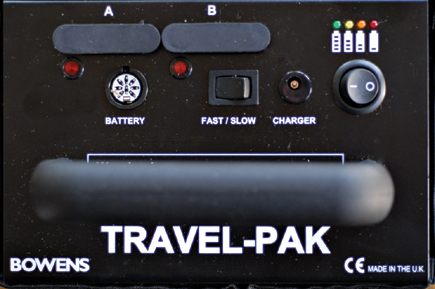
The Travel-Pak battery is a take-anywhere power source that comes with a handy carrying handle and case with shoulder strap. Note the two outlets; both 500 ws heads or one at a time can be used.
 |
 |
The Gemini kit is composed of two flash heads (monoblocs), two heavy-duty 9-foot stands, two umbrella reflectors, two umbrellas, all cords, bulbs, and cables, as well as a strong duffle bag-like carrying case. The optional Travel-Pak battery was also utilized. The supplied stands come with an "L" bracket that allows you to mount the heads in vertical or horizontal positions. Once mounted you can choose from either AC or battery power; be sure to set the appropriate switch on the back and avoid connecting both at the same time. Once you do, the green "go" light comes on quickly and you're ready to shoot.
In The Field |
|
 |
|
|
The heads' output is variable over five full f/stops, from full to 1/32
power, with 1/3 EV steps in between. The accompanying modeling lamp must be
manually set to match the flash output, which is easily done by matching numbers
on the dials. If you need an audible signal that the flash has built up full
power you can set the sound switch to "on," or turn it off if desired.
When you hit the flash you can have the modeling lamp dim out or stay on all
the time.
You can dial in up to five power ratio stops in 1/3 EV intervals by simply turning
the Power dial. The modeling lamp can be coordinated, made brighter or turned
off, if desired. This power ratio range gives you a great amount of control
over the output, especially when using the two lights as key and fill.
In The Studio |
||
 |
 |
|
|
||
There are three ways to trigger the flash. If you want to test the flash or
use multiple pops you can work with the Open Flash button. You can also use
a standard 1/4" jack attached to the socket on the rear of the unit. If
you want to fire just one flash you can go straight in, or use a "Y"
connector for both heads. This is where you can also plug in an infrared receiver
or similar wireless triggering device. One accessory you might consider is the
Bowens Pulsar Radio Trigger, which mounts in your camera hot shoe and can be
used, says Bowens, for popping the flash up to 100 meters away! This is a radio
transmitter so you can shoot through walls and around corners. It offers four
individual channels and what is known as six studio selectors, each with a different
ID for different flash units. Bowens tells us that the low-voltage operation
of the unit makes it ideal for use with digital SLRs.
| |||||||||
|

| ||||||||


 FEATURED VIDEO


Get the Latest Photo Tips, News & Reviews from Shutterbug!






| Camera Reviews Other Reviews | |
Mobile Reviews Photography Reviews Columns | |
News | |
Features | |
How-To | |
Resources |
 © 2026 Shutterbug
AVTech Media Americas Inc., USA
All rights reserved