


- REVIEWS
Camera Reviews 
More Reviews Mobile Reviews Photography Reviews - GALLERIES
- VIDEOS
- BUYER'S GUIDES
Making A Spectacle Of Themselves; Unique Lenses For M-Series Leicas
Until you understand the reference, "spectacle" lenses for M-series
Leicas are a rich source of confusion. Are they for spectacle wearers? And why
(when you see a picture) do the lenses themselves appear to be wearing spectacles?
To make life still more interesting, there are two separate reasons why some
Leica lenses have "spectacles," and better still, some of the "spectacle"
lenses are indeed better for wearers of spectacles--though that wasn't
why they were designed. Now read on.
 |
|
|
An M-series Leica has a series of fixed frame lines corresponding to different
focal lengths. On the latest Leicas, these are shown in pairs: 28-90, 35-135,
50-75. On the classic M2 they were 35-50-90 and on the classic M3 they were
50-90-135.
If you want to use a 35mm lens on an M3, therefore, you require a separate viewfinder.
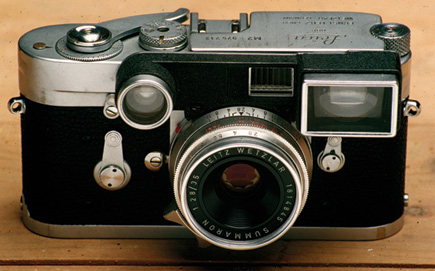
Or alternatively, you can use a "spectacles" 35mm lens. The "spectacles"
are nothing more (or less) than an adapter for the viewfinder to increase the
field of view: the 50mm frame of an M3 immediately corresponds to the field
of view of a 35mm lens.
One half of the "spectacles" covers the viewfinder window, obviously,
but slightly less obviously you also need another lens over the small rangefinder
window or the rangefinder would, to put it mildly, be rather difficult to use
because one image would be bigger than the other. Several 35mm Leica lenses
were made in "spectacles" form: Summaron, Summicron, and Summilux.
You paid extra for the "spectacles," of course: about 15 percent.
This was actually cheaper than buying a separate finder, though: less than half
the price, and it was one less fiddly little bit to lose. Understandably, therefore,
"spectacles" 35mm lenses sold pretty well.
You can use them equally well on an M2 (or any other Leica) and still use the 50mm frame for the 35mm lens, and this is where the advantage to spectacle wearers comes in. Spectacles--the sort you wear on your face--can make it hard to get your eye close enough to the viewfinder to see the outer frame: in the case of an M2, therefore, the (unmodified) 35mm frame. But with the "spectacles" lens, the 50mm frame becomes the 35mm frame, and therefore easier to see.
 |
|
|
You might think that similar arguments would apply to a 135mm lens on an M2, but actually, this is only half the story--or possibly, 1/3 of it. Yes, the "spectacles" in this case allow you to use a 135mm lens on a camera where the longest lens for which there is a viewfinder frame is 90mm. But a moment's thought will show that the 90mm frame is easy enough to see anyway with any Leica, so the "spectacles" can't make it easier to see.
Or can they? The 135mm frame on any Leica is pretty small, and obviously,
making it bigger makes it easier to use--even with an M3. This is the second
reason for its existence. But there is still more to it than this.
Only one 135mm lens was ever offered in "spectacles" form, the 135mm
f/2.8 Elmarit-M, and a 135mm f/2.8 is right at the limit of what most photographers
can easily focus with a split-image rangefinder. If you magnify the rangefinder
base, of course, you make the rangefinder easier to use. This is the third reason
(or the other reason, if you discount the frame magnification) why the 135mm
f/2.8 needed "spectacles," even with an M3: it was never made in
non-"spectacle" form.
This is a delightful lens with superb performance, but I have to confess that
I sold mine a couple of years ago because I almost never used it: a 135mm lens
just isn't very convenient on a rangefinder camera. I sometimes wish I
still had it but then I remember what an inconvenient lump it was to pack (which
was why I so seldom used it) and I can understand why Leica dropped it in favor
of the 135mm f/3.4 Elmarit-M: simpler, cheaper, more compact, and only half
a stop slower.
| |||||||||
|

| ||||||||


 FEATURED VIDEO


Get the Latest Photo Tips, News & Reviews from Shutterbug!






| Camera Reviews Other Reviews | |
Mobile Reviews Photography Reviews Columns | |
News | |
Features | |
How-To | |
Resources |
 © 2026 Shutterbug
AVTech Media Americas Inc., USA
All rights reserved