


- REVIEWS
Camera Reviews 
More Reviews Mobile Reviews Photography Reviews - GALLERIES
- VIDEOS
- BUYER'S GUIDES
The Contax T3
Lens Shutter Plus
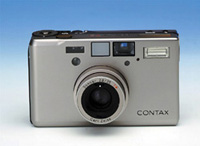
Professional photographers need a snapshot camera, too. But they require one that delivers the sharpness they have come to expect in their working cameras and a quality look and feel. Happily, there is a small, and somewhat pricey class of cameras that meet these requirements, one that's grown a bit larger with the addition of the Contax T3. Housed in a titanium body, the T3 is a palm-sized unit with a built-in Carl Zeiss Sonnar T* 35mm f/2.8 lens. Although the strength of the built-in flash leaves something to be desired, especially when used with ISO 100 film, the camera delivers tack-sharp images that even the most demanding photographer will admire. The T3 has one major change in design over the T2--placement of the shutter between the lens. This eliminates any possibility of vignetting, the darkening of corners of the frame at narrow aperture settings. One word describes the T3's layout and controls: simplicity. The controls on the T3 are downright Spartan, with nothing on the camera back save a window that shows you that film is loaded in the camera. As we'll see, however, this simplicity of design belies the many features and often-complex nature of the T3's system itself. Atop the camera is the main switch that is linked with the aperture dial. The first indent is at P for Program exposure mode, a center-weighted SPD cell that reads in an impressive -1 EV to EV 18. Most point-and-shoot cameras start somewhere around EV 6, with EV 8 the norm. This means that the T3 can deliver a good reading even in the dimmest light. After the P setting on the dial you can choose the aperture in normal stops from the widest, f/2.8 to f/16. There's no way to judge depth of field, of course, but you at least get to match the setting with your intentions, if not with specific ranges. This then becomes an Aperture Priority mode. Shutter Speed Indicators |
||||
As mentioned, the shutter speed is stepless, which means any speed within the ranges listed will be set, but you never know exactly what that speed might be. You definitely need a scorecard at first when working with this system, and it's a bit odd. But Contax wanted a way to let you know what the shutter speed range would be when working in Aperture Priority mode, and this is it. One good thing is that the balance and feel of this camera makes hand holding at slow shutter speeds a fairly effortless and ultimately rewarding experience. The shutter release sits next to the exposure dial. When you press down on the button halfway you are taking a focus and exposure reading, then you squeeze gently to make the exposure. The feel and lack of sound on the release is one of the true pleasures of working with this camera. There is no loud whir and the camera emits a tiny click, necessary to let you know that exposure is made but so quiet that not even close subjects will notice. Focusing System |
||||
Focus lock can be obtained by using the focus lock button atop the camera. To work with focus lock you hold down the AFL button for about 2 sec, and then release to take the picture. Like all such cameras the focus detection is centered, so focus lock comes in handy when you want to compose with your principal subject off to the side of the frame. Speaking of locks, although not described too clearly in the instruction book, AEL (AutoExposure Lock) can be activated by partial pressure on the shutter release button. You have to keep this depressed slightly to hold the exposure lock. This comes in handy for reading highlights or shadows for slide and negative film, respectively. The meter is quite center-weighted as well, so AEL is a necessity when shooting slide film in high-contrast lighting conditions. You can also set focus manually. You might want to do this to prevent the shutter from blocking, shooting when the AF system can't obtain focus, or when you're doing quick candids in Aperture Priority mode and can guesstimate the depth of field (a chart's provided in the instruction book for quick reference). With the 35mm focal length at f/16 and the focus set at 3 meters you've pretty much got a fixed focus lens that will deliver a depth of field for any subject from about 6 ft to infinity. You set focus via the mode button and rotate the dial until the required distance shows up in the finder. The camera will hold this focus until it is turned off or, using a custom setting, will retain it even when turned off. Yes, the distance is marked in meters, so get your metric mind in shape before attempting this. |
||||
Flash Matters For example, at f/2.8 the flash can cover up to about 7 ft when using ISO 100 film. At narrower apertures the flash seems almost useless. At f/8, with ISO 100 film, the coverage is less than 3 ft! Using ISO 400 film gives a slightly better range, but at f/8 you're still looking at less than 6 ft. Our advice? The same as that from Contax--stick to P mode and be prepared to have a very shallow depth of field when flash is required. Better yet, invest in the Contax TLA200 flash unit for TTL exposure control. This triples the flash coverage power--at f/8 you can get a more acceptable 7-8 ft coverage, and on Program (f/2.8) you can get out to about 25 ft. Without this accessory flash this is a decidedly available light camera. |
||||
Exposure Information For nuancing exposure control there's an exposure compensation setting in +/-2 EV, programmable in 1/2 or 1/3 EV increments. We recommend testing this with your favorite film to see how you can manipulate tonal values and color saturation. This is a wonderful addition that will be most appreciated by those with the instincts and experience to make the right setting decisions. There's also a two-time self-timer, one at 10 sec for getting yourself into the shot and one at 2 sec, recommended for camera steadiness when shooting long-time exposures. The 2-sec timer is a fine substitute for lack of a cable release socket. You can also set your own long-time exposures ranging from 1 to 180 sec. You can use this with or without a flash fire. This mode does not provide automatic exposure control, so you're on your own. But if you're shooting negative film, or are willing to bracket to get the exposure right, the 2-sec delay sure comes in handy. Field Test Although this is a point-and-shoot camera with a Program mode, I couldn't help but work with the camera in Aperture Priority mode. This is a luxury with a camera this compact and gave me a feeling of control over at least some aspect of the scene. The lack of specific shutter speed readouts did not get in the way and I got quite used to the range readouts the Contax T3 provides. If I did want to stop action it was easy enough to switch to a wider aperture; in addition, a check of the Program mode chart in the instruction book shows that the system always favors a fast shutter speed over a narrower aperture. |
||||
This is a camera made for working in available light. Every image I made in dim light was rock steady. The lens, as expected, delivered tack-sharp images with excellent color rendition. As mentioned, the flash is anemic. I tried the flash a few times in night scenes and the coverage was very short, as the specs imply. The only way that the built-in flash would provide meaningful coverage is with fast films, at least ISO 400 and perhaps even ISO 800. Those who like to work with slower speed films might well consider the optional flash add-on. My exposures were very, very good with negative film. When I switched to slide I found the best results were obtained by strict adherence to using AEL and/or compensating with minus EV, by 1/2 or 1 EV step. Granted, I shot all of the tests in bright Florida light, but this slight tendency to overexpose is a boon for negative shooters and somewhat problematic for slide film shooters. In open shade the camera did great with slide film; here, you would compensate for effect and not critical exposure control. I highly recommend testing with your favorite films and compensating accordingly. Many people will use this camera with negative film, such as pros looking for a quality weekend snapshot and family camera. Those who shoot only slides might want to keep the EV compensation set at some minus mark, especially for images in bright light. In all, the Contax T3 is a delight to use. Those seeking tack-sharpness in a highly portable camera need look no further. It's an excellent traveling companion that makes candid work a breeze. The fixed 35mm lens is just right for many shooting situations and is right up there with quality Carl Zeiss T* expectations. And the look and feel evokes the feeling you get when you have a fine instrument in your hands. For more information, contact Contax at (800) 526-0266; fax: (732) 560-9221; www.contaxcameras.com. Technical Specifications |




| ||
|
||


 FEATURED VIDEO


Get the Latest Photo Tips, News & Reviews from Shutterbug!






| Camera Reviews Other Reviews | |
Mobile Reviews Photography Reviews Columns | |
News | |
Features | |
How-To | |
Resources |
 © 2026 Shutterbug
AVTech Media Americas Inc., USA
All rights reserved