| |
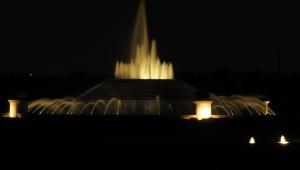
Victoria
Harbor, Vancouver Island, just after sunset. A situation
that precluded a close-up meter reading. Again, my 1Þ
meter made a difficult situation a simple one. I read
a medium tone, in this case on a building just outside
the image area, and exposed as indicated. I bracketed
liberally as I was concerned with reciprocity failure
due to the several second exposure. However, the first
shot was the best of the series.
Photos © 2002, Joseph A. Dickerson, All
Rights Reserved
|
|
For the record, I use TTL (Through
The Lens) metering and automatic modes quite often. Many of my subjects,
birds on the wing for instance, are just too flighty to allow for thoughtful
metering. But, give me a rustic barn, an historical California Mission
or, my favorite, a Victorian lighthouse isolated on a windswept bluff
looking out on a storm-tossed sea and I'll immediately reach for
my trusty spot meter. This is when I really want control, and a spot meter
gives me the control I need. I can compare highlights and shadows to assure
detail in both. Or, with a multifunction meter, I can take several readings,
compare or even average them. In short, it's all about precise exposure
control.
A Definition Or Two
And A Few Parameters
First, there are two basic meter types. Incident meters read the light
that falls on, or is incident to, your subject. Incident meters are distinguished
by the white dome that looks like half a Ping-Pong ball that covers the
light sensor. To make a reading the dome is usually pointed at the camera
from the subject's position. This method averages the highlights
and shadows and the indicated exposure setting will allow all the tones
in the scene to be recorded as they appear in the scene. This method works
well in the studio or where the Subject Brightness Range (SBR) is limited.
However, when the SBR is greater than our film can record we lose detail
causing blown-out highlights or shadows without any substance.
|
| |
Lime
Kiln lighthouse on San Juan Island, Washington. Blue sky
is a medium tone so it was easy to meter it with a 1Þ
spot meter and set the camera at the suggested reading.
Even with a light meter I trust I'll still bracket
the exposure if time, and the subject, will allow.
|
|
Second, as the name implies,
a reflected meter evaluates the light reflected by the subject. At first,
this would seem to make more sense but here, too, there are some caveats.
The meter is an ignorant tool. It doesn't know, or care, whether
you are photographing the proverbial black cat in a coal bin or a snowy
plover in a snow drift. It will indicate the correct exposure to make
whatever it is pointed at a medium tone. That is how they are designed,
and that's what they do, period.
Most reflected light meters have a fairly broad angle of view, usually
somewhere around 30Þ. This is adequate for many subjects but occasionally
it presents a problem. That moose in the meadow probably won't tolerate
you holding your meter 2 ft from its nose to make sure you're getting
the right reading. So, we also have narrow angle meters. These generally
read an angle of view of around 10Þ while true spot meters will
read as low as 1-5Þ.
A Lesson In Photographic
Mythology
In college we were taught that light meters are calibrated to a standard
of 18 percent reflectance or middle gray. Well, they lied to us! It ain't
so: 18 percent gray is like Santa, the Easter Bunny, and the Great Pumpkin.
Suffice it to say that light meters are calibrated to a reflectance of
around 12-18 percent and that you need to do a little testing to be sure
that your meter will produce the exact tones you expect. For more on this
diabolical plot to mess up the minds of young photographers I'll
refer you to two excellent sources. Post Exposure, Advanced Techniques
for the Photographic Printer, Ctein and/or The Hand Exposure Meter Book,
Martin Silverman, Jim Zuckerman, and our own Bob Shell.
|
| |
The
Old Veteran, Point Lobos, California. This scene would
be easy for almost any meter to read. With my 1Þ
spot meter I simply read the gray bark of the gnarled
cypress, said a short prayer to Ansel and Edward, and
exposed as indicated. Instant gray card.
|
|
Less Is More
Many photographers prefer spot meters that do one thing and one thing
only. They want to read a small area of the scene, selectively and accurately,
and that's it. These basic spot meters will indicate the brightness
by providing an EV (Exposure Value) number. This value is then transferred
to a dial that in turn indicates the f/stop and shutter speed values--it's
simple, quick, and reliable. The Pentax Digital Spot Meter has long been
considered the benchmark of this KISS (Keep It Simple, Stupid) approach.
It is remarkably compact, has
solid-state ruggedness, a reputation for exposure accuracy, and has seemingly
been in production forever. By the way, for those of you in the market
for a new meter I've included a chart on page 162 that compares
spot meters, their specifications and who to contact for more information.
But as useful as these basic spot meters are, some photographers need,
or want, more.
OK, Maybe More Is More Several
manufacturers offer spot meters that are capable of reading both ambient
light and flash. These are generally digital meters and as such they indicate
f/stops and shutter speeds and/or EV using an LCD read-out. Many photographers
like the easily read numerical read-outs while some may be intimidated
by all the numbers--you pay your money and you take your choice.
Some displays include an analog scale and memory, which allows several
readings to be recorded and then compared.
The Sekonic Dual Spot F (L-778), for example, will even indicate the exposure
required to make the current reading a highlight or a shadow value. The
user decides how far above or below the middle tone this highlight or
shadow should be and the meter shows the exposure needed to achieve that
tonality. This is a very useful feature for practitioners of the Zone
System. Studio photographers frequently utilize multiple "pops"
of their flash to properly expose at a desired f/stop. Many of these meters
provide a degree of automation for even this tricky task. However, I do
have one word of caution. While most experienced photographers can intuitively
figure out how to use basic spot meters, you'll probably want to
spend some quality time with the Owners Manual of one of these ambient/flash
units. I know if I don't use mine for a while I have to spend a
little time
re-acquainting myself with its operation.
|
| |
Old
barns, Los Olivos, California. I metered the dark wood
on the nearest barn and stopped down 1 stop. I usually
carry a gray card with me and here I made some comparison
readings with tones in the scene to check my exposure
plan.
|
|
More Than One Meter
It has long been known that most pros wind up with a plethora of meters.
They'll have a spot meter for Zone System work, a flash meter for
studio shots, and an incident meter for quick and dirty outdoor shooting.
So, what's the logical next step? Yep, nothing gets by you guys.
I think Sekonic was the first with an all-in-one, but everybody is in
the game now. The latest entry, the Minolta Flash Meter VI, was introduced
at the PMA Show this year and is very impressive. I'll be working
with one for a while and will have more to say about it in the upcoming
2003 Shutterbug's Photography Buyer's Guide, due on newsstands
this September.
Do these all-in-ones mean that it is now possible to carry one meter and
handle any metering task imaginable? Are there any drawbacks to the all-in-one
wunderkind? Well, one is cost. They ain't cheap. But, considering
they replace two, or perhaps even three, separate meters they could be
a real bargain over the long haul. For reasons best left to the engineers,
they aren't quite as sensitive as their less versatile cousins either.
My Sekonic L-608, an incredible tool, pops out a couple of EV before my
Dual Spot F L-778 does. For me, this has not been a serious problem, but
if you do a lot of available darkness photography it's something
you should consider.
How I Use Spot Meters
My spot meter methodology varies a bit depending on whether I'm
shooting black and white film or color slide film. With black and white
the most important thing is to assure adequate shadow detail so that's
the area I meter first. I identify the darkest area where I want that
texture and meter it. As pointed out earlier, the meter will give an exposure
value that results in a medium tone, but this area should be darker. This
means I must stop down, or reduce the exposure to achieve that tone. I
usually reduce the exposure by 2 steps, either f/stops or shutter speeds,
which makes it dark but retains the texture.
An example would be dark gray bark on the shady side of a tree. Having
determined this exposure value I compare it to readings taken from the
lightest area of the scene where I also wish to preserve detail. As long
as the textured highlight is no more than 5 stops brighter than the textured
shadow all is well. Both areas will have detail and texture. This is one
of the tenets of the Zone System, which I have obviously simplified for
purposes of our discussion. There are many useful books devoted to this
one subject alone. While the study of the Zone System can be daunting,
knowledge of its principles and applications can't help but make
you a better photographer.
When I'm shooting color slide film I'm more concerned about
the highlights blowing out so I read the important highlight first. Then
I increase the exposure to make the highlight area lighter than the indicated
medium tone exposure. Usually 11/2-2 stops will do it. If I desire, I
can then check the darker tones to see where the image will retain shadow
detail. Anything more than 4 stops less than my highlight exposure is
going to be pretty much black.
With color negative film you still need to base your exposure on the important
textured shadow, just as with black and white, but the highlights shouldn't
be more than 4 stops brighter, as the color negative film has less latitude
than black and white.
Will owning a spot meter make you a better photographer? Probably not.
But owning one, taking the time to understand what it does and then mastering
its use will. Besides, spot meters are such cool things, you know you
just got to have one!
Editor's Note: A Comparison guide of spot meters appears on page
162 of the July 2003 issue.
|