| |
I posed this model against a shadowed background so there'd
be nothing to compete with her energy or the colorful
ceremonial umbrella.
Photos © 2003, Jack Hollingsworth, All Rights Reserved
|
|
I spent last October in China,
shooting on assignment for four different stock agencies. It made me
think about how my work is affected by changes in the world. Frankly,
the stock industry has been dominated by what I call "Wonder Bread
images"--essentially pictures of white people. But lately
there's been a need for multicultural, multiethnic, multinational
images. Because of recent trade policies and the economic growth of
China, there's a tremendous need for "modern life in China"
photographs. So there I was, with a rather large crew--assistants,
a makeup artist, a location scout, a driver, guide, and interpreter--taking
pictures in schools, homes, shopping malls, and, of course, on the street.
And they were almost all photographs of people--all kinds of people,
doing all kinds of things.
|
| |
For this photo, the background came first. After I saw it,
I waited about 30 minutes for the right person. When the
little girl and her father came by, I talked with them and
suggested that she pose for my picture.
|
|
A Job...And A Passion
Which would seem to answer the question posed in the title. I take people
pictures because it's my job. But I was taking people pictures long
before photography was my profession. I was always drawn to taking pictures
of people, and fortunately, I never had to overcome any shyness to do
it. At first I thought that photographing people elevates the travel experience
for me, but I soon realized that it's actually the most important
part of the experience. And it's really much more than just photographing
people--it's meeting them, talking with them, learning about
them and their culture. It's about engaging with people. When I
do that, I'm no longer photographing as an observer, but as a participant.
The truth is, I travel to meet new people as much as see new places. I'd
do it even if it wasn't my job--I just wouldn't be able
to do it as often.
|
| |
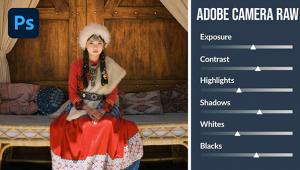
She's
a Beijing Opera performer, and was a paid model for my shoot.
I set up in open shade with a seamless backdrop behind her.
I had an 81A warming filter on the lens.
|
|
There's a big difference
between travelers who meet and photograph people and those who don't,
and the difference can be summed up in one word: passion. It's a
passion to be more than a tourist; it's a passion to know more about
people and their culture and to connect with them, even briefly.
Without that, the experience isn't complete. I can't go to
a place and not be involved with the people. Shooting a colorful market,
a sunset, the landscape, that's only part of the experience. For
those who make the effort to make a connection, to be curious and understanding,
the travel experience is so much more enriching.
In China, some of the people I photographed were professional models,
but most were just people going about their lives who were kind enough
to spend some time with me. I considered clothing, props, backgrounds,
and settings, of course, but the key element was always the person. I
spent some time getting to know them, exchanging information--I often
show pictures of my family to let them know something about me. I have
fun when I'm doing this, and I hope that shows in the pictures.
There's always dialog, an exchange of information. And I don't
really do this to ease my way into picture-taking; it's to really
find out what's going on. Once I make a connection, the pictures
are the natural result. That way the photographs are never intrusive.
|
| |
I was shopping for a prop when I met the store clerk. We
chatted for a bit, I asked her to pose and then thought
of moving the mannequins outside.
|
|
I think we travel to experience
something different, not just to observe it. When we meet people and photograph
them, we make that experience more meaningful. Why people photography?
Because people are the epitome of the travel experience.
Equipment Note
All the photos you see here were taken with my Mamiya RZ67 fitted with
either the 110mm f/2.8 or the 180mm f/4.5. My color film is 800 speed
Fuji NPZ, and when I shoot black and white it's Kodak T-Max 400,
pushed to 800. I use a Sekonic L-508 Zoom Master meter and carry a number
of reflectors to control the light as much as possible.
|