


- REVIEWS
Camera Reviews 
More Reviews Mobile Reviews Photography Reviews - GALLERIES
- VIDEOS
- BUYER'S GUIDES

The Leica MP
And Now, "Leica A La Carte"
All Photos © 2004, Roger W. Hicks, All Rights Reserved
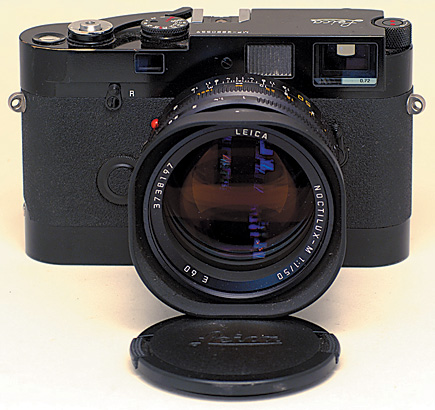
The Leica MP is the greatest Leica for years--maybe decades. If you want a classic all-mechanical Leica, and you can afford a new one, this is the one to buy. That's all there is to it.
So much for the short review: how about a longer one? Well, it is best summed up in three words: "very little change." You could add five more: "and all for the better." That's before you come to "Leica a la carte," a wonderful development to which I shall return at the end of the review.
 |
|
 |
|
|
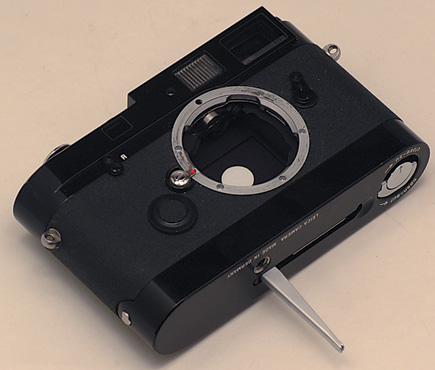
A standard MP is immediately recognizable to anyone who has ever used a classic M2 or M3, even down to the pull-up rewind knob. That's right: knob, not crank. Why drop the crank that appeared on the M4 and lasted to the (current) M7? Easy: longevity. It's possible to bang the crank on an M4-M7 and bend it: I know, I've done it, and I had to straighten it out again with a Leatherman tool beside a lake in Slovenia. But the knob is almost impossible to damage, though you can buy a bolt-on crank as a frighteningly expensive add-on. This is a camera designed to last as long as 35mm film is available, which will be decades yet.
The finder is available in the usual range of magnifications, with the usual frames exhibited in pairs: 28-90mm, 35-135mm, 50-75mm. It is slightly more prone to flaring out of the rangefinder patch than the M2 and M3, but somewhat less prone to flaring out than the M4 and M6 series. This is a problem that arises only when you are shooting in low-light levels with powerful, directional lights, and it's why I often use an early-1960s M2 in such situations rather than my early-'80s M4-P.
 |
|
|
If you want the standard black paint model, you'll have to have a 0.72x finder. Black paint? Yes: more retro, and again, for the very best of reasons. Although black paint scratches and mars more easily than black chrome, it also wears more gracefully, slowly revealing the brass underneath. The rangefinder housing weighs an ounce or two but is CNC milled from a solid slab of brass weighing several pounds. It's an expensive way of doing it, but it's also the best way. This is not a camera that is built down to meet a price point.
You could argue that polycarbonate would be a better material for the housing, or the zinc alloy that they once used. But when you buy a legend, you're buying mystique and tradition as well as mechanical excellence. Would you want an LED Rolex, or a diesel Bentley? There are plenty of Leicas in use that date from the '30s, and if brass was good enough for them, it's good enough for the MP.
 |
|
|




































 FEATURED VIDEO


Get the Latest Photo Tips, News & Reviews from Shutterbug!






| Camera Reviews Other Reviews | |
Mobile Reviews Photography Reviews Columns | |
News | |
Features | |
How-To | |
Resources |
 © 2025 Shutterbug
AVTech Media Americas Inc., USA
All rights reserved