


- REVIEWS
Camera Reviews 
More Reviews Mobile Reviews Photography Reviews - GALLERIES
- VIDEOS
- BUYER'S GUIDES

Glory Days; On Any Given Sunday, You’ll Find Ron St. Angelo Prowling The Sidelines For The Dallas Cowboys
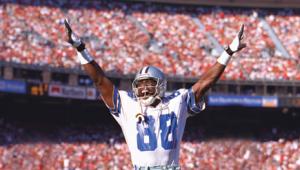
The first Dallas Cowboys Ron St. Angelo photographed were the Dallas Cowboys' cheerleaders. It was a good start. Studio shots of the cheerleaders led to photographing the players, then the games. Today his business card reads, "Official photographer of the Dallas Cowboys." Ron's been with the team from the late 1970s, from Landry and Staubach, through Johnson and Aikman, to Parcells and Testaverde and now Parcells and Bledsoe. Highlights were plenty: a division playoff in '79, a conference championship game in '80, and Super Bowl victories in '92, '93, and '95. There were rough times, too: 3-and-13 in '88, 1-and-15 in '89 come to mind. "I've been through all the good and bad times," Ron says, "but luckily for us it's been more up than down."
 |
|
|
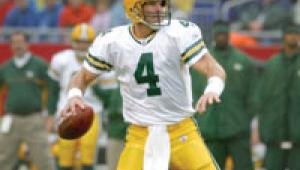
As the Cowboy's designated shooter, Ron has the advantage of pre-game access to the Cowboy's bench that other photographers may not enjoy, but at game time he's merely one among many. "When the game starts I work the field like everybody else," he says. Team practice sessions, though, can give him an edge. "I'll know the plays they're working on that week and the areas of concentration. I'll talk to the coordinators and get a feel for what they're planning. And I have a friendship with the guy who manages the radio frequencies between the coordinators and Coach Parcells. He monitors the plays as they're piped in, and if I talk to him I might get some information. But even the called play isn't necessarily what happens. Things can break a different way because of the defense's setup. At the line of scrimmage the quarterback reads the defense, makes an adjustment--like Drew [Bledsoe] runs a quarterback sneak on fourth down because he saw a situation. And if I've got the camera on him the whole way instead of swinging it with the running back, I feel pretty good. There's a certain amount of luck in this, you know."
 |
|
|
Homework tends to reduce the need for luck. "I'll take a look at the other team's players and what their tendencies are," Ron says. "I look at a lot of still images, and I monitor the Internet."
 |
 |
||
|
|
There are tip-offs to the kind of routes receivers will run in certain situations. If, say, you know that the opposing quarterback doesn't have the strongest arm, you'll figure he's not going deep. "That holds true for how the coaches design the plays for a particular player," Ron says. "Vinny [Testaverde] had a terrific arm. He could throw all the routes and power the ball in there. Knowing which routes the receivers like to run, that's important, too. When Michael Irvin was here he ran all those slants. There was no mystery; Irvin was fairly predictable. It was like he said, here's what I'm gonna do, see if you can stop me."
 |
|
|
| |||||||||
|

| ||||||||







 FEATURED VIDEO


Get the Latest Photo Tips, News & Reviews from Shutterbug!






| Camera Reviews Other Reviews | |
Mobile Reviews Photography Reviews Columns | |
News | |
Features | |
How-To | |
Resources |
 © 2026 Shutterbug
AVTech Media Americas Inc., USA
All rights reserved