| |

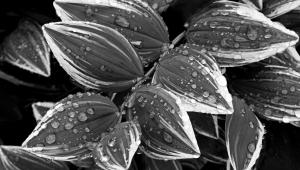
This
photograph of skunk cabbage was made in the Sangre de
Cristo mountains south of Westcliffe, Colorado using a
Bender 4x5 camera with Rodenstock 210mm lens and Tri-X
film.
Photos © 1999, Joe Farace, All Rights Reserved
|
|
"The tone he produces
on rough platinotype paper by skillful printing and carefully aged mercury
baths cannot be reproduced by any mechanical process."
--George Bernard Shaw on the photographs of Frederick Evans
I remember the first time
I saw a Frederick Evans platinum print. Because many of his photographs
were made in churches and cathedrals, you might say it was a religious
experience, and in many ways it was. Frederick Evans' prints form
a body of work that is as impressive today as they were when he made
them at the turn of the last century.
The platinum process dates from 1873 and prints contain no silver, producing
the final image with platinum. Platinum is an extremely inert element,
even more so than gold, and properly processed prints can last 500-1000
years. While popular in Evans' day, the use of platinum printing
declined after World War I because of rising costs. During this time,
some photographers switched to palladium printing, which has almost
the same tonal scale, richness, and delicacy as platinum prints. Palladium
prints are warm black to sepia and have a smoother tone, while platinum
prints tend to be neutral gray. The printing techniques used in palladium
printing are almost identical to those used in the platinum process.
Because it's much more costly for the photographer and more difficult
to produce, less than five percent of today's fine art photographs
are printed using platinum. One photographer who still does is Bill
Craig, who some people call the "Ansel Adams of the Rockies."
I talked with Craig about the materials and techniques he uses to create
his limited edition platinum prints.
Making Platinum Prints. If you're interested
in making your own platinum prints, here's all of the equipment
you'll need to get started: a photographic negative, contact printer,
several developing trays, clear plastic wrap, a 25w yellow bug light
(to be used as a safelight), an ultraviolet (UV) radiation source (more
on this later), platinum paper, platinum paper developer, and rinsing
agent.
Most darkrooms already have a contact printer and several developing
trays, but since these trays should be completely free of fixer and
any residue from chemicals used for processing silver-based prints,
you may want to purchase new trays and dedicate their use to platinum
printing. If you have to use existing trays, clean them first using
Clorox or a similar bleach, then rinse the trays for an hour. If the
trays are not absolutely clean when used for platinum printing, you
can get streaks or marks on your finished prints.
The type of clear plastic wrap used for the process isn't critical
and Craig uses the kind that's used for wrapping sandwiches, which
is available from your local supermarket. Just about any type of print
washer that you use for your silver prints will also work for washing
platinum prints. The prints are exposed by an UV radiation source and
you can build your own or use the sun, which is what Craig does. The
images for this story were created with chemicals and paper that are
available from Palladio, who sells starter kits that include pre-coated
platinum/palladium paper and the chemicals necessary to get started
making your own prints. Chemicals are also available from Photographer's
Formulary, who carries materials for platinum printing as well as other
processes, and all chemicals come with instructions.
|
| |
The
Las Trampas Mission, which is on the high road between Taos
and Santa Fe, New Mexico, was made using a Zone VI 4x5 camera,
Ilford Delta 100 film, and Rodenstock 210mm lens.
|
|
Exposing The Negative.
The platinum or palladium printing process requires contact printing,
so obviously large format negatives are the way to go. Craig uses 4x5"
negatives, but you can use any size you want--the bigger the better. To
make the exposure, take the negative and, with the contact printer open,
place the negative with the emulsion side facing up away from the glass
of the printer. Then take a piece of clear plastic wrap and cover the
negative with a piece at least twice the size of the negative. This holds
the negative fast to the contact printer's glass and serves as a
barrier between the negative and the coated platinum paper. When you close
the hinged contact printer lid, the negative will have its emulsion side
next to the paper with the plastic wrap serving as a barrier protecting
the negative.
The next step is to make a test strip using a 1" wide piece of platinum
or palladium coated paper. If you use pre-coated paper, you will have
to "re-humidify" the paper before the test strip can be made.
Here's how Craig accomplishes this: his 12x15' darkroom has
a single safelight, which he replaces with a 25w yellow bug light when
working with platinum printing materials. To re-humidify the paper, he's
found that using a plastic bucket filled with steaming hot water works
well for adding humidity to the paper. The key is to hold the paper by
its edges in the steam coming off the water. You should be careful not
to get the paper wet. After the paper has been in the steam for a minute
or so, it becomes soft and pliable. That's when you know it's
ready to use.
After the paper is re-humidified, you should place it--emulsion side up--on
the contact printer. When you close the contact printer, make sure that
the negative covers the paper. The next step is to expose the paper. Craig
then slips the contact printer into an old black plastic bag that once
held photographic paper and heads outdoors. Once outside, he takes the
contact printer out of the bag and uses the sun as an UV source, which
has a few advantages and drawbacks. The advantage is that it's free
and the drawback is that it can be inconsistent. If you expose the test
strip in the bright sun and it becomes cloudy when you process the final
print, you will have to start over with a new test strip or wait until
the sun comes out again. Another variable is the time of the day that
the exposure is made. The richest UV source is typically from 10:00am
to 2:00pm, and you can introduce inconsistency into the process if you
make the test strip at 2:00pm and the print later at 4:00pm.
Craig lives in Colorado at 6000 feet above sea level, so his exposure
times are less than they would be at sea level, due to the higher amounts
of UV light at this altitude. When exposing the platinum or palladium
test strip, he uses the standard method of covering part of the paper
with an opaque sheet of cardboard. One difference between silver and platinum
printing is that because the chemicals in the paper react to the UV before
processing occurs, you can actually see what the exposure is going to
produce before processing the paper. Craig watches the paper until it
looks like it's almost dark enough for a proper exposure, then covers
portions of the negative. When doing platinum/palladium test strips, the
exposure times will be in minutes of exposure and not the seconds you
may be more familiar with. If the print looks like it is almost dark enough
at three minutes, he covers the first 1/5 of the paper and in minute intervals
continues to cover the rest of the paper in 1/5 increments. In this example,
the first 1/5 is exposed at three minutes, the next 1/5 is at four minutes,
and so on. The photograph of the Las Trampas Mission, for example, took
four minutes of exposure to the sun. After exposing the paper, he places
the contact printer back in the black plastic bag and heads into the darkroom
to process the paper.
Processing The Paper. Palladio offers two kinds of developers:
warm tone or cool tone and Craig uses both for his fine art work. The
warm tone developer produces the brown palladium look seen in Craig's
photograph of the Las Trampas Mission and the cold tone produces the classic
platinum look seen in his skunk cabbage image. When working with all of
Palladio chemicals, the company suggests that you wear a mask and latex
gloves for mixing chemicals and that you wear gloves while processing
the prints. Here are the steps Craig used to process those two images.
There are two different chemicals needed to process platinum or palladium
paper: developer and clearing bath. Craig mixes the developer with distilled
water at 70°F and adds an ounce of hydrogen peroxide to boost contrast.
The hydrogen peroxide is the same topical anti-infective you can buy at
the drug store and is a three percent solution. A key part of the first
processing step is to slip the paper into the developer with the emulsion
side up. Slip it in quickly; any hesitation will cause a line to appear
on the paper. Once the paper is fully immersed in the developer, let it
set for four minutes. Do not agitate. After four minutes, dip the paper
in a water bath for one minute. Timing on this step is not critical because
the purpose of the water bath is to prolong the life of the clearing baths.
After the water dip, immerse the paper in a first clearing bath for at
least four minutes, then place it into the second clearing bath for at
least four minutes. During the clearing baths, you can use some gentle
agitation.
The clearing baths are not like fixer, so there's no need to worry
about over clearing. Craig has left prints in the clearing bath while
eating dinner and an hour later washed the prints with no problems. Both
clearing bathes use the same chemicals. The idea of using two clearing
baths is to prolong the life of the baths. After the clearing baths, wash
the prints in an archival print washer. Washing is not as critical as
with silver prints and Craig uses a 15 to 30 minute wash compared to a
two hour wash for fiber-based silver prints. After the wash, hang the
print to dry. During the entire process from the steaming of the paper
to the washing and hanging of the print to dry, be sure to hold the paper
by the edges and never touch the emulsion. The emulsion is extremely delicate
and you can damage it if you touch it. To flatten the print after it has
dried, place it on the platen of a cold dry mount press or slip the prints
between two sheets of rag matte board and use a stack of books for flattening.
Platinum or palladium printing is a never-ending learning process. As
with silver printing, platinum/palladium printing improves with experience
and patients and printers with 20 years of platinum/palladium experience
tell me they are still learning and improving on their methods.
Manufacturers/Distributors
Palladio
PO Box 28
Cambridge, MA 02140
or 200 Boston Ave.
Medford, MA 02155
(800) 628-9618
Photographer's Formulary,
Inc.
PO Box 950
Condon, MT 59826
(800) 922-5255
(406) 754-2891
fax: (406) 754-2896
|