Overexposure has always been
the bane of photographers, be they the film or digital variety. If using
negative film, moderate overexposure could be easily handled when printing.
But overexpose a slide film and colors, details, and especially bright
areas would become washed out, with subsequent loss of detail and quality.
The same goes for digital, where overexposure creates interference and
causes the sensor to drop out detail and create crossovers (artifacts,
odd colors) when an attempt to fix the image in image-editing software
is made. Until now photographers would have to always bias their digital
exposures toward the highlights, much as if they were exposing slide
film. This controlled the highlight problem, but often at the expense
of shadow detail. No photographer can properly handle gross overexposure,
or deliver both bright highlights and deep shadow detail in one image,
without controlling exposure and development carefully.
|
| |
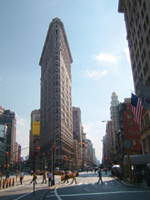
This
was a very backlit scene made in the late afternoon. Getting
detail in the shadow areas is well beyond expectations without
some post-processing. To see what sat within the shadow
recording I selected the sky and played with the Levels
controls on the street and Flatiron Building.
Photos © 2003, George Schaub, All Rights Reserved
|
|
4th Generation CCD
That being the state of affairs we were intrigued when Fuji announced
their 4th generation CCD, which they tell us includes both HR (for resolution)
and SR (for dynamic range) CCDs. Both 3.35-megapixel CCDs are employed
to deliver sharpness and a dynamic range they claim matches film to deliver
a 6.7-megapixel image, thus close to an 18MB file. In the CCD SR there
are both high-sensitivity (the so-called S-pixels) and low-sensitivity
(the R-pixels) components. Thus, claims Fujifilm, while the S-pixels may
be saturated in highlight areas the R-pixels continue to respond to light
without over-saturation. Therefore, the Super CCD SR achieves four times
the dynamic range than their previous CCD manifestation. When all is said
and done the HR and SR combo is integrated in the image processor and
the results should be such that they overcome previous exposure problems.
Our tests show that for the most part this is true, except of course when
the contrast range is beyond reason and even beyond that which true Zone
System practitioners could handle. But this 4th generation CCD did better
than most digicams we've seen with high contrast scenes, and did
so with a close-to 18MB file size that could be used for some great 11x14"
prints.
|
| |
Lo
and behold the detail was there after a quick Levels adjustment
of the selected area.
|
|
Improved Dynamic Range
To test the FinePix F700 we made pictures of very bright urban scenes
and some with very dominant highlight areas. In some cameras these bright-dominant
scenes would cause the metering system to underexpose, due to being fooled
by the highlights. This could result in saturated highlights but very
little shadow detail. All the images were photographed on Auto mode without
fill flash or any exposure compensation. On one scene where the subject
was almost totally backlit, we used a Magic Wand selection in Photoshop
to see just how deep into the shadows we could get.
The results were impressive indeed. This tiny digicam delivered some of
the best exposures in contrasty situations we've seen, close to
those delivered by high-end digital SLRs shot on raw mode and post-processed
in raw software. We did little or no post-processing on any of them. Most
impressive were the scenes with bright highlights and deep shadows. The
dynamic range was rather incredible, making us feel as if we could work
with this camera more if we were shooting color negative film, rather
than the more limiting color slide film type exposure procedures we practice
with most digicams. Take a look at the images and their captions for more
information. Street prices we've seen range from the high $400s
to the mid-to-high $500s. If you're looking for a camera that can
handle street scene contrast or nature shots on a bright day then the
breakthrough Fujifilm FinePix F700 is worthy of consideration. My only
complaint, though small, is that the camera uses those very, very tiny
xD cards, which I always misplace in my camera bag.
For more information about the FinePix F700, visit Fujifilm's website
at: www.fujifilm.com.
|
| |
This
very bright, reflective white door would give many camera
metering systems, and sensors, fits, but the FinePix F700
handled it in Auto as if I had spot metered it and gave
it a plus one exposure compensation. The door itself shows
texture and great highlight control.
|
|
|
| |
Digging into the shadows on a bright day would give most
slide film and digicam users problems, but the FinePix F700
delivered this exposure with no effort. Note how the shadow
details read with full information and how the highlights
are well under control. This shows off the great contrast
handling characteristics of the 4th generation Super CCD
sensor.
|
|
|
| |
A
scene like this taken with many digicams would have resulted
in harsh highlights that would be difficult to control even
in post-processing. The texture of the building and color
richness that came from an Auto exposure cause us to give
this camera high marks.
|
|
|
| |
The light was bouncing brightly off the Empire State Building
and this cast-iron beauty before it. Regardless of the lighting
conditions, the F700 delivered great texture in all the
highlights without making the sky go inky black. This is
just as much a testament to the Super CCD's dynamic
range as are the shots with more shadowed areas.
|
|
|
| |
Even with all the exposure advantages of the F700 the color
richness is excellent as well. You can see how bright the
light was here, and how the colors jumped, but note also
the shadow opening dynamic range.
|
|
|