


- REVIEWS
Camera Reviews 
More Reviews Mobile Reviews Photography Reviews - GALLERIES
- VIDEOS
- BUYER'S GUIDES

The Fotoman 810PS; Yes, The PS Stands For Point-And-Shoot!
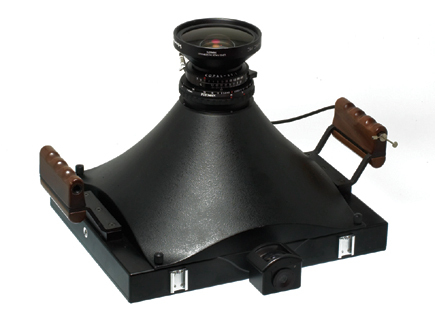
The name gives it away. The Fotoman 810PS is indeed an 8x10" point-and-shoot (PS) camera. Well, sort of. It brings you that huge, beautiful 8x10" (203x254mm) image in a camera that is more basic than you may readily imagine.
Unlike smaller point-and-shoots, there's no autofocus or autoexposure, and even with a wide angle lens (150mm, pretty much the equivalent of 21mm on 35mm) you can't rely on hyperfocal distance or depth of field. You really do have to focus the thing, though for distant subjects (over about 10 meters/30 ft) and with modest apertures (f/16 and below) you needn't be too finicky.
 |
|
|
Why, then, is it called a point-and-shoot at all? Simply because it has none of the camera "movements" that are expected on an 8x10 camera. You cannot move the lens parallel with the film (shift movements) and you cannot destroy the parallelism of the lens panel and film (tilt or swing movements). You point it at the subject; set focus and exposure; and shoot.
The next question, inevitably, is why anyone would want an 8x10 point-and-shoot. I have already answered this question: the great big 8x10" negative or even, if your finances allow it, transparency. There is something about an 8x10" contact print that transcends enlargements. The detail goes on forever.
The lack of movements is obviously a disadvantage in one sense, in that it is often useful to be able to raise the front in order to "correct" converging verticals, or to use swings and tilts to hold a receding plane in focus, but in another sense, it forces you to concentrate on the image, rather than on the camera. At least a rising/falling front would be regarded by many as essential for this kind of composition--but it isn't essential.
 |
|
|
The 810PS is also about as far as you can get from either digital photography or automation. The former alone will commend it to those who avoid pixels, while the latter will appeal to those who want to remain in full control of both focus and exposure, instead of relying on a computerized algorithm to do it all for them.
There is no point in saying too much more about the advantages of a basic, large format, hand holdable camera, because you will either understand why it exists, or you won't. If you don't, there's little point in reading on, except out of curiosity. On the other hand, it is worth adding that before the Fotoman 810PS became available, I had seen or heard of at least three custom 8x10" cameras with similar specifications--though they were bulkier, less convenient, and had significantly inferior viewfinders to the neat, optical, bubble level-equipped finder on the Fotoman. Nor were they as easy to hold steady; the grips on the Fotoman really are very comfortable.
As with most Fotoman products, the body is an astonishingly good value: the majority of the expense is in the lens, which is a wide angle for obvious reasons--it's easier to focus, and allows longer handheld speeds. The review camera was supplied with a 150mm f/5.6 Schneider Super Symmar in a Copal shutter offering 1 second to 1/500 sec plus B and T; the minimum aperture is f/64, marked (but not click-stopped) at 1¼3 stop intervals. Other lenses can be supplied to order, in different cones. The widest that will cover 8x10" (and barely, at that, though it is OK on 18x24cm) is the 110mm f/5.6 Super Symmar. This is roughly equivalent to 16mm on 35mm, while the longest lens that makes sense is probably a 210mm, roughly equivalent to 30mm on 35mm. It is even possible to have your own lens custom-mounted: Fotoman reckoned they would be able to put my 168mm f/6.8 Goerz Dagor into a focusing mount (roughly 24mm on 35mm), though they stopped short of quoting a price for doing so.
 |
|
|
Focusing is normally by scale, with easy-to-read depth of field markings on the smooth, well-finished focusing mount: another advantage over the custom cameras that went before. You can also use a separate, uncoupled rangefinder: I already had an old one, from the 1950s, but Fotoman has just introduced one. Alternatively there is a ground glass, with a useful protector outside it. It is just about possible to slide the protector out; focus on the ground glass, even handheld; replace the protector; remove the ground glass; and slip in a film holder. It is not, however, quick and easy to do this.
| |||||||||
|

| ||||||||




























 FEATURED VIDEO

Get the Latest Photo Tips, News & Reviews from Shutterbug!






| Camera Reviews Other Reviews | |
Mobile Reviews Photography Reviews Columns | |
News | |
Features | |
How-To | |
Resources |
 © 2025 Shutterbug
AVTech Media Americas Inc., USA
All rights reserved