


- REVIEWS
Camera Reviews 
More Reviews Mobile Reviews Photography Reviews - GALLERIES
- VIDEOS
- BUYER'S GUIDES

Fotoman 617; An “Affordable” Panoramic Camera
The Chinese-built, American-designed Fotoman 617 justifies itself as soon as you see the first transparencies on the light table. The huge format is a knockout. It's gorgeous. That vast slab of film is 21/4x62/3". That's 56x168mm, or over 11 times the area of 35mm.
It's ideal for scanning, too. Even a very modest flat-bed film scanner giving just 1200dpi of optical resolution will allow a 4x enlargement at 300dpi in publication and 6x at 200dpi with an inkjet printer. That's 9x261/2" (224x672mm) and 131/2x391/2" (336x1008mm) respectively. Unfortunately it's also a 62MB TIFF file from my Epson 1680, but you can't have everything.
 |
|
|
It's disputable, of course, whether 6x17 needs to exist at all. You could make the same size prints from cropped 6x12 scanned at less than 2000dpi--and this is one reason why Fotoman also offers a 6x12 camera. For that matter you could crop top-quality 6x9cm and scan at 2400dpi (they do a 6x9 as well). Not only would you get more shots to the roll, six or eight instead of four, but the film will be flatter with the smaller formats so you can work at wider apertures without needing to stop down for depth of focus (as distinct from depth of field).
On the other hand, the Fotoman 617 makes everything gloriously easy: it's the same logic that kept 4x5" in use for press photography long after roll film or even 35mm should have supplanted it. You get superb detail, gorgeous tonality, and excellent sharpness even if you are less than perfectionist in your technique and film choice. To a large extent it's the old American dream. Forget "Less is More": the 617 format is clear proof that "More is More."
 |
|
|
The reason I have stressed scanning is that unless you are happy with contact prints--though these can be surprisingly impressive--you need a 5x7"/13x18cm enlarger, which can be quite hard to find and even harder to find space for.
All right. Enough about the basic advantages and disadvantages of the format. What are the specific advantages and disadvantages of the Fotoman?
The biggest single advantage is the price: $1600 for a complete camera without lens. Heretofore you have either had to pay dearly for 6x17cm or make it yourself from two old 6x9cm cameras. The Fotoman adopts the super simple, let's-keep-the-price-believable approach previously seen only in homemade kits.
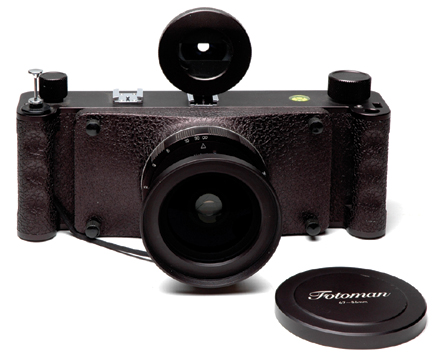
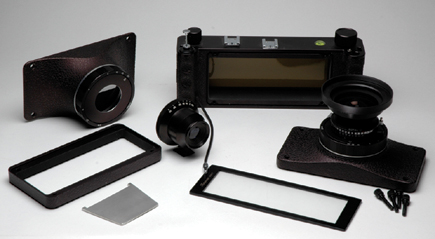
This is not to say it looks homemade. Far from it. It is very well made--but very simple. The genius of the design is that it is modular. Depending on how you count them, there are up to six or possibly seven modules. All major parts are very substantial CNC light alloy, by the look of it anodized or powder coated in matte black. The texture of the finish is reminiscent of textured Vulcanite or fake leather, but appears to be machined from the solid metal. The standard of finish is best described as "tool room": in other words, precise, unostentatious, far from luxurious, and deeply satisfying to anyone who likes solid, simple engineering.
 |
|
|
Module 1 is the film body, a simple dark box almost exactly 10" (254mm) long. For most of its length it is about 12/3" (42mm) deep, but there are grips (an integral part of the body) at either end. Height, excluding knobs, viewfinder, etc., is 33/4" (95mm): the knobs add another 3/4" or 18mm. The scale of the rest should be clear from these measurements.
Module 2 is the spacer between the body and the lens cone. This separates the cone from the body to give the right distance for infinity focus with the lens in use. Not all cones require spacers: it depends on the focal length.
Module 3 is the lens cone, which is most easily explained by looking at the photograph, and Module 4 (built into Module 3) is the massive helical focusing mount. It may lack the ball-bearing smoothness of a Schneider, Rodenstock, or Alpa mount but is not going to wear out in a hurry. Obviously both the focusing mount and the spacer (Module 2) must be matched to the focal length.
The focus scale is in meters only on "my" mounts, down to 2m (6 ft, 8") for the 110mm and 1.2m (4 ft) for the 75mm, but US versions should be engraved in feet. There is no depth of field scale but it is disputable how useful it would be: how would you determine depth of field for 6x17 anyway?
| |||||||||
|

| ||||||||





 FEATURED VIDEO


Get the Latest Photo Tips, News & Reviews from Shutterbug!






| Camera Reviews Other Reviews | |
Mobile Reviews Photography Reviews Columns | |
News | |
Features | |
How-To | |
Resources |
 © 2026 Shutterbug
AVTech Media Americas Inc., USA
All rights reserved