


- REVIEWS
Camera Reviews 
More Reviews Mobile Reviews Photography Reviews - GALLERIES
- VIDEOS
- BUYER'S GUIDES

Baldessa 1
Fun, Despite Its Performance
The Baldessa 1 from Balda in the Schwarzwald is one of those cameras that quickens the heart of a collector simply by its looks: beautiful styling and a superb late-1950s West German finish. Unfortunately upon closer examination it turns out to be a bit of a bimbo (for the ladies, think of it as a himbo or dumb hunk--I don't want to be unduly sexist).
The biggest letdown I see is the (fixed) lens. The more expensive option was a 45mm f/2.8 Isco Westanar "four-element lens": almost certainly a Tessar-type, well out of its depth at f/2.8.
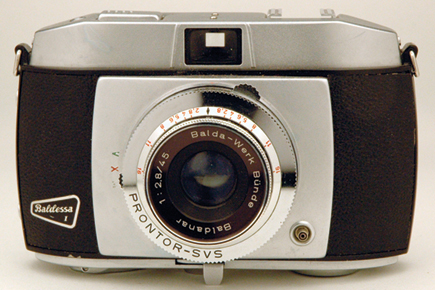
My camera doesn't even have the Westanar. It's a Baldanar 45mm f/2.8, apparently a triplet. The front-cell focusing does nothing for image quality, either: spacing must necessarily be optimized for one focusing distance, and a compromise at others.
But there's no doubt that it's fun. Sorry, but that sexist image mentioned earlier has stuck in my mind. Going out and using it reminds me of having lunch once with a friend's beautiful teen-age daughter: all those admiring or envious glances from other middle-aged men. Or in this case, other camera collectors--another bunch of middle-aged men, now that I come to think of it.
Apart from the finish, there's the detailing. The shutter release was described in the original publicity material as "piano-key" type. Mounted flush with the top deck, it requires only the very lightest pressure to operate it. Alongside it is a hole threaded for a standard Compur-tapered cable release.
Stranger still is the wind-on, a key under the lower left-hand end of the camera as you are holding it. Half a twist advances the film and cocks the shutter. Every single frame number is marked in tiny figures on the subtractive, manually reset frame counter, and is displayed one at a time in a cutout, though the cutout is covered by the key when it is folded.
A 1957 review praises the speed of the wind-on, saying that one frame per second is easy, and that with a little practice, two are achievable. I'd prefer a lever wind or (better still) a trigger, thank you all the same.

In fact, when you look at the positioning of the tiny film reminder, concentric with the tripod socket, you realize that quite a lot has been sacrificed to styling. The reminders, incidentally, are Color Positiv [sic], Color NT, Color NK, and film speeds from 11/10 Din, 10 ASA, to 24/10 Din, 200 ASA. NT and NK would be Negativ Tageslicht [Daylight] and Negativ Kunstlicht [Artificial Light]--a distinction you might expect to be more useful with Positiv [slide] film. Even the back latch came in for styling: two independent press buttons, which must both be pressed in together.
The crowning glory, though, is surely the rewind--if one can have a crown on the bottom of the camera. Move a slide below the lens from T (Transport?) to R (Rewind?) and what appears to be a vestigial and immobile lever wind drops free at the opposite end of the base from the winding key, revealing itself as a very large rewind crank.
There's an accessory shoe (not "hot") and the viewfinder is a plain optical type, no brightline, no parallax compensation. The shutter (1-1/300, plus B) uses the poisonous EV/LV system, introduced at photokina 1954 with the Prontor SVS shutter fitted to this camera and unaccountably adopted even by high-end manufacturers such as Rollei and Hasselblad.
The EV scale on the Baldessa runs from EV 2, 1 second at f/2 (the best the Baldessa can do is B at f/2.8) to EV 16, 1/300 sec (all right, 1/250 sec) at f/16, again the limits of the shutter speed and aperture on the Baldessa. EV 10, for example, allows anything from 1/2 sec at f/16 to 1/125 sec at f/2.8. If you have set EV 10, 1/30 sec at f/4, switching to 1/60 sec will automatically change the aperture to f/2.8 and switching to 1/15 sec will automatically stop down to f/5.6. You have to depress a little catch to set shutter speeds and apertures separately.
The best part of half a century on, the shutter isn't terribly accurate anyway: about what I'd expect for a camera that has never seen much use, by the look of it, and probably hadn't had a film through it in a decade or more. As tested with my ZTS Tester Pro, most speeds were about 1/3 stop slow (including 1/300, which is actually very good) but some were 2/3 stop slow: good enough for negatives, but hardly for color slide.
Results? Lousy. Someone has had this one apart, and not reassembled it properly. But I'd normally expect good post card-sized prints, tolerable 5x7" enlargements, especially at modest apertures (f/8 and f/11), and 8x10" to be rather more than one might realistically hope for.
Value? I paid the equivalent of $6 for it, eight or 10 years ago. Today, someone specializing in "collectible" cameras could hardly be blamed for trying for $50 or more--even $100--but I'd reckon that $30 or $40 was nearer the mark. The 1a (with rangefinder) and 1b (with rangefinder and exposure meter) should be worth quite a lot more: maybe double. But let's be honest: this is a classic of design and finish, not performance.
| ||
|
||










 FEATURED VIDEO


Get the Latest Photo Tips, News & Reviews from Shutterbug!






| Camera Reviews Other Reviews | |
Mobile Reviews Photography Reviews Columns | |
News | |
Features | |
How-To | |
Resources |
 © 2026 Shutterbug
AVTech Media Americas Inc., USA
All rights reserved