


- REVIEWS
Camera Reviews 
More Reviews Mobile Reviews Photography Reviews - GALLERIES
- VIDEOS
- BUYER'S GUIDES
Print Permanence; An Epson White Paper
How long will a photographic print last? There is no simple answer. But it is important for anyone who cares about their photos to have a base understanding of the factors that affect the longevity of prints to make informed decisions and insure those photographic prints will last an expected time.
This white paper deals with the complex subject of print permanence and how knowledge of industry-accepted comparative print permanence testing can lead to the best decisions about buying or specifying imaging products. Every bit as important, this document will help the reader detect potentially misleading marketing claims about photographic image quality, print permanence and the limitations of universal compatibility.
We at Epson want to help consumers and professionals learn more about how prints are made and how different inks and papers can help create not just memories but high quality memories and works of art that will look good not only today but also to future generations.
A Brief History of Print Permanence
Toward the end of the 19th century most photographic images were captured with
sensitized silver salts coated on cumbersome glass plates. After exposure to
light, the plates were chemically developed which formed a reversed or negative
image, hence the term "negative." After the negative image was "fixed,"
the photographer created a positive print by individually contacting the negative
with a sensitized paper which was then chemically developed. The process was
complicated, and expensive, and amateur photographers were few.
In the late 19th century flexible roll film became commercially viable. This film, which could be transported through smaller, more portable hand-held cameras, allowed users to make numerous exposures. With no heavy, rigid, breakable glass plates involved, producing photographic prints became relatively easy. Soon non-professionals took up photography.
As photography became widespread, people recognized the intrinsic value of photographs in documenting their times and in preserving cherished memories for themselves and future generations. The photographic print became and still is a most valued personal possession. During times of natural disasters, heroic efforts are often made to save photographic prints because while most material possessions can be replaced, photographic prints are in many cases unique and cannot be replaced. When a print is lost, copies are often impossible to make because the original negatives are either damaged or in many cases simply lost.
It is also clear that most photographic prints will have greater longevity than a computer hard drive or magnetic media. Not only can digital storage devices be damaged by magnetic fields, viruses and equipment malfunction, but rapid changes in technology tend to make the devices and their file formats obsolete. In addition, many back-up digital storage systems such as CDs and DVDs incorporate materials that may fade or change in ways that could make their contents unreadable in the future.
From the beginning of the 20th century until the 1950s most photographic prints were in black and white. If properly processed, these fiber based black and white prints had and still have great resistance to fading from light or gas and to water damage. Because of the high inherent stability of fiber based black and white prints, many of these early photographs remain in excellent condition and even now reside in family collections, commercial collections and museums.
Because consumers and professionals had not experienced significant fading with the properly processed black and white prints they received from a lab or developed themselves, when color prints were introduced in the late 1950s, they had no reason to suspect that new color prints might fade. The leading photographic manufacturers of the time settled on dye-based systems as the only feasible way to bring color photography to the marketplace. Unfortunately these dye-based photographic materials had significantly less print permanence than those in existing black and white films and prints. As they competed for adoption and market share, manufacturers of this time put little effort into making this information available. By the 1970s and '80s most of those cherished memories, important historical records and purchased photography in color had not only faded, but sometimes had virtually disappeared, even when the film and paper used were from the leading brand.
Almost everyone has had a disappointing experience with the rapid fading or loss of color in their traditional prints. However, few people understand the nature of print fading and the options that enhance permanence that are available to them today. People want their photos to last for generations. We at Epson are trying to make that desire a reality.
Basics of Print Permanence
The subject of image stability of color photographs has become considerably
more complex in the last decade. In the past, most color prints were produced
by labs or service providers using a chemical-based analog process with materials
obtained from just a few manufacturers. The number of companies producing traditional
sensitized materials remains few, but there are significant print permanence
differences in these products that can be measured.[1] Unfortunately few consumers
know there are differences and that they have choices.
WIR Print Display Permanence Ratings
| [1] Type of Silver-Halide Paper | WIR v3.0 Endpoint at Both 1.0 and 0.6Densities Cool White Fluorescent Illumination Years of Display Based on 450lux/12hrs/day Prints Framed Under Glass |
| Fujicolor Crystal Archive Type One Paper (silver-halide color prints) · Printed with Fuji Frontier Digital Minilab and Fuji washless chemicals |
40 years |
| Kodak Edge Generations and Royal Generations Paper (silver-halide color prints) · Printed with Noritsu Digital Minilab and Kodak washless chemicals |
19 years |
As photography moved into the digital age and as more companies entered the business, the industry developed predictive print permanence tests that give better insight into how all prints, especially those displayed in light, will look to future generations. But if any manufacturer makes compromises to print permanence testing methods that artificially inflate longevity predictions, a new generation of consumers may see their precious memories fade, just as they have in the past. No photographic print can last forever, but responsible companies like Epson are continually striving to improve the permanence of inks and papers so that photographic prints can last for generations even when displayed and exposed to light.
The past decade has seen a significant increase in the number of images produced with digital printers by both professionals and consumers. The number of output devices has increased dramatically, and the different materials being used vary widely in both their composition and response to environmental factors. To make informed decisions, it is critical to recognize confusing apple-to-orange comparisons and to beware of sweeping claims of universal compatibility. Both may adversely affect image quality or print permanence or both.
The three primary technologies in use today to produce color photographic prints
are:
· Traditional Silver-Halide
· Dye Sublimation
· Inkjet
· Traditional Silver-Halide Color Photographic Prints
Until the 1990s almost all color prints were made with light sensitive materials
that incorporated color dyes in an emulsion adhered to a paper which was sealed
by a plastic coating. In normal practice, these prints are made by first creating
a negative image with a camera and color negative film. The negatives are then
used to print a positive image on a silver-halide sensitized paper. A traditional
silver-halide color print can also be made from a digital file. Instead of exposing
the sensitized paper with white light passing through a negative via an optical
enlarger, a laser or an LED exposes the paper. It is important to note that
regardless if the print was exposed with a laser or with a traditional optical
enlarger, the permanence characteristics of a silver-halide color print remain
the same. If stored in the dark, with low humidity, traditional silver halide
prints may last from 50 to more than 100 years. If exposed to light, the colors
will deteriorate at a more rapid pace. This deterioration will vary widely between
manufacturers' products and the levels of illumination and ultraviolet
light to which a print has been exposed.[2]

Cross-section of traditional silver-halide color paper
WIR Print Display Permanence Ratings
[1] See: WIR Display Permanence Ratings for Current Products in the 4x6-inch
Printer Category, Wilhelm Imaging Research, Inc., December 7, 2004, available
at www.wilhelm-research.com.
[2] Henry Wilhelm and Carol Brower (contributing author), The Permanence And
Care of Color Photographs: Traditional and Digital Color Prints, Color Negatives,
Slides, and Motion Pictures, Preservation Publishing Company, Grinnell, Iowa,
1993. This 758-page book is now available in PDF format at no cost from www.wilhelm-research.com.
· Dye Diffusion Thermal Transfer Prints (Dye-Sub Prints)
In this process files generated from digital cameras or scanned negatives, transparencies
or traditional prints are sent to a printer where heat transfers colorants from
a donor ribbon to the final print. Today most dye diffusion thermal transfer
printers apply a clear protective layer to the print during the transfer process
to ensure water resistance and to prevent smearing and staining when rubbed
or handled. This protective layer provides relatively little protection against
the effects of light. When exposed to well-lit display conditions suitable for
the enjoyment of photographs, the permanence of these prints is generally not
very good. [3] Usually claims of exceptional lightfastness for dyesub prints
assume dark storage or such very low light conditions that most people would
consider the illumination inadequate for viewing prints.

Cross section of donor and receiver system
· Inkjet Prints
As with dye-sub printers, files generated from digital cameras or scanned negatives,
transparencies or traditional prints are sent to an inkjet printer. The majority
of photo-quality printers use inkjet technology in which very small droplets
of ink measured in picoliters (trillionths of a liter) are deposited onto paper.
Inkjet print stability varies widely based on the composition of the colorants
used in combination with the particular paper selected. Many combinations are
available. [4]
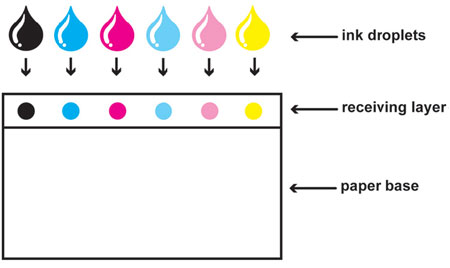
Cross section of coated inkjet paper
Dye Inks and Pigment Inks
Inkjet manufacturers either use dye-based inks that are similar in some respects to those used in traditional photographic prints
and/or they use pigment-based inks similar to the colorants used in automotive paints. In the past the majority of inkjet
printers utilized dye-based inks, which at the time had a significantly wider color gamut than pigment-based inks. This
wider color range produced excellent quality prints with more vivid colors. At the same time, pigment-based inks which have
excellent longevity characteristics were primarily used in conjunction with one or two specialty papers or media for specific
non-photo applications, such as outdoor signage, because of the limited color gamut.
In the past several years, Epson developed a unique microencapsulated technology for pigment-based inks in which each
pigment particle is coated in resin, yielding an increased color gamut while retaining the excellent longevity characteristics of
pigment inks. This technology has resulted in an inkset called UltraChrome K3TM, which has become the de-facto standard for
the most discerning professional photographers who seek the highest image quality combined with the greatest print
permanence. Epson also markets a similar micro-encapsulated pigment inkset for
consumers called DuraBrite® Ultra. In general, pigment-based inks have greater
lightfastness, greater resistance to ozone, and greater resistance to humidity
and water than dyebased inks. In addition, UltraChrome K3 inks deliver outstanding
image quality and print permanence on a wide variety of papers, allowing end-users
more flexibility and greater creative expression. Other manufacturers may promote
a single ink and media combination that achieves a high lightfastness rating;
but this high rating is often achieved with only one or two specific papers,
and the prints, especially those made with a swellable paper, may be susceptible
to damage with normal handling.
Papers
Inkjet prints can be made on a wide variety of coated papers. High quality photographic
prints are often made with coated papers in the following categories:
· Swellable
· Porous
· Cotton Rag
· Swellable Paper
As its name implies, the surface of this type of coated inkjet paper swells
in the presence of the moisture in the ink, allowing colorants to penetrate
the top layers. Swellable papers typically have three layers: a protective top
layer; a layer that fixes the ink droplets in place; and below that, a layer
that absorbs additional ink components. The paper base is sandwiched between
two polyethylene layers (similar to traditional silver-halide RC photographic
papers) and backed by an anti-curl coating and an anti-static layer.
The polymer coating on swellable papers not only acts to stabilize the inks by keeping the dyes from spreading, it also helps protect the image from fading due to light and atmospheric pollutants. However images printed on swellable paper often require extended drying times and are susceptible to image degradation caused by exposure to water, moisture via fingerprints and residue from a variety of vapor sources such as sneezes, cooking fumes and aerosol sprays. Swellable papers are generally suitable only for dye-based inks. Contrary to one-size-fits-all marketing claims made by some manufacturers, the use of a swellable paper produces poor image quality with pigment-based ink because the pigments are not totally absorbed into the swellable ink receptive layer. This type of ink and media mismatch produces prints that not only suffer in image quality, but that rarely dry properly. For example, Eastman Kodak promotes its swellable Ultima paper for use with both pigment-based or dye-based inks [5], but Epson's internal tests and reports from customers show that this relatively expensive paper marketed as a product to improve quality actually yields poor image quality when combined with Epson's UltraChrome K3 or DuraBrite Ultra pigment inks.
Cross-section of coated inkjet paper
[3] See: WIR Display Permanence Ratings for Current Products in the 4x6-inch
Printer Category, Wilhelm Imaging Research, Inc., December 7, 2004, available
at www.wilhelm-research.com.
[4] See: Anush Yegyazarian, "The Fade Factor," PC World, pp. 18-,
San Francisco, California, November 2002, and Dan Littman, "Cheap Ink
Probed", PC World, pp. 22-, San Francisco, California, September 2003.
· Porous Paper
The surface of a porous paper is coated with microscopic inert particles that
create cavities in which ink is deposited. These cavities prevent the ink from
spreading. Porous paper has a higher resistance to moisture and humidity and
is often referred to as "instant dry paper."
As a result, these papers require minimal drying time, so the print can usually
be handled immediately with less concern about smudging. However, because this
type of print has no protective polymer layer, the colorants are susceptible
to attack by atmospheric pollutants such as ozone and oxides of sulfur and nitrogen.
Porous paper is the preferred paper to use with pigment-based inks, which are
less affected by atmospheric contaminants than dye-based inks. In addition,
pigment-based inks generally have much better lightfastness characteristics
and ozone resistance on porous papers than dye-based inks.
| |||||||||
|

| ||||||||


 FEATURED VIDEO


Get the Latest Photo Tips, News & Reviews from Shutterbug!






| Camera Reviews Other Reviews | |
Mobile Reviews Photography Reviews Columns | |
News | |
Features | |
How-To | |
Resources |
 © 2026 Shutterbug
AVTech Media Americas Inc., USA
All rights reserved