


- REVIEWS
Camera Reviews 
More Reviews Mobile Reviews Photography Reviews - GALLERIES
- VIDEOS
- BUYER'S GUIDES
Split Field Lenses
Get Impossible Depth Of Field
Obtaining deep depth of field on a scenic subject is increasingly difficult. Most of the current SLR cameras that offer a zoom lens do not have a traditional depth of field scale, which could assist you in using the hyperfocal length of the lens to obtain the maximum visual depth. In addition, programmed automatic exposure typically does not select a smaller lens aperture, which would produce the greatest depth. So, what's a person to do? There is one add-on lens that permits you to obtain sharp focus on a subject very close to the lens while keeping the background in focus. This miracle attachment is called a split-field close-up lens and you must understand it is not suitable for use with every subject. Only certain scenic type subjects are helped by using a split-field lens. In addition, there will usually be a slightly fuzzy area across the entire image along the edge of the half-lens. But, if you can live with these limitations, you can achieve seemingly impossible visual depth in an otherwise normal subject. Use Aperture Priority Although obtainable in standard screw-in filter rings, you have more creative possibilities for exact positioning of the split lens if you use a filter adapter having both rotation and horizontal-to-the-film-plane sliding capabilities, such as the Cokin (and other brands of) universal filter attachment. With this combination you can use the split-field lens in a conventional horizontal attitude, or use it either angled or vertically in the picture frame so it can be adapted to a variety of subject situations. As with standard close up lenses, the split field lenses are available in several strengths, typically +1, +2 or +3. Naturally you will also need an adapter ring with threads that match the lens you plan to use. |
|||
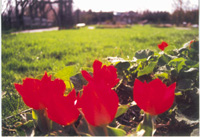
How To Use It Don't attempt to use a split-field lens in a situation when sunlight will strike the flat cut edge of the lens, as this will result in a more pronounced, distracting, visible line in the final image. This distracting result is often aggravated by use of a smaller lens opening. When used with any other type of outdoor lighting, the edge of the split lens is just a blurred line and is often minimally visible. I used my Cokin and Pro Optic (a brand available from Adorama) +2 split-field lenses on a Canon EOS A2 AF SLR with a 35-135mm Canon zoom lens on a variety of springtime subjects. Even when used at the widest (35mm) focal length with the lens stopped down to f/16, the visual depth without the lens was minimal. But, when the split-field lens was attached, the visible depth was greatly enhanced for visual impact. Even if you are forced to use a wider lens opening (such as f/4 or f/5.6) a split-field lens will still enhance the visual depth of sharp focus in the entire scene. If you like scenic photography, and unusual depth of sharp focus, then you should have a split-field close-up lens handy in your gadget bag to produce this result with any focal length lens used at any aperture. |

| ||
|
||


 FEATURED VIDEO


Get the Latest Photo Tips, News & Reviews from Shutterbug!






| Camera Reviews Other Reviews | |
Mobile Reviews Photography Reviews Columns | |
News | |
Features | |
How-To | |
Resources |
 © 2026 Shutterbug
AVTech Media Americas Inc., USA
All rights reserved