


- REVIEWS
Camera Reviews 
More Reviews Mobile Reviews Photography Reviews - GALLERIES
- VIDEOS
- BUYER'S GUIDES

The Pentax K20D; A Rugged Enthusiast-Level D-SLR With The Highest Resolution In Its Price Category
Until recently, 10 megapixels was the norm among the enthusiast-level D-SLRs but that changed with the introduction of Nikon’s 12-megapixel D300. Pentax was the first to move to even higher resolution with their 14.6-megapixel model, the K20D, followed by Sony with their 14.2-megapixel Alpha A350. Aside from a 4.6 million increase in effective pixels, the Pentax K20D boasts some other important upgrades over their K10D; these were discussed in my First Look report in the March 2008 issue. (That preview is also available at www.shutterbug.com easily found with the Search function.) The most noteworthy include Live View, new Picture Style modes, a PRIME quality level for superior JPEGs plus two dynamic range expansion functions.
 |
After working with a preproduction sample with early firmware, I received a K20D that was ready for testing and used it extensively while shooting a fashion show, a downhill ski race, and for travel photography in Nevada and South India. The new camera is similar to the K10D in many respects, including the metering system, 11-point AF system, the sensor-shift Image Stabilizer, automatic sensor cleaner, and numerous modes and overrides. Hence, my testing focused primarily on the new technology and features, including Live View, as well as the image quality provided by the entirely new sensor.
 |
|
|
Design And Features
This is a medium-size camera with a comfortable handgrip, large/bright viewfinder, stainless steel chassis, and 72 gaskets for water resistance. That level of protection also applies to the optional vertical grip and the high-end DA* series lenses, but not to the other lenses. The body sports a full range of external controls, including two input dials, a thumb pad, and various buttons such as one marked Fn. The latter provides quick access to frequently-used functions, reducing the need for hunting through the multitude of items in the full menu.
 |
|
|
The Function submenu includes a new feature that’s particularly worth noting: the Custom Image—or Picture Style—modes with a full set of parameter adjustment options for each. Scroll to select the Vibrant, Landscape, Bright, Natural, or Portrait style and you can also set a desired level for Saturation and Hue plus Contrast and Sharpening. Switch to the Monochrome style and you can apply various filter effect and toning options to modify the entire look of a photo; the Contrast and Sharpness level can also be adjusted.
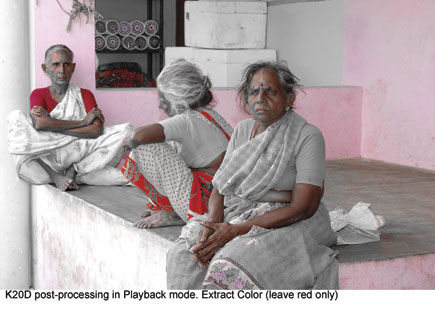
When a Custom Image mode is selected, the last photo made with the camera is displayed on the LCD monitor. As you make any parameter adjustments (or try a monochrome filter or toning), the display is modified to reflect the effect that your choice will produce; this preview is really useful. Note, too, that the same type of preview display is available for the WB (White Balance) function as well. That makes it easy to select the option that will achieve the desired WB effect. Pentax also provides JPEG image adjustment tools in Playback mode, with options for various Monochrome and Sepia effects, Soft Focus, High Dynamic Range, Brightening, and Slimming. The K20D also allows for in camera raw file modification and conversion to JPEG.
 |
|
 |
|
 |
|
|
Evaluation: During testing, I was impressed with the camera’s responsiveness, the logic of the control sequences, and the ability to customize virtually every aspect for my own personal preferences. The 3 fps (frame per second) Continuous Drive mode was fast enough for capturing youngsters competing in an amateur ski race. I was able to shoot 39 Large/Fine JPEGs or 15 raw frames in a single sequence when using a fast Class 6 or 133x SDHC card. Switching to the new Burst mode raised the framing rate to a blazing 20 fps but reduced resolution to 1.6 megapixels. That combination should be useful for motion study sequences for 4x6” prints or for excellent illustrations for Internet use.
Autofocus was very fast in most situations, particularly with the DA* 50-135mm f/2.8 ED SDM zoom (with ultrasonic focus motor), although AF did become a bit sluggish in low-light conditions. The slightly improved Shake Reduction system was certainly effective in night photography in Las Vegas, enabling me to consistently get sharp photos at 70mm (105mm equivalent) using a shutter speed of 1⁄20 sec. As with any stabilizer system, I always took three shots of any important subject during such tests; one of these was usually sharper than the others.
 |
|
|
When used at the default setting in the Natural Picture Style mode, the K20D produced JPEGs with moderately high sharpness, slightly low color saturation, and acceptable color accuracy. It’s well worth using the various other Picture Style modes and/or the parameter adjustments to achieve just the right effect for any type of subject or scene.
| |||||||||
|

| ||||||||






























 FEATURED VIDEO

Get the Latest Photo Tips, News & Reviews from Shutterbug!






| Camera Reviews Other Reviews | |
Mobile Reviews Photography Reviews Columns | |
News | |
Features | |
How-To | |
Resources |
 © 2025 Shutterbug
AVTech Media Americas Inc., USA
All rights reserved