


- REVIEWS
Camera Reviews 
More Reviews Mobile Reviews Photography Reviews - GALLERIES
- VIDEOS
- BUYER'S GUIDES
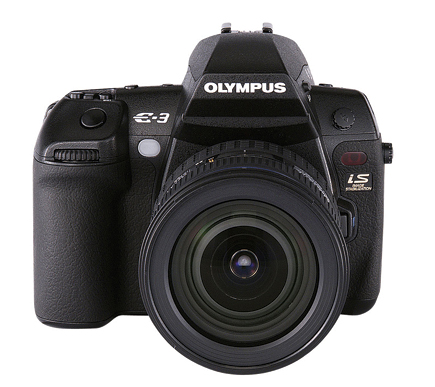
The Olympus E-3; A Pro-Caliber 10Mp D-SLR
The new "flagship" of the Olympus E-System, the E-3 replaces the 5-megapixel E-1 introduced in 2003. This 10-megapixel model shares no components with its predecessor but a quick glance through the specifications may suggest that it's similar to the EVOLT E-510. In truth, the E-3 is more advanced in virtually every respect, boasting superior technology, an entirely new AF system, and additional high-end features. It's more desirable in other aspects, too, including more rugged construction and a fully articulated LCD screen that makes Live View far more practical.
 |
There has been some debate about the E-3's "professional" designation. Some participants agree that it's a "pure professional" D-SLR as Olympus has suggested because of its tank-like construction, pro-style controls, and pro-oriented feature set. Others view the E-3 as a "prosumer" model like the Pentax K10D, Sony A700, Canon EOS 40D, and Nikon D300. (In truth, the D300 also qualifies as a pro camera by some definitions.) That's understandable because the E-3 is priced far below the Nikon and Canon pro series and it does not provide the same speed or the same resolution as the higher-end models from those companies. On the other hand, some working professionals have been using the E-1 for several years; the more sophisticated E-3 should appeal to a larger segment in this category.
 |
|
|
Technology And Features
Smaller and lighter than average for the category, the E-3 exudes a professional
look and feel. It gains size and heft with the optional HLD-4 vertical grip;
this accessory includes a set of secondary controls and accepts two BLM-1 lithium
ion or six AA batteries. The camera's magnesium-alloy frame is very rigid
but lightweight. The body--as well as the grip and SWD-series lenses--are
fully splashproof, capable of tolerating a thundershower, not merely a light
drizzle. The E-3 is built for long-term use; the shutter mechanism has been
tested for reliability during a minimum of 150,000 cycles. Olympus has employed
a lot of sophisticated technology including a new 10-megapixel Live MOS sensor
with faster data transfer capability and a larger "light capture area"
at each pixel. The latter aspect should provide wider dynamic range and better
image quality at high ISO.
Like the E-510, the E-3 employs a Supersonic Wave Drive motor to shift the sensor
module for Image Stabilization, but benefits from a more sensitive gyro for
shake detection. According to Olympus, this is "the world's most
effective Image Stabilizer with shake compensation up to a remarkable five EV
steps." Two IS modes are available, one for multipurpose use and the other
strictly for panning. When the camera's Live View feature is on, the effects
of the Image Stabilizer can be previewed with constant pressure on the IS button.
 |
|
|
Pros who have been shooting with an E-1 will appreciate the dramatic improvement in autofocus performance. Olympus has installed a faster and more effective AF system, including a sensor with 11 (not three) detection points. All are double cross-hatched for great reliability with any type of pattern. There's no need for an f/2.8 lens for optimal focus detection as with some other cameras. The E-3 is much faster than its predecessor in other respects, too, including the 5 fps (vs. 3 fps) Drive mode. Improved algorithms for the TruePic III engine plus a larger buffer (temporary data storage bank) allow for shooting 17 raw files or an "unlimited" number of JPEGs in a sequence.
 |
|
|
Unlike any previous camera with a Four Thirds (17.3x13mm) size sensor, this
one features an oversized viewfinder, with virtually 100 percent framing accuracy.
The viewing screen is bright and contrasty, great for manual focusing. The 2.5"
LCD monitor provides a crisp image with automatic brightness adjustment to suit
the lighting conditions. A dual axle mechanism allows for 360Þ articulation:
the LCD can be pulled out from the body and placed into just about any desired
position. This should be standard on any with Live View since the moveable screen
allows for shooting from ground level or over heads in a crowd, or at waist
level for candid picture taking. A larger LCD--with even higher resolution--would
be preferable.
A built-in flash is typically considered an amateur-oriented feature, but this
amenity allows the E-3 to provide pro-caliber lighting. When the camera is used
with the new FL-50R or FL-36R flash units, wireless off-camera TTL flash is
possible without the need to buy a "commander" accessory. The built-in
flash can trigger up to three groups of remote units, with four channels for
each group. While taking photos of a model posing in various locations in Old
San Juan, Puerto Rico, with two off-camera flash units, the process proved to
be simple and quick.
 |
|
|
Since pros tend to shun a mode selector dial, that control has been omitted;
the body includes many well marked buttons, a few with two distinct purposes.
There's also a four-way thumb pad, two input dials, and a (customizable)
Fn button for quick access to the user's favorite function. The menu includes
a multitude of items but frequently used features can be quickly accessed from
a submenu, found by pressing the OK button.
Evaluation: This is a remarkably solid, fast, and incredibly versatile 10-megapixel
camera with some new or uncommon features. That makes a study of the instruction
manual--and some experimentation--essential. This includes checking
out items such as gradation control for wider dynamic range, the new external
white balance sensor option, and the highlight or shadow spot meter for better
exposures with ultra-bright or very dark-toned subjects.
 |
 |
||
|
|
| |||||||||
|

| ||||||||


 FEATURED VIDEO


Get the Latest Photo Tips, News & Reviews from Shutterbug!






| Camera Reviews Other Reviews | |
Mobile Reviews Photography Reviews Columns | |
News | |
Features | |
How-To | |
Resources |
 © 2026 Shutterbug
AVTech Media Americas Inc., USA
All rights reserved