


- REVIEWS
Camera Reviews 
More Reviews Mobile Reviews Photography Reviews - GALLERIES
- VIDEOS
- BUYER'S GUIDES
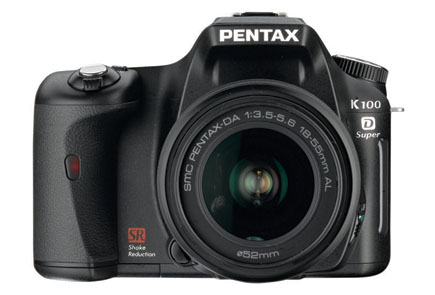
Pentax’s K100D Super; The Digital K-Mount Revolution Continues
In 1979 Pentax launched the ME Super as a manual focus, aperture-priority automatic SLR with an electronic focal plane shutter. It was small, light, and by all reports had excellent ergonomics. It used the by-then ubiquitous K-mount lens system and was sold successfully through '84. Fast forward to 2007 and Pentax Imaging launched the K100D Super D-SLR with a few of the innovative features found on their more advanced, higher-priced camera, the K10D.
 |
 |
 |
Since its introduction I've recommended the Pentax K100D to people who were looking to move up from digital point-and-shoot cameras and all of them--even those with initial reluctance because they weren't familiar with Pentax--have thanked me for it. And why not? The K100D and K110D are well-made, easy-to-use, inexpensive D-SLRs that provide a gateway to more than 24 million K-mount Pentax lenses already out there, and that doesn't even count those made by third-party companies! The Pentax K100D Super is the newest member of the K-series of D-SLRs and it combines shake reduction, dust removal, and full compatibility with SDM-series autofocus lenses.
 |
|
 |
|
|
The K100D Super uses the "trickle-down" theory of digital imaging. Some of the capabilities of Pentax's capable, semipro K10D trickled down to the entry-level K100D series of D-SLRs, producing the feature set for the K100D Super. The imaging sensor's low-pass filter is coated with a vapor-deposited fluorine compound to reduce dust attraction. Then the camera uses the K10D's super high-frequency Shake Reduction (in body Image Stabilization) mechanism to remove dust particles. Any dust shaken from the CCD falls onto an adhesive sheet located at the bottom of the Shake Reduction unit, stopping it from jumping back onto the imager. I guess that last part is similar to how the DUST-AID (www.dust-aid.com) sensor cleaning system works and all of my files from the K100D Super were as clean as Martha Stewart's kitchen.
 |
 |
|
|
||
| |||||||||
|

| ||||||||


 FEATURED VIDEO


Get the Latest Photo Tips, News & Reviews from Shutterbug!






| Camera Reviews Other Reviews | |
Mobile Reviews Photography Reviews Columns | |
News | |
Features | |
How-To | |
Resources |
 © 2026 Shutterbug
AVTech Media Americas Inc., USA
All rights reserved