| |
Toyo Field, 90mm f/8 Schneider, Manfrotto tripod and ball
head, Fuji Velvia 100 exposed at 1/15 sec at f/32.5, scanned
on UMAX PowerLook III with Silver Fast SE, color corrected
in Photoshop 7.0 on an Apple Power Mac G4.
© 2003, Paul Mozell, All Rights Reserved
|
|
In The Field
For a first field test of the meter I set out on a perfect New England
autumn day to photograph the fall colors in a state forest near my home.
Shooting the new Fuji Velvia 100 in my Toyo Field view camera I knew that
I had about a five-stop exposure latitude to work with. After adjusting
the diopter ring to correct for my nearsightedness, I used the built-in
1Þ spot meter to pick out dark shadows in the scene, reading the
basic exposure information first in the spot meter’s viewfinder,
and then on the backlit LCD display on the meter’s main panel. I
determined that the shadows were a couple of stops beyond my film’s
sensitivity. (This meter’s predecessor, the Sekonic L-508, had a
zoom 1-4Þ spot meter. Sekonic found that very few photographers
used the 4Þ angle.)
I also learned that a white reflection of the sky in a pond would be about
a stop out of range as well, but it was not critical to the composition.
Next I took readings on some medium gray tree bark, a gray rock, and some
red leaves, and pushed the “Memory” button to store each one.
By pushing the “AVE/EV” button I got a reading that averaged
all my spot selections. Not trusting the reading entirely, I compared
it to an incident reading I took with the large retractable, swivel-mounted
white dome on the top of the meter. I was not surprised that my incident
reading was about 1/2 stop under the average spot meter reading. Incident
readings in bright sun can be tricky—varying slightly as you change
the measurement angle of the dome. The L-558 allows you to store up to
nine different values. I went with the spot meter reading and the processed
film showed that I made the correct choice.
Next, I screwed a polarizing filter on my 90mm Schneider lens, applied
the filter factor using the meter’s handy buttons and thumbwheel,
and exposed another sheet of film using the corrected values. The processed
film showed matching exposures but the polarized sky was too deeply saturated
for my tastes.
Digital And Film
As unforgiving as Velvia can be to highlights, readers of this publication
know that “overexposure in digital is death.” And, the underexposed
and muddy shadows that you sometimes get with transparency film can be
even more of a problem in digital—recorded as noisy, color-shifted
shadows. As good as the in camera meters have become, they still don’t
give the photographer as much information as a good handheld meter can.
In the studio it’s the same. The more you know about your lighting,
the less time you’ll spend editing files. It remains true that you
can’t fix everything in Photoshop, and shooting dozens of digital
exposures because they are “free” is an inefficient use of
your time.
Working With Flash
Later, I decided to shoot some portraits of my daughter. With bright sun
coming in the south window I had a chance to use flash fill techniques.
I used the sun as a hairlight and popped a Norman studio strobe with an
umbrella as my key light. A disk reflector provided fill. The Sekonic
very handily showed me the flash and ambient readings, plus the combined
reading of the two on one legible analog scale. That’s the power
of information that I need.
Photographers with large studios that have multiple banks of ceiling-mounted
strobes will love the remote triggering capability of the L-558. Using
the optional PocketWizard transmitter that pops into a door in the backside
of the meter, you can trigger and measure different power packs and cameras
up to 100 ft away. Sports photographers who use strobes mounted in the
catwalks above a basketball court will also love this capability.
Low-Light Capability
Later in the day, as dusk arrived, I stepped outside to try the meter’s
low-light sensitivity. Sekonic claims that this is the most sensitive
meter of its kind on the market. It takes reflected flash readings down
to f/2 and incident down to f/0.5, ambient incident readings to -2 EV
(Exposure Value) and ambient reflected down to 1 EV (at 1Þ). So
if you want to make 30-minute exposures by moonlight and test the reciprocity
failure of your film, you’re all set with this meter!
Metering Standards?
Because I put more film through my Nikons than any other camera, I use
its metering as my personal standard. Over the years I have found that
all my handheld meters were 1/2 to 2/3 stop under the Nikon reading. But
Sekonic, Gossen, et al. make no apologies for this, saying that there
is no international standard for a neutral gray. Sekonic says they match
Nikon’s standards but I found about a 1/2 stop difference. Further
shooting and tests will tell me more.
Fortunately, the L-558 lets you make separate global calibrations for
both incident and reflected light. With other meters I always had to adjust
the ISO speed or filter factor to accomplish this. Just remember that
you made the change, because there is no reminder on the LCD screen.
Other key functions include: full, 1/2, or 1/3 step readings; dual ISO
settings; corded, cordless, radio-triggered, and multiple-flash settings;
all-weather design; and full CINE features for motion picture and video
use.
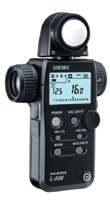
I have only one complaint about the Sekonic Dualmaster L-558—its
size. Being somewhat bulkier than some dedicated spot meters or single-function
meters, it doesn’t slide easily into a photo vest or coat pocket.
But the size is a small sacrifice, given the comprehensive functions and
accuracy of this tool. Its LCD settings are straightforward and intuitive,
and the manual’s text and graphics are precise and no-nonsense.
The Sekonic Dualmaster L-558 has a street price of $499, and is distributed
by Mamiya America. For more information, visit Sekonic’s website
at: www.sekonic.com.
Paul Mozell is a nature and
landscape photographer and digital imaging consultant. See his work or
contact him at: http://mozellstudios.com.
|