


- REVIEWS
Camera Reviews 
More Reviews Mobile Reviews Photography Reviews - GALLERIES
- VIDEOS
- BUYER'S GUIDES

Zeiss Ikon Lenses; ZM Mount For New Zeiss Ikon Rangefinder 35mm Camera
As we said in the review of the new Zeiss Ikon (ZI) 35mm rangefinder (April 2006 issue of Shutterbug or online at www.shutterbug.com), we received six of the seven Zeiss ZM-mount lenses announced at photokina 2004: 15mm f/2.8, 21mm f/2.8, 25mm f/2.8, 28mm f/2.8, 35mm f/2, and 50mm f/2. The 85mm f/2 (listing at $2759, plus $127 for the lens shade) still wasn't available as we went to press, but then, you can't hurry perfection. For that matter, the 15mm f/2.8 was a preproduction lens with a serial number that a collector would kill for: 000 000 05.
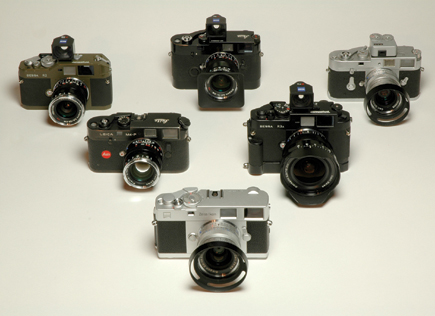 |
|
|
All save the 15mm f/2.8 and 85mm f/2 are Zeiss designs made under Zeiss quality control in Japan; the longest and shortest lenses (and easily the most expensive) are made by Zeiss in Oberkochen.
All, Japanese and German alike, have a real feeling of quality with engraved, paint-filled markings, crisply milled focusing and aperture rings, and a real "heft" to them--though it has to be said that the 15mm f/2.8 feels closer to Leica "heft" than the 21mm to 50mm. Roger prefers black, Frances prefers chrome. It is easiest to begin with the features common to all lenses.
Features In Common
All have 1/3 stop gradations on the aperture rings. The markings are so wide, and so nicely (and equidistantly) spaced, that you can easily set to 1/6 stop accuracy if you wish. For many applications, 1/3 stop is more accuracy than you need, but for bracketing color slides it is perfect, as noted in the review of the camera body. Some may find it fiddly; we loved it, and see it as a clear advantage over Leica's half-stop rests.
Minimum aperture is f/22 on all but the 85mm f/2, where it is f/16. Obviously diffraction limitations to resolution are fairly severe at f/22, but enormous depth of field is sometimes an advantage.
The lens mount is the four-claw Leica M bayonet introduced in 1954: in place of Leica's raised red dot for lens location, Zeiss has one in Zeiss blue. Both make it equally easy to change lenses by touch, a habit to be encouraged because the blue dot is slightly harder to see than red.
All lenses are marked with their focal length to the left of the depth of field scale, with blue paint on silver-finish lenses and red on black-finish lenses. The numbers are easier to read on silver-finish lenses. Focusing scales are "feet/meter" with meters nearer the index and feet slightly outboard of them. The meter scale is black (chrome lenses) or white (black lenses) while the feet scale is blue (chrome lenses) or red (black lenses). Depth of field scales are clearly marked, again in black or white. Unusually for modern lenses, all have infrared focusing indices, always to the right of the main focusing index, variously at f/4, f/5.6, or f/8.
 |
|
|
Lens Hoods
The 21mm to 50mm lenses all have external bayonet-mount lens shades (lens hoods) of the most exquisite quality. There are three hoods at $127 each: one for the 21mm f/2.8 or 25mm f/2.8, another for the 25mm f/2.8 or 28mm f/2.8, then another for the 35mm f/2 and 50mm f/2. All three taper briefly outward from the front before tapering back in toward the lens. This gives the maximum possible shading with the minimum possible size of hood. Shared hoods inevitably involve some compromises but with Zeiss T-coating they should rarely be significant. All hoods are "ventilated" to allow maximum vision through the viewfinder, which inevitably is partially blocked by large lenses or shades. All can be fitted or removed with the lens cap in place.
The 15mm f/2.8 has a built-in "flower"-type lens shade with a big, push-on cup-type lens cap. Others have clip-in or "pinch"-type caps which are infuriatingly hard to grip if you try to put them on or remove them with the lens shade in place: the ribs are arranged parallel with the optical axis, which makes the grip less secure, rather than at right angles to it which would make it more secure. If we owned any of these lenses we would immediately modify the caps with a Dremel tool or some epoxy resin.
Filters are standard screw fitting in 43mm (35mm f/2 and 50mm f/2), 46mm (21mm f/2.8, 25mm f/2.8, 28mm f/2.8), 55mm (85mm), and 72mm (15mm). Designing a 15mm to take a filter at all was quite an achievement.
 |
|
|
Focusing Ease
All the Japanese-made lenses have a lug or bump at about 7 o'clock as the lens is viewed from the front: not a full finger grip such as is found on (for example) the Voigtländer 50mm f/2.5 Color-Skopar, but more than adequate for fingertip focusing and for setting distance by feel. The 15mm f/2.8 does not have this lug and of course the 85mm f/2 was not supplied for test. Focusing on the Japanese-made lenses is "quick" at 90Þ, though the 15mm f/2.8 is a bit slower at about 100-110Þ. Again, we don't know what the 85mm f/2 might be like.
Evaluation
Exactly which lenses you choose is intensely personal. For Roger and his Leicas it is 35mm and 75mm, with 21mm in third place and then 15mm for specialist applications. For Frances and her Voigtländers it is 25mm or 28mm and 50mm, with 90mm in third place and (again) 15mm for special applications. With the ZI, the 85mm could probably replace both the 75mm and the 90mm, but then the drawback would be that we'd both want it at the same time.
Performance of any of these lenses is exactly what you would expect from lenses with "Carl Zeiss" graven on the lens bezel. The 15mm f/2.8 is obviously the lens that will attract the most attention, as it has two main competitors, the 15mm f/4.5 Voigtländer at about 1/10 of the price and the 15mm f/2.8 reflex-fit Leica at about twice the price.
Yes, the corners are significantly darker than the center, especially at full aperture, but for those (relatively rare) occurrences where this is a real disadvantage a center-grad filter will be available. Curvilinear distortion is minute, imperceptible even with straight lines near the edge of the frame, though like all ultra wides, three-dimensional objects (including people's heads) are "stretched" unpleasantly toward the edges of the picture. This is a perspective effect; depends solely on focal length; and is therefore common to all ultra wides. Technically it is not distortion, though most would perceive it as such.
The Distagon is 11/3 stops faster than the Super-Wide-Heliar and (unlike Leica's 15mm f/2.8) fits on a rangefinder. Extraordinarily long handheld exposures are feasible--1/15 sec, 1/8 sec, and even longer--so ultra low-light, ultra-wide angle reportage becomes surprisingly easy.
With the other lenses, where the design is nothing like as difficult or demanding, such concerns as drawing, resolution, vignetting, etc. are simply not an issue. All, including the 15mm, have the kind of sharpness and micro-contrast that make transparencies stand out on the light box, and endow negatives and resultant black and white prints with "sparkle," an elusive quality that is easier to recognize than to quantify. The quality will probably not be visible in reproduction, because photomechanical printing is a great leveler, though it is still more reliable in most cases than web images.
We would recommend any of these lenses without hesitation as among the best in the world. The only real objection is that some faster options might be desirable, given the availability of (for example) Voigtländer's 28mm f/1.9 and 35mm f/1.2, or 35mm f/1.4 and 50mm f/1 lenses from Leica.
| |||||||||
|

| ||||||||








 FEATURED VIDEO


Get the Latest Photo Tips, News & Reviews from Shutterbug!






| Camera Reviews Other Reviews | |
Mobile Reviews Photography Reviews Columns | |
News | |
Features | |
How-To | |
Resources |
 © 2026 Shutterbug
AVTech Media Americas Inc., USA
All rights reserved