Tunnel Vision A Guide To Using Super Telephoto Autofocus Lenses
Stan Trzoniec, August, 2003

Tunnel Vision
| |
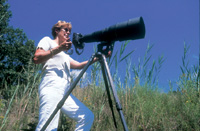
Even on steep terrain, make sure the tripod and lens is
secure by testing it with your left hand while getting
ready to fire the camera with a cable release in your
right hand. A strong and versatile tripod like this Gitzo
carbon-fiber version is great in a situation like this.
Photos © 2002, Stan Trzoniec, All Rights Reserved
|
|
There certainly seems to be
a true mystique when it comes to telephoto lenses. In a quick poll taken
in our lab I found out that when a person buys a new single lens reflex
camera the next lens he or she wants is a telephoto. Not much of one,
of course, as folks with youngsters simply don’t want to be bothered
with all the trouble of one over the focal length and fast film to capture
it all. Something less than 200mm or so seems to be the magic number.
But as you advance you start to reach out further. Zoom lenses are popular,
especially in combinations like the 80-200mm or 70-300mm. Serious photographers
seem to stay away from a zoom once they get what I call “tunnel
vision.” Then, these same people, when confronted with the likes
of a 300mm or even a 500mm lens, start to get a strange look about them.
Their eyes start to glaze over and their speech begins to slur. In short,
what they really want is to move up the ladder to bigger and longer millimeters.
|
| |
| Today’s
modern telephotos incorporate a wide number of features
one of which is the new Silent Wave type focusing motors.
Here the author was able to follow two youngsters as they
peddled their way through an old New England village. |
|
Getting Started
Let’s talk millimeters first, straight millimeters and not zooms.
When I’m in the field my gut feeling is that I get more use (and
sharper images) by using a traditional telephoto in 300, 500, or 600mm.
Zooms are great, and my own Nikon 80-200mm f/2.8 AFS delivers some extraordinary
images, but for some reason I’m always fiddling with that darn power
ring. Call it habit or whatever but when that great blue heron comes to
a screeching landing, I’m always at the wrong end of the power ring.
A cursory look at what’s
available today in straight, no nonsense super telephotos makes for good
reading. Nikon and Canon, for example, are known for their fast reacting
telephotos complete with all of the goodies like Silent Wave or Ultrasonic
motors. These front-end motors are built into the actual lens and are
not driven by the camera body itself, assuring quick and decisive pinpoint
focusing. Even today we are on the forefront of new technology in the
form of Image Stabilization, Vibration Reduction lenses from Canon and
Nikon, along with the new stabilization lens from Sigma. The end result
is what we’re all looking for—more keepers for our files.
|
| |
| For
neat effects like compression, super telephotos are the
way to go. The distance between these two buildings is about
150 ft, but note how a 500mm lens has shortened this space.
Are they sharp? Just look at those hanging flowers. You
can see every vine and leaf! |
|
Glass is certainly an important equation in any lens, more so in super
telephotos. Each manufacturer has a combination of finely tuned optics
to capture sparkling images in all kinds of light. Don’t forget
for a minute that people like Nikon, Canon, Contax, Pentax, Minolta, Sigma,
Tamron, and others build their reputations on what the good photographers
like us place on film. Now everything being equal, you still—and
especially in super telephotos—get what you pay for. High quality
telephotos cost plenty, but they are sharp, clear, and have a true color
rendition of what the photographer captured at that particular moment
in time.
Naturally other features come into play. Do you have the option of switching
from autofocus to manual at a heartbeat or can you fine-tune your image
as an override when shooting a marsh wren through waving tall grass and
cattails? Limit switches come in handy, especially when the subject is
on the plain side (keeping in mind autofocus lenses need a contrast difference
to function correctly) and you want the lens to stop hunting for that
perfect point of focus. Built-in or readily available lens shades are
a plus and the deeper the better. Tripod collars are a must, especially
with longer optics as they balance the whole package for fast-paced action
shooting and allow you to turn from horizontal to vertical without even
touching the ball head or tripod.
|
| |
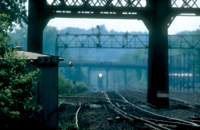
The
Nikon 600mm f/5.6 ED IF was used to isolate the foreground
from the train, which was almost a half mile away. The haze
of a hot summer day helps to convey the feeling and since
there was no movement involved, the manual focus lens was
just the tool for this scene. |
|
What’s Out There
Today, like everything else in our society, telephoto lenses of all kinds
are out there in spades. Nikon has both a 300mm f/2.8 and 300mm f/4 AFS.
From there you move up to 400, 500, and 600mm AFS versions. Canon’s
line is very similar and very impressive and includes autofocus lenses
from 300mm up to and including a very formable 1200mm f/5.6L complete
with an Ultrasonic motor. The cost on this baby? If you have to ask, a
mere $79,000.
Sigma has a line of autofocus super tele’s that range from the popular
300-800mm that couple to most modern cameras. Tokina has a pair of 300s
in both the f/2.8 and f/4 versions; Pentax has a neat 400mm f/5.6; Minolta
follows suit with a 300mm f/2.8 and f/4, a 400mm f/4.5, and a more traditional
600mm f/4 lens. For a more complete update see the attached chart or purchase
the latest Shutterbug’s Photography Buyer’s Guide, which offers
all specifications, lens mounts, and prices. Also, check the updates in
our PMA show report published in the June, 2003, issue of Shutterbug.
|
| |
| Are
telephotos good for close-ups? You bet, as witnessed by
this daisy photographed on Velvia with a Nikon 300mm f/2.8
lens all tied together with a PK-13 extension ring. |
|
Sorting Out Your Needs
Super telephotos can play a very active role in both your photography
objectives and budget, so let’s look a little closer at how millimeters
affect relative size and the image on your film. For the sake of argument
let’s say you have an image in front of you that you want to photograph.
Size is unimportant at this time, but let’s say you’d like
it to fill your frame comfortably in the horizontal format. With a 300mm
lens, you need to back up to around 49 ft, a 400mm lens will push you
back to about 65 ft, a 500mm will move you to the rear 82 ft, and with
that super 600mm you’ll be at 98 ft.
Still another fact to consider is how much difference in image size one
will gain by going to a different focal length. About two years after
purchasing my Nikon 500mm f/4 AFS I had a real strong desire for that
600mm f/4 AFS. But would I really gain anything of significance with only
100mm more? Reason shows that the difference between 500mm and 600mm is
only 20 percent. True, but to a point. In fact, asking around I was given
a formula by a manufacturer that when you square the focal length of the
lens the image size increases. So playing the 500mm against the 600mm
my increase in image size would not be 20 percent but an impressive 44
percent. Now that’s pretty good considering that the angle difference
between the two is less than 1Þ! That’s what I was looking
for and consequently purchased the lens.
|
| |
| It’s
simply amazing what you can do with a 300mm lens and a 1.4x
extender attached! Even with the newer Nikon 300mm f/4 and
the extender, the close focusing distance has not been changed
allowing full frame images with more than adequate working
distance. Note the sharpness on the inside of the flower.
|
|
Still another avenue to consider
is weight. More glass and larger maximum aperture equals a heavy lens
that costs more money. For instance, in my battery of upper-end telephotos
(in millimeters now, not dollars) you’ll find the 300mm f/2.8 AFS,
300mm f/4 AFS, 500mm f/4 AFS, and 600mm f/4 AFS. The reasoning behind
all of this hardware soon becomes clear. For extended travel by airline,
hiking, or from a precarious vantage point, the 300mm f/4 AFS gets the
nod. Light in weight, costing less than a quarter of the money I paid
for the 300mm f/2.8 AFS and containing that famous Nikon ED glass, this
new version is a much improved product especially in the response uptake
for moving subjects. The 300mm f/2.8 AFS comes on-board when (1) I’ll
being using my Suburban for travel, (2) using a tripod for both the extra
speed and perhaps a tele-extender, and (3) when I want to employ the use
of the 2x extender handheld or braced on a set of beanbags.
The big guns—my 500mm and 600mm Nikkors—are my out and out
favorites. The 500mm I’ll use when I’m going on a substantial
hike and I’m still comfortable with the 1.4x extender. The 600mm
f/4, on the other hand, finds more and more use as it allows me more reach
without the use of extenders that can degrade overall quality if you’re
not in tune with proper technique matched with a really sturdy tripod.
|
| |
| Even
in flight this heron can be tracked handily by the use of
a high-performance tripod head like those made by Kirk or
Wimberley. The author’s Nikon 600mm f/4 was used with
Provia 400F. |
|
Last in our series is the 400mm
class of super telephotos. Both Nikon and Canon have this model in the
f/2.8 version, both autofocus with the 2x extenders to reach a whopping
800mm at f/5.6. However, the sleeper in this series seems to be Canon’s
400mm f/5.6. Small and light, folks who have this lens swear by it as
one of the best in its category for full action photography, panning,
and overall image clarity. Presently, all we need now is for someone to
introduce a 400mm f/4 and all the gaps in this 16” focal length
will be filled.
Moving Up With Film
With all those really good products out there all I can say is don’t
be in too much of a hurry to slow down! Don’t be miffed by the fact
that using slow film like ISO 100 is always the best, as many factors
can ruin even the best day. Sure 1/100 sec at f/16 is normal on a bright
day and shooting a long lens at f/8 (2 stops from wide-open on a f/4 lens)
is best, but you have to consider various lighting situations that always
seem to enter the picture.
For example, sidelighting can eat up 1-2 stops depending upon the subject
and darker subjects can also drop shutter speeds down even more. In my
workshops I encourage students who are new to the world of telephotos
to start with a film with an ISO 400 rating to help instill confidence.
When photographing a brace of dark mallards with Provia 100F on a dark
riverbank with a 1.4x tele-extender you get speeds of around 1/125-1/160
sec with a 500mm wide-open at (with the extender) f/5.6. Even on a tripod
this really starts to get marginal at best, so proper technique—good
tripod, cable release, static subject—makes for another keeper.
ISO 400 film is getting better and better, and when I’m out in the
field with any of my super telephotos one Nikon F5 is always loaded with
Provia 400F. I find no disadvantage here—use this film with high
shutter speeds combined with a moderate aperture and you’ll get
great prints in the 11x14” class. Still another favorite that pushes
really nice is Kodak’s EliteChrome in ISO 200. Great color, tight
grain, and when you do your part with a crisp image one never even takes
note of the grain pattern. Remember: take a little grain anytime over
the loss of a one-time image. Additionally, I find that because of their
narrow angle of field (500mm has around 5Þ of angle) my exposures
seemto be more consistent. Why? Simply because your camera’s metering
system has now turned into a spot meter and a concentrated area means
a better exposure.
|
| |
| Walking
along the beach in Maine, the author found the Canon EOS
3 with their 400mm f/5.6 lens a great combination with Fuji
Provia F ISO 400 film. Stalking the common seagull was easy
with no stress on either the bird or the photographer. |
|
My Aching Back!
The bigger the lens the more you’ll need under it to support the
bulk. Over the years, between inside studio and outside on-location work,
tripods have come and gone. The larger Bogens are great for view cameras
and static studio setups. For wildlife, a favorite of mine is the Manfrotto
3021, which is more than adequate for most of my work. When I start to
reach that 500mm and up plateau I reach for the Gitzo Mountaineer MK2
and equip it with their G1377M magnesium center ball head with the more
common camera mounting screw.
This Gitzo has a bare weight of around 41/2 lbs, is made from carbon fiber,
and has legs that adjust just inches off the ground. If I’m using
lenses with the ACRA type mounting system I’ll switch over to the
Kirk ball head. For unrestrained movement, the Kirk King Cobra or the
Wimberley head is great. When it comes to ultra-sharp telephoto images,
it’s all in the support system under it and whether you want to
believe it or not, the tripod is the strongest link.
Finally, use a remote cable release. Unless your shutter speeds are way
up there shoot single bursts with a pause, if possible, between each frame
to allow your rig to settle down. Additionally, allowing the mirror to
be set in the up position during the exposure (in manual mode) is yet
another way to erase all the variables in long distance photography. And
don’t forget an additional set of batteries. With full camera automation
and in-lens motors all I can say is, “Don’t leave home without
’em!”
I know, I’ve been there…
|
| |
| Long
lenses like a 500mm or 600mm actually seem to render more
consistent exposures due to their very narrow angle of view.
Can’t get any worse than this. A dark mallard on an
almost black riverbank. Matrix metering figured it out and
gave a perfect exposure. |
|
Go The Distance
There is a very simple rule out there concerning super telephotos and
it goes like this: No matter how long your present lens is, it’s
never long enough! Just when you think you have the best of the best,
that brown pelican you’ve been stalking since the wee hours of the
morning is just that much farther away. That’s when you start needing
tele-extenders.
Common today are 1.4x and 2x extenders that will increase that 500mm into
a 700mm with the former and up to 1000mm with the latter. With one you
lose one stop of light (now that 500mm f/4 becomes a 500mm f/5.6); with
the 2x you vacuum up yet another stop of light. The folks using digital
seem to have the best of both worlds. They keep the original lens opening
yet, because of the digital format of multiplying 1.6x the focal length,
your 500mm now becomes a 800mm f/4. If you really want to space out, add
a 1.4x extender to the math and bingo, you’re at 1120mm! Is that
beyond the scope of practicality? Maybe, but keep it all supported and
you’re in. Whatever your choice, tele-extenders are one inexpensive
way to add power to your
super telephotos.
Autofocus
Super Telephotos |
Millimeters
Aperture |
300
f/2.8 |
300
f/4 |
400
f/2.8 |
400
f/4.5 |
400
f/5.6 |
500
f/4 |
600
f/4 |
800
f/5.6 |
1200
f/5.6 |
| Nikon SWM |
X |
X |
X |
|
X |
X |
|
|
|
| Canon USM |
X |
X |
X |
|
X |
X |
X |
|
X |
| Pentax |
|
X(1) |
X |
|
X |
X(2) |
X |
|
X |
| Minolta |
X |
X |
|
X |
|
|
X |
|
|
| Sigma HSM |
X |
|
|
|
X |
X(3) |
|
X |
|
| Tokina |
X |
|
|
|
|
|
|
|
|
| Tamron |
X |
|
|
|
|
|
|
|
|
Notes:
(1) Pentax 300mm f/4.5, (2) Pentax 500mm f/4.5, (3) Sigma 500mm
f/4.5,
SWM=Silent Wave Motor, USM=UltraSonic Motor, HSM=HyperSonic Motor |
|
|