Site Links
|
 |
 |
 |
Canons f1.0 USM A Super Speed Lens
By Stan Trzoniec April, 2002
|
|
|
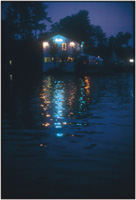
With Provia
400F pushed to one stop, this night scene was photographed
wide-open at 1/30 of a sec.
Photos ©
2001, Stan Trzoniec, All Rights Reserved
|
|
Ever since I started in photography
I was enthralled with the virtues of good, clean available light photographs.
After high school my graduation present was a Heiland Pentax complete
with an f/2 lens. Combining that with Tri-X film--then rated at ASA 200--and
a Gossen Lunasix meter, my low-light candids really started to improve.
However, being human I wanted that Nikon f/1.1 lens that, at that time
of my life, was only available as a very costly option on these now legendary
rangefinder cameras.
Technology and times change,
and photographers have never had it so good. At the last PMA show while
checking out the wares at the Canon booth, I had to stop short when among
all those optical products a rather pudgy lens really stood out. Inquiring
further, the representative gladly took it out of the case and handed
it to me. Much to my chagrin it was a 50mm f/1.0 lens, complete with an
ultrasonic motor.
The last time I even came close
to physically holding anything close to this was when I enrolled in the
Leica school in Wetzler, Germany, while in the service for what I believe
was a three-day blitz in German high-grade cameras and optics. Then, and
again I'm testing my memory, they showed us an f/0.85 lens used for the
sole purpose of data recording. Now that was a lens.
|
|
|
|
Believe it or not,
this evening lit scene was photographed about a half
hour after sunset. Handheld, wide-open with Provia
400F film pushed to ISO 800.
|
|
Sometimes it's really
hard to get turned on by a plain-Jane 50mm lens. Experts tell us
that the 50mm lens is just about right for all-around shooting.
Lens makers drive the point home further by making them in such
great numbers that even for an f/1.4 version the price is right.
Camera manufacturers still like to sell their camera bodies with
this 2" optic and for the most part it equals or comes close to
the angle seen by the human eye. Is it really best for most situations?
Well, maybe…
Right off the bat I'll
tell you that I don't even own a 50mm lens except within the range
of a very common zoom like the 28-70mm. The 50mm seemed too mundane,
too staid, too everything else.
That is, until this Canon
50mm f/1.0 came across my desk. Currently, this is but one of two
f/1.0 lenses presently out there. Leica makes the other one for
its M-series. Nikon has its famed manual focus f/1.2 Noct and Olympus
rallies with its own f/1.2 version. If only Eisenstadt or Cartier-Bresson
were here to see it all.
|
|
|
|
By using daylight
film at night, colors seen normal by the naked
eye take on a new look when shot at dusk.
|
|
Overall Impressions
Why all the hoopla about a 50mm f/1.0 lens? Well, for one
thing, as compared to a more germane f/2.0 lens, you gain
an additional two full stops of light and from the more common
f/1.4, one full stop.
While you might
think it's not such a big deal considering the financial outlay,
my first roll of film shot with the lens showed the advantage.
After making some casual outdoor photographs with Kodak Ektachrome,
I finished the roll with a few candids of my wife doing the
bills. Although the color is off--I was using daylight film
under tungsten conditions--I photographed her in a moment
of thought at 1/30 of a sec wide-open at f/1.0. The big deal
was that I only had ISO 100 film in the camera!
Physical makeup
of this lens is indeed impressive, and becomes even more so
when you place it on the camera and around your neck. The
complete package--lens, shade, EOS-1 V, and its power booster--comes
to 51/2 lbs. Hefty for sure, but manageable especially when
it comes to low-light situations. Braced on anything solid
like a wall, light post, or a table, the extra mass of the
entire assembly helps to secure clear, sharp photographs even
at the slowest of shutter speeds.
|
|
|
|
Looking
for photographs at night is a very different
experience. Note the glow of the sky and
the car on the road. Exposure here was
1 1/125 of a sec at f/1.0.
|
|
At 2.2 lbs
the lens contains 11 elements in nine groups, has a
minimum aperture of f/16 and, considering its outer
diameter, uses filters with a 72mm diameter. Those trying
to standardize on one filter size will find that other
lenses in this elite "L" class, like the 20mm f/2.8,
85mm f/1.2, 135mm f/2, or 200mm f/28, share the same
filter size. Two aspherical elements help to promote
ultra-sharp images.
More And
More Features
Naturally a lens of this pedigree demands other features
worthy of more than a passing glance. For instance,
a USM (UltraSonic Motor) has been integrated to provide
quick response and lock on focusing capabilities for
crisp images even at close to wide-open apertures. Canon
was the first to utilize such a feature and to this
day is extremely proud of its popular innovation.
|
|
|
|
For informal portraits, this example
of my grandson shows a mild softness
and severely out of focus background.
Wide-open, this lens is hard to
beat for such a task.
|
|
If
conditions demand, you can touch up any focusing
defect that may not have been within the selective
focus grids by merely tweaking the lens by hand.
For those who might want to work from a static
position (e.g., tripod) the lens does contain
a manual/autofocus switch on the barrel in addition
to a limit switch that helps you select two predetermined
distance settings. Canon has thoughtfully included
f/stop marks on the barrel next to distance scales
in both feet and meters.
In
The Field
To test the lens I used a wide range of film in
a variety of lighting conditions. Starting at
our baseline of f/1.0 the lens was understandably
a touch on the softer side, obviously suffering
from any help from depth of field to help sharpen
the image. By f/2.8--just three stops from wide-open--the
lens really started to shine. The corners were
starting to come in and the center began to tighten
up appreciably.
On
a scale of 10, I'd peg either f/4 or f/5.6 as
the prime hot spot of this lens for all-around,
general photographic duties.
But
what if you purchased the lens for its f/1.0 capabilities?
The advantage here is obvious--any image is better
then none at all. For instance, one night in Maine
using aperture priority, I opened the lens to
its widest point (f/1.0), loaded up with Provia
400F and set the ISO to 800, a one stop push.
|
|
|
|
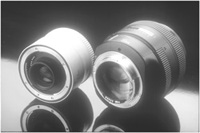
No, don't even think about
it! Because of design differences
the lens and extenders are
not compatible.
|
|
Walking
a- round a favorite nighttime spot I watched
intently as the shutter speed went from
a 1/30 of a sec to 1/2000 as the light and
subject matter changed. From right after
sunset to about two hours or so into the
night, this lens proved itself over and
over again by providing me with not only
the ability to capture low-light images
but to do it with amazing consistency. With
another lens of lesser speed, a tripod would
have certainly been necessary.
With
all the positive attributes are there any
negative vibes in this report? Yes, and
it deals with the Canon extenders. Both
the 1.4x and 2.0x incorporate a lens extension
that extends back from the host and the
50mm f/1.0 has a flush rear element. Thus,
the two shall never mate. Pity, for visions
of a 70mm f/1.4 or a 100mm f/2.0 were always
dancing around in my head.
|
|
|
|
For operator convenience there
is a limit switch and depth
of field scale on the lens
barrel.
|
|
So
who will reap the benefits of a lens like
this? Professionals dedicated to the art
of photojournalism now have an exciting
tool that will never quit, no matter the
light. Layman photographers into available
light work can put it to good use in self-assignments,
casual candids, and family outings where
one lens can handle it all. It's expensive,
with a street price of around $2530. But
if a lens like this is in your blood, go
for it!
For
more information, contact Canon at (516)
328-5000 or on the web at www.usa.canon.com.
|
|
|
|
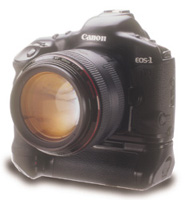
Attached
to Canon's famed EOS-1 V,
this 50mm f/1.0 lens is one
formable piece of glass slated
for heavy available light
work. Checking in at 2.2 lbs,
the complete package --EOS-1
V, lens, and shade--now comes
to 51/2 lbs.
|
|
Focal
Length:
50mm
Maximum Aperture: f/1.0
Lens Construction: 11 elements,
nine groups
Picture Angle: 40°, 27 minutes
Focal Length Scale: 50mm only
Distance Information: Lens to body
Focusing: Ultrasonic Motor
Aperture Scale: f/1.0 to f/16
Minimum Aperture Lock: Internal
Diaphragm: Eight blades
Filter Attachment Size: 72mm
Size: 3.6x3.2"
Weight: 2.2 lbs
Street Price: $2530
|
|
|
|
|
|
 |
|
 |
|
|
 |
 |
 |
|