


- REVIEWS
Camera Reviews 
More Reviews Mobile Reviews Photography Reviews - GALLERIES
- VIDEOS
- BUYER'S GUIDES

The Zeiss Ikon SW Camera and Zeiss Lenses; 35mm Precision In The Digital Age
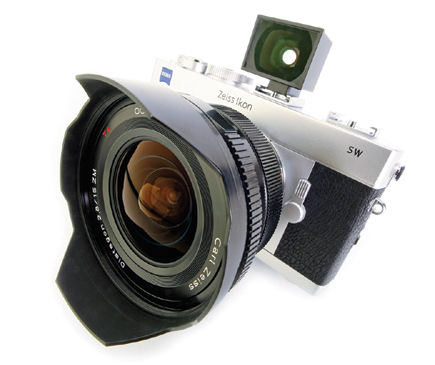
There are few truly magical names in camera design but Carl Zeiss is certainly one of them. The brand conjures up an image of optical perfection and cameras built to a standard, not a price point. Back in the 1950s, when I was dancing on TV's Buddy Deane Show and dreaming of making photographs with a camera that was more precise, more German, than my Argus C3, Zeiss Ikon cameras were already known for their innovative design, excellent build quality, and superb lenses. The new Zeiss Ikon SW 35mm camera follows in that tradition and is built for the uncompromising photographer who likes to make wide angle images.
 |
So where does a 35mm rangefinder--heck, the SW has no finder--camera fit into today's digital photography world? Traditional photography is not dead; it's alive and well because tools such as the Zeiss Ikon SW give us ways to create images that suit how we work. Don't get me wrong, I'm not going to soup the film shot in the SW in a special developer and lock myself in the darkroom making prints. Nope, the film will be lab processed, scanned, and manipulated in the digital darkroom just like all my other digital image files. The only thing that's changed is the method of capture.
 |
Back To The Future
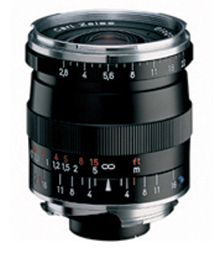
It's really all about the lenses: The high-performance super wide angle lenses such as the Zeiss Distagon T* 15mm f/2.8 ZM and Biogon family of T* lenses deliver results produced by a company for whom optical perfection is their raison d'être. To produce lenses for the Zeiss Ikon system Zeiss teamed up with Cosina, but some lenses in the Zeiss Ikon system, including the Distagon T* 15mm f/2.8 ZM and Sonnar T* 85mm f/2 ZM lenses, use floating element designs and require special test equipment that Carl Zeiss developed for cine lenses and are manufactured in Oberkochen, Germany. The lens mount is the same M bayonet that Leica introduced in 1954, and instead of using a red dot for lens location, ZM lenses are in Zeiss blue.
In the May 2007 issue of Shutterbug, Roger Hicks and Frances Schultz wrote about all of these lenses except the Biogon T* 21mm f/2.8 ZM that I was able to use for this test. The Biogon T* 21mm f/2.8 ZM makes an ideal compliment for the SW. Your taste might run to the other focal lengths, including the hefty in size and price Distagon T* 15mm f/2.8 ZM. The 21mm f/2.8 ZM has an aperture range from f/2.8-22 and the depth of field scales are marked in black or white, depending on whether your lens is silver or black. I had black lenses and there is no extra charge for black or silver. The 90Þ angle of view of the Biogon T* 21mm f/2.8 ZM is neither too wide to cause distortion nor too narrow, making it an ideal lens for architectural and landscape photography. Slides were crisp and negatives made with the 21mm were snappy and it quickly became my all-around favorite lens.
 |
|
|
The Zeiss Ikon SW offers the same high-quality build as their rangefinder camera, but lacks the rangefinder and is slightly more affordable. The camera's main structure is a single aluminum die-cast part and the lens bayonet and focal plane shutter are attached to it. Film aficionados might think of the SW as a 35mm version of Hasselblad's legendary Super Wide and it is similar in operation in many ways. One big difference is that the Zeiss SW has an electronically-controlled metal shutter, offering speeds from 1/2000 sec to 8 seconds in Automatic (Aperture Priority) mode and 1/2000 sec to 1 second plus Bulb in Manual mode. The fastest flash syncro speed is 1/125 sec. Talk about details: The lower part of the shutter is painted light gray to optimize
light metering.
 |
|
|
Out Here In The Real World
I didn't photograph any resolution charts because I don't think that's what most of you will do with a camera like the SW and its powerful optical array. Instead I used it to photograph interiors, exteriors, landscapes, with an indoor car show thrown in for good measure.
The Zeiss Ikon SW, while traditional in design, is not a technological Luddite. In addition to the electronically-controlled shutter with Aperture Preferred autoexposure, the camera has an LED system on its back that indicates shutter speed and over/underexposure warning. Three LEDs specify overexposure (blinking green LED), underexposure (blinking red LED), and shutter speed (various combinations of illuminated red, green, and orange LEDs). It's a system that's easy enough to understand once you remember that as the colors get warmer--orange, then red--shutter speeds are increasing.










 FEATURED VIDEO


Get the Latest Photo Tips, News & Reviews from Shutterbug!






| Camera Reviews Other Reviews | |
Mobile Reviews Photography Reviews Columns | |
News | |
Features | |
How-To | |
Resources |
 © 2026 Shutterbug
AVTech Media Americas Inc., USA
All rights reserved