


- REVIEWS
Camera Reviews 
More Reviews Mobile Reviews Photography Reviews - GALLERIES
- VIDEOS
- BUYER'S GUIDES

Shutterbug’s 2005 Picks Of The Top Slide Films; Despite Today’s Digital Revolution, Chromes Are Better Than Ever
Now doesn't it seem ironic that just as we're in the midst of the
digital revolution that slide films are at the peak of performance and quality?
While all sounds like doom and gloom when it comes to silver-based products,
around my circle of friends I find that most are still shooting film at a rate
close to or even sometimes more than they were shooting before. Sure, they have
purchased a digital SLR camera, but I think the keyword here is "transition,"
as most are not quite ready to give up their film cameras or the newer slide
films.
Case in point: For years now, I have been documenting the American railroad
scene. With over 15,000 slides on file, it's hard to move into digital
because of workflow and my own filing system. In addition, I want to take advantage
of the newer, more modern emulsions, which, in my view, can rival the quality
of even larger megapixel cameras. The wide variety of films available adds yet
another dimension to photography with a host of film speeds, color characteristics,
and even different grain and sharpness qualities. I've also found that
most photographers are happy using only one or two types of film on their photographic
outings. They simply like the "personality" their favorite films
delivered.

So here's our pick of 15 great slide films, including many that I use
all the time and a few I revisited when researching this article. As of this
writing, all were available from leading photo stores. The compiled list is
in no particular order of preference, but I think you'll find that among
all the films you'll find a few that match the way you like to see, shoot,
and show off just how you see the world.
1. Agfa RSX II 50 (ISO 50)
This film is hard to beat for all-around shooting. Even in bright sunlight,
my tests show that highlights held tight while the shadows were rich in detail
and smooth in color and lacking (to an extent) the coolness sometimes associated
with other films in this speed class. Grain was nonexistent, colors were bright
but not overly saturated, and contrast was kept in control.
 |
|
|
2. Agfa RSX II 100 (ISO 100)
For landscape photographers, Agfa's RSX II 100 film is a revelation! Sharpness
of all my images was outstanding and combined with an impressive saturation
curve makes this an excellent choice for any outdoor photographer. Photographs
taken of a bright white New England church showed clean whites against a deep
blue sky that rivaled the use of a polarizer. Images taken to balance both sun
and shade showed more than enough detail in both to satisfy the most discriminating
film user and can be pushed one or even two stops.
 |
|
|
3. Agfa CT precisa 200 (ISO 200)
This chrome film is aimed at the consumer market (vs. a pro film) and I found
it to be warm in color with clean whites and just enough saturation to make
it a good choice for all-around shooting. Overcast days produced cooler images
but were easily cleaned up with the addition of an 81A filter. There is a slight
grain pattern visible in all of my processed film and this might be a good choice
for those who may want to accent this feature on larger prints.
 |
|
|
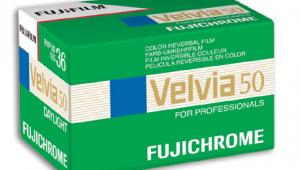
4. Fujichrome Astia 100F Professional (ISO 100)
This new version is an improvement over previous emulsions. Made for commercial
photographers looking for faithful reproduction, all colors render without undue
contrast while retaining excellent details across a wide range of sharpness
and rich color. Fuji rates this film with an RMS granularity value of 10, which
places it just above Velvia 50 (9) and below Provia 400F (13).
 |
|
|
5. Fujichrome Sensia 100 (ISO 100)
This is what I call my "coffee break" film as by the time this part
of the morning comes most stop shooting and Sensia comes to the rescue. I find
it a bit warmer than most and when the sun is high, this amounts to a built-in
81A filter that has been incorporated deep within the layers of the emulsion.
I like its blend of realistic colors and sharpness, which makes it a regular
visitor to my camera bag.
 |
|
|
6. Fujichrome 64T Type II Professional (ISO 64)
While working on a how-to-do-it book on model railroads I wanted to combine
a tungsten film with a bank of photofloods for photos of the project from beginning
to end. The choice was Fujifilm's 64T Type II Professional film as it
gave me plenty of punch for colorful model locomotives and deep green scenery
details. The result was a film that delivered ultra-fine grain and better than
average reciprocity characteristics all within a comfortable and acceptable
ISO range of 64.
 |
|
|
7. Fujichrome Provia 100F (ISO 100)
Boosting the best RMS value (8) of just about any film on the market today,
Provia 100F has indeed found its way up the popularity scale among serious outdoor
photographers. Sporting Fujifilm's Super-Fine Sigma-Crystal and Micro-Grain
Solubility Control Technology, it offers smooth, vibrant color that also delivers
when scanned for large prints. It is extremely sharp and for early morning or
late in the day shooting is one of the best film-based products you can buy.
 |
|
|
8. Fujichrome Provia 400F (ISO 400)
Provia 400F seems to have taken most by surprise. Color saturation is about
a step below but very close to its Provia 100 counterpart. Grain is very fine
for a high-speed film, giving you two stops of additional speed over the 100.
It's a film that lets you keep shooting even if you are caught after the
light gets low. Additionally, Provia 400F is comfortable being pushed and, if
your lab has the capacity, it can be extended to ISO 800, 1600, or 3200 while
still retaining a good balance between color and contrast.
 |
|
|
| |||||||||
|

| ||||||||









 FEATURED VIDEO


Get the Latest Photo Tips, News & Reviews from Shutterbug!






| Camera Reviews Other Reviews | |
Mobile Reviews Photography Reviews Columns | |
News | |
Features | |
How-To | |
Resources |
 © 2026 Shutterbug
AVTech Media Americas Inc., USA
All rights reserved