| |
The
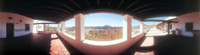
28/220's extreme vertical angle of view makes
it ideal for interiors and other close quarters. New
Cornelia Mine from Greenway mansion, Ajo, Arizona. Approximately
360Þ rotation.
Photos © 2002, Dave Howard, All Rights Reserved
|
|
The Roundshot line of professional,
full-rotation (360Þ horizontally) panoramic cameras is easily
the most extensive and best known in this decidedly small niche of the
special-purpose camera market. The product of Seitz Phototechnik AG
of Switzerland, they are not inexpensive. They are, however, worth every
penny to any professional or dedicated amateur photographer having a
genuine (e.g., income producing) need for the unique capabilities of
this type of camera.
Built like the proverbial tank, Roundshot products are typically employed
by industrial and commercial photographers, as well as event photographers
specializing in large groups of people. The company produces several
models in several film formats (35mm, 120/220, 70mm, and 5" roll
film), some with fixed lenses, others with interchangeable lens capability.
The latest model is the 28/220, referring to the lens focal length and
maximum film load, respectively. There are two versions available, the
"full" 28/220 and the 28/220 Outdoor. The latter is a more
economical ($2950), "stripped-down" model of the more deluxe
28/220 ($3650). We'll be examining the top model here, though
I'll note the main differences along the way.
|
| |
Roundshot
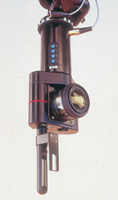
28/220 with AF Nikkor 28mm f/2.8 lens, swiveling finder.
|
|
Lens/Film Combo
Since the lens/film format combination is rather unique, let's start
there. The camera features a lens mount that accepts 35mm format Nikon
lenses (Leica R and Contax mounts available on special order). However,
the 28/220 is designed to work with only one focal length: 28mm. Specifically,
any of the following 28mm Nikkors: AF f/1.4 and f/2.8; manual focus f/2
and f/2.8; PC Nikkor f/3.5. Other "Brand-X" 28mm lenses in
Nikon mount may work, but try before you buy; their image circle may be
insufficient, resulting in "soft" top and bottom edge areas
of the film frame. Pictures taken with other focal lengths will be blurred
and/or distorted.
The 28mm focal length, film transport speed, and point of focus are inseparably
linked; for this camera, focus is 7 meters (23.5 ft). Detailed instructions
are included for testing the ideal focus setting for your particular lens,
but it will generally be between 3-5mm inboard of the lens' infinity
mark. With the aperture set at f/8 or f/11, depth of field is of little
concern.
|
| |
Rear
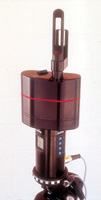
view, showing control buttons, LCD panel, dual levels,
and remote release.
|
|
How It Works
You may already have picked up on the fact that this is a 35mm format
lens, paired with medium format (120/220) film. So how does the lens manage
to cover the larger film? If it had to cover the corners of a normal rectangular
frame, it couldn't. However, this type of camera exposes through
a narrow vertical slit onto film that's being transported past the
slit during the exposure. The slit occupies a thin slice through the center
of the lens' image circle, further taking advantage of the extra
coverage that good optics are designed with in order to minimize light
falloff at the edges of the frame.
Simply put, the greater the lens' image circle, the sharper the
top and bottom edges of your 28/220 negs and transparencies will be (lens
shades and thick filters are a no-no). It should therefore be fairly obvious
that the ideal lens for this camera will be a "PC" (Perspective
Control) lens, which has a much wider image circle to accommodate its
rise/fall and/or lateral shift movements. Indeed, although a non-PC 28mm
may work, as far as I'm concerned, anyone desirous of maximum results
from this camera will consider the PC mandatory, both in the interest
of maximum edge sharpness and the ability to adjust the placement of the
horizon line.
This lens/format combination creates an extreme (83Þ) vertical angle
of coverage that distinguishes the 28/220 from otherwise similar cameras.
Most medium format partial and full-rotation panoramic cameras have lenses
in the 50-75mm focal length range, in the interest of a reasonably "normal"
perspective rendering. This is fine for landscapes and most other general
subject matter, but the accompanying limited vertical angle of view can
be frustrating to industrial and commercial photographers, a group comprising
a large percentage of Roundshot customers. Full-rotation cameras are regularly
used to document building site progress, architectural environments, and
interiors both cramped and expansive. These situations often cry out for
great vertical coverage as well as the encompassing full circle, and this
is where the 28/220 really shines.
|
| |
|
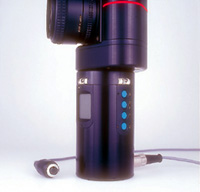
Close-up of control buttons, LCD panel, levels, and remote
release.
|
|
Some Limitations
This immense vertical angle of view does, however, limit the camera's
usefulness for general outdoor scenic photography. Even with a PC lens,
you will have huge areas of sky, and foreground nearly up to your tripod
legs, as well as a very rapidly receding background. Towering mountains
will be reduced to the proverbial molehills. If the sun is in the field
of view, it will cause flare; solutions include hiding it behind a tree
or building, or shooting near high noon (also the best means, other than
an overcast day, of obtaining even lighting with a 360Þ outdoor
composition). On the other hand, the 28/220 would be a great asset within
dense, tall forests, such as the California redwoods or the towering firs
of Washington's Olympic Peninsula.
Operation & Controls
Operationally, the 28/220 is quite straightforward. Although the camera
could conceivably be handheld for impromptu (offbeat, "creative"?),
spontaneous use such as journalistic coverage of "sea-of-humanity"
events (e.g., demonstrations, riots) of up to 270Þ horizontal coverage
or thereabouts, for normal applications, careful leveling is proper technique.
To this end, the cylindrical base features two vial levels, mounted 90Þ
from one another.
A detachable, rotating, "sport"-type finder is supplied, allowing
exact determination of the vertical angle of coverage; it is adjustable
by 8mm up and down to mimic any rise/fall movement of a PC lens. From
a practical standpoint though, I found the 83Þ vertical angle to
be so all-encompassing as to make consulting the finder fairly superfluous;
just level the camera, determine the start and stop points for your desired
horizontal coverage, and shoot.
|
| |
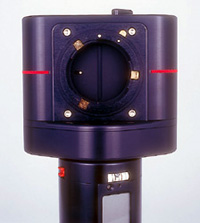
Lens mount, sans lens. Brass tab at upper right is lens
release. Small, sliding switch to the left of the exposing
slit selects high/low shutter speed range.
|
|
Degrees Of Rotation
The degree of rotation is selectable in 45Þ increments; the manual
suggests adding a 60Þ overlap at the beginning and 30Þ at
the end (90Þ total, or plus two 45Þ increments). This allows
the camera's motor to get up to full speed before the exposing slit
gets to the critical image area of your composition and ensures that the
slit is past the far limit of your picture before braking.
For example, if you want a full 360Þ image, set the camera for 450Þ
(10 increments of 45Þ). In practice, I found this to be a generous
overlap, but it does provide extra leeway for your final cropping. You
can get three such exposures on a roll of 120 film, seven on 220 (there's
a few inches of "leftover" film on a 120 roll that adds up
to the seventh exposure on 220). For motion studies, you can make exposures
extending beyond 360Þ; set at 999Þ, the camera will run continuously
through the whole roll.
Readouts
All settings appear on a LCD screen in the handle-like motor base (the
screen is absent in the Outdoor model). In addition to the degree of rotation,
the LCD readout shows effective shutter speed (rotation speed); film length
(120/220); frame counter (represented as remaining number of 45Þ
increments); state of charge of the rechargeable battery; 10-second start-delay
timer. Four buttons adjacent to the LCD display select or adjust the functions.
The top one (START) switches the camera on and triggers an exposure (it
can also be triggered via a remote release cord). The second is the MODE
button, which selects shutter speed, rotation angle, the delay timer,
"NEW," when loading a film, and "END" to wind
off the film after the last exposure. The bottom two are up/down buttons,
used to adjust the shutter speed and rotation values. There is also a
red main switch that prevents accidental exposure release and turns off
the power. When on, standby mode is automatic after 2 minutes.
|
| |
Top housing removed, showing film path. Note rubber drive
belts ("O"-rings) conforming film edges to
curved film drum.
|
|
Shutter Speed Range
Effective shutter speed range is 1/500 sec to 8 seconds on the 28/220;
the Outdoor model has only 1/60, 1/125, and 1/250 sec speeds. The "full"
28/220's speeds are divided into high and low ranges; to select
either, remove the lens and move the then-exposed small brass slide switch
to the left (outside) for slow range, right (inside) for high.
Actual camera head rotation speeds for a 360Þ exposure are 0.7 seconds
at 1/500 sec, 5 minutes at 8 seconds. At 1/60 sec, the rotation is 6 seconds,
which is about the minimum time that you can beat feet around your tripod,
staying out of range just behind the exposing slit as it rotates for a
360Þ or greater run; for faster speeds, set the 10-second delay
and run for cover, if there is any. For rotation angles of 225Þ
or less, just stand in the unexposed "dead spot" of the circle.
Film Loading
Loading a film is simple. Unscrew the large thumb screw atop the main
housing, then lift off the cover. This exposes the film feed and take-up
spool holders and the hinged pressure plate. From there, except for having
to swing the pressure plate out, it's pretty much the same as loading
a medium format film back. After inserting the paper leader into the take-up
spool, winding to the film's start mark and closing the pressure
plate, replace and secure the top housing. Then switch the red main switch
on, cycle the mode button to "NEW" on the LCD screen and use
the up/down buttons to select 120 or 220 film. Press the START button;
the camera head will rotate, transporting the film to the proper point
to begin the first exposure (transport to frame one differs on the Outdoor
model).
Do not rotate the head manually; film will be transported without being
exposed (e.g., wasted). There is no winding operation following an exposure
as with traditional cameras; at the completion of an exposure, the camera
is ready for the next. If you are bracketing exposures, however, you will
have to move the camera to the proper starting point for the composition
before each succeeding frame.
If your last exposure (rotation angle) happens to exactly coincide with
the remaining film length, a blinking "END" will appear on
the LCD screen. Push the START button to wind off; the camera head will
rotate three times in the process. More often, though, you will end up
with a remnant length too short for another exposure; to initiate wind
off, cycle the mode button to "END" and push the START button.
|
| |
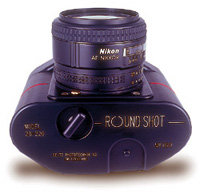
Top
view. Large key is screw that secures top housing to battery/control
base unit. Small button in horseshoe shaped recess is
spring-loaded, retains swiveling finder.
|
|
Evaluation
The Roundshot 28/220 performed flawlessly, as have all other Roundshots
that I've used. I consider the "full" 28/220 well worth
the $700 difference in price over the Outdoor model; the latter's
lack of slow speeds would be too limiting for the variety of subject matter
and lighting conditions that I regularly deal with, and the absence of
a full-function LCD read-out would be too "bare bones" for
me. Your needs, of course, may differ from mine. Tripod socket is 3/8".
The camera, which weighs 3.2 lbs without lens, comes with a battery charger
(10 hours for full charge with 110v model), remote release cable, and
hard transport/shipping case.
The 28/220 opens up a world of panoramic picture possibilities in cramped
locales that demand extreme coverage vertically as well as horizontally.
If you don't need the awesome vertical capability, with its attendant
rapidly receding background, then by all means investigate the several
other Roundshot cameras available; there are many specialized requirements
within the already specialized niche of full-rotation panoramic photography,
and Seitz Phototechnik builds a solution for nearly any panoramic problem.
Contact: Roundshot cameras
are distributed in the US by Custom Panoramic Lab, 1387-85 W. Palmetto
Park Rd., Boca Raton, FL 33486; (561) 361-0031; www.roundshot.com.
The owner, Peter Lorber, is a recent president of the International Association
of Panoramic Photographers and is extremely knowledgeable on all things
panoramic. And if you need to have your long pan negs professionally printed,
his lab is one of the few dedicated panoramic facilities in the country.
A Quick Guide To Full-Rotation
Camera Technique
· Level the camera carefully; a wavy horizon line is the penalty
for
not doing so.
· Use lens rise/fall (if available) to adjust placement of
horizon line.
· Choose a camera with a lens focal length (and therefore
perspective) best suited to the subject matter you shoot most
often (e.g., landscapes and groups vs. interiors and exteriors).
· The 220 (or 70mm) film capability avoids overly frequent film
changing.
· Check for evenness of lighting; overcast days or noon sun are
best for 360Þ compositions.
· Color negative materials best handle wide exposure variations
within a full-circle image.
· Negative materials require big enlargers (5x7" min) or specialized
panoramic printers.
· Avoid polarizing filters; the effect is disturbingly uneven with
large rotation angles.
· Flash is not an option; any supplemental lighting must be
continuous in nature.
· Slow shutter speeds can produce interesting blurs and/or
distortions of moving objects within the scene.
|