The "new" medium
format cameras shown at PMA '99 were, by and large, the same ones
previewed late last year at photokina and Photo Plus East. The good
news is that those early teasers are now beginning to arrive at your
local dealers as fully functioning production models.
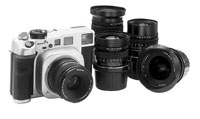
The Contax 645 is of chief note in this department. The camera has received
previous exposure in Shutterbug, so I'll just give you the capsule
refresher. It is the third autofocus 6x4.5cm format camera introduced
in the past year, but the first totally modular one, and the only one
that can boast of a "starter" line-up of six Carl Zeiss
lenses. The standard lens is an 80mm f/2 Planar T*; other focal lengths
include a 35mm f/3.5; 45mm f/2.8; 120mm f/4 Apo-Macro; 140mm f/2.8;
210mm f/4. This range corresponds to 21-131mm for the 35mm format; rest
assured that more optics are in the works. The full-information, 90°,
eye-level AE prism finder (95 percent field of view) comes standard,
though the TTL metering functions (ambient and flash, spot and center-weighted
averaging) are available with any finder, as the SPD sensor is located
within the camera body rather than in the finder. The eyepiece is adjustable
from -2 to +1 diopter, and can be extended with accessory diopter lenses.
Top shutter speed is 1/4000 sec, with X-sync at 1/125 sec. The integral
motor drive advances the film at 2.5 fps. Interchangeable film backs
are available in 120 and 220 versions (both with data imprinting), with
an optional vacuum insert for the 220. I found the Contax 645 to be
well-balanced, and the viewfinder brightness, especially with the 80mm
f/2 lens, rivaled many 35mm SLRs.
|
|
Mamiya rolled out the Mamiya
7 II, an updated model of their popular 6x7cm format rangefinder camera.
The new refinements include: high-visibility frame lines in the viewfinder
that remain clearly visible even in the presence of intense ambient light;
three strap lugs give the user a choice of vertical or horizontal orientation
of the camera; the cable release socket has been relocated to the more
accessible lower-right side of the body; multiple exposures are possible
via the change-lever system with safety lock; the exposure compensation
operation has been simplified; a ratchet mechanism and flip-out twist
wing for the darkslide curtain facilitate quicker lens changes. The Mamiya
7 II will be available in matte black and champagne gold finishes.
Also introduced was a new 50mm f/4.5 L wide angle lens for the Mamiya
7 and 7 II. The 10-element lens comes with its own accessory optical viewfinder
(with built-in level and diopter correction), as well as a bayonet-mount
lens hood. The lens accepts 67mm filters. It should be a natural in combination
with the optional 35mm panoramic (24x65mm) adapter.
|
| |
Cabin
3x loupe for 6x7cm.
|
|
Photographers who use 6x7cm
cameras have had rather slim pickings when it comes to finding a good
magnifying loupe with which to examine their transparencies and negatives.
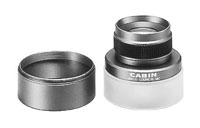
Mamiya has improved the situation with the debut of their 3x Cabin Precision
Magnifier. The focusable, three-element loupe covers full frame 6x7. It
comes with interchangeable opaque and translucent skirts for viewing by
transmitted and reflected light, and a removable neck cord. Mamiya also
offers the Pro-Cabin 67 Z projector for 6x7cm transparencies.
Pentax expanded the selection of autofocus optics for their Pentax 645N
camera to eight, with the introduction of three new lenses. The first
is the SMC Pentax-FA Macro 120mm f/4, which focuses down to 1.3'
(1:1 life size). A focus limiter permits dividing the focusing range (macro/normal)
for faster AF operation. The medium-telephoto range is served by the SMC
Pentax-FA 645 200mm f/4 [IF]. A SMC Pentax-FA Zoom 80-160mm f/4.5 seamlessly
covers the most-used range of focal lengths. The front lens element does
not rotate, facilitating the use of accessories such as a polarizing filter;
the supplied lens hood features a window that permits rotation of the
polarizer without having to remove the hood.
|
| |
NPC
Proback for Pentax 67 II.
|
|
Kiev USA announced two new
perspective control lenses and three new film backs for their Russian-made
Kiev 60 and 88C cameras. The PC lenses are available in 55mm and 65mm
focal lengths, and provide excellent optical performance at a fraction
of the price of similar lenses by other makes. They also fit Pentacon
and Exakta 66 cameras. The film backs are available in 120, 220, and 6x4.5cm
versions, and feature a darkslide storage compartment; the backs fit the
Kiev 88 as well as Hasselblads.
Rollei had no less than seven new lenses for their 6000 series cameras.
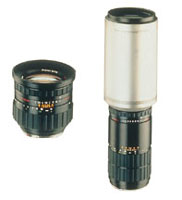
At the wide angle end of the range is the Zeiss 40mm f/4 Distagon FLE
(floating element) HFT PQ; the 11-element optic focuses to 0.5m and accepts
93mm drop-in filters via an adapter ring. Next is the Zeiss 50mm f/4 Distagon
FLE HFT PQ; the nine-element design also focuses to 0.5m, and accepts
Rollei bayonet VI filters. For portrait and low-light applications there's
the Zeiss 110mm f/2 Planar HFT PQ; this seven-element lens focuses to
0.8m and uses 95mm filters. The f/2 aperture lends itself to selective
focus techniques. For a long reach there's the Zeiss 500mm f/8 Tele-Apotessar
HFT PQS; it has five elements, an f/64 minimum aperture, a centered tripod
socket, focuses to 5m, and takes 86mm filters. The integral, matte-silver
lens hood contrasts smartly with the black lens barrel.
|
| |
Photogenic
PL2 Series PowerLights.
|
|
The other three new lenses
comprise Rollei's new EL-series of more affordable optics. There
are no optical quality shortcuts taken, as they use the same previous
PQ designs. Some recent innovations and manufacturing economies, such
as providing screw-thread filter mounts instead of bayonets, permit the
more user-friendly pricing. The three focal lengths offered cover the
most-used range with 6x6cm cameras. A Rollei 50mm f/4 Distagon HFT EL
consists of seven elements, focuses to 0.9m, and accepts 67mm filters.
The Rollei 80mm f/2.8 Planar HFT EL also features seven elements, focuses
to 0.9m, and takes 67mm filters. The last of the trio is the Rollei 150mm
f/4 Sonnar HFT EL, with five elements, 1.4m close focus distance, and
common 67mm filter size. Bayonet lens hood mounts are retained with the
EL lenses.
Rollei was also demonstrating their new Gamma C4 one-shot/multi-shot digital
back for 6000 series cameras. Performance was impressive, but, as with
all current digital backs of this professional/industrial caliber, you
could buy a very nice car for the same money.
|
| |
Free
Eye orbital lens shift adapter.
|
|
The Rolleivision 66 dual P
slide projector was on display, a fully automatic, autofocus 6x6cm machine
that can also project 35mm slides (not intermixed). Two projectors can
be paired with an external control unit for programmed AV dissolve presentations.
Beseler introduced a unique, 6x9cm format pinhole camera kit. Made in
Switzerland, it was designed by a professor at the Basel School of Design
who for 20 years used it to teach pinhole technique. Constructed of heavy,
die-cut cardboard, and supplied with a piece of metal shim stock laser-drilled
with a 0.3mm pinhole. An assembly manual and a roll of 120 Ilford black
and white film are included. This simple kit is a great class project
and teaching tool. At $39.95 it's also a good way to experiment
with pinhole photography, before deciding to shuck out for one of the
many wooden cameras available from various sources.
Polaroid announced the Polaroid Daylab 120 instant transparency printer,
a new medium format model of the well-known Daylab daylight printers.
Photographers can now use unmounted 6x6cm and 6x7cm transparencies (no
35mm) to make instant prints, image transfers, and emulsion transfers
on 3x4, 4x5, and 8x10 Polaroid materials, including SX70 manipulations.
Built-in, microprocessor-controlled, autoexposure via the unit's
integral electronic flash makes operation straightforward and simple.
The head uses separate acetate or gelatin filters, and is compatible with
previous Daylab bases.
|
| |
Excalibur
3200 monolight.
|
|
Another nominally medium format
item from Polaroid was a new single-use instant camera dubbed PopShots.
The compact, ergonomically shaped camera produces 10 4.4x2.5" color
prints. To take a picture, the user simply throws a bright yellow switch
to an indoor or outdoor setting (flash/no flash), composes the scene in
the viewfinder, presses the shutter release, then pulls a ring on the
side of the camera to eject the externally developing print. PopShots
features two apertures (f/32 outdoors; f/13.4 with flash), variable shutter
speeds, and real-time exposure metering. How will Polaroid encourage people
to recycle these instant cameras? By packaging a postage-free return mailer
with the camera; by entering all returns in a sweepstakes that offers
prizes such as CD players and a trip for four to anywhere in the world;
and a $2 coupon good for PopShots or other Polaroid products. A $4 rebate
is offered to customers who return the $19.99 (list) camera for recycling.
Giancarlo Gardin, of Milan, Italy, was showing a neat item called Free
Eye. It is a "universal, multi-format lens shifting system,"
which allows shifting the camera lens up, down, left, right, or diagonally
for perspective control applications. It can do so because it employs
an orbital arrangement of movement, rather than the usual rack movement.
In practice, you use lenses from the next larger format than the camera
you're shooting with, in order to obtain an adequate image circle
when shifting. For example, if shooting with a 6x4.5cm or 6x6cm camera,
use 6x7cm (or greater) format lenses. Although illustrated on a 35mm SLR
(adapted via T2 adapters), the device is applicable to most medium format
cameras, as well as some digital models. Southpaws can order Free Eye
with the clamping lever on the left for greater convenience.
|
| |
Profoto
ProBig reflector.
|
|
NPC has announced availability
of a new Proback for the recently introduced Pentax 67 II. The Proback
allows use of Polaroid proofing films, and does so without compromising
any camera features, or having to transfer any camera controls to the
back of the Polaroid film chamber. It is no longer necessary to pre-cock
the shutter before attaching the Proback, as it was with the previous
Pentax 67. The focal plane is shifted to that of the Proback via a fused,
coherent fiber optic bundle. It produces a full 6x7cm contact image. Due
to the design of the 67 II body, a new, double live pin hinge must be
installed.
JustRite has a new medium format camera bracket that highly mobile shooters
such as wedding photographers will line up for. One of those, "Why
didn't I think of that?" items, its signature feature, is
a set of four feet that let you set a camera/flash combination down without
having to lay your multi-thousand dollar investment down on its side on/in
camera-hostile environments (e.g. dirt, wet grass). Available in five
versions to accommodate high and low-profile flashes, and with fixed or
tilting head, the JustRite bracket features a comfortable rubber grip;
a camera quick-release; rubber-tipped feet to protect furniture; a flash
mount that positions the flash head directly over the lens axis; a mounting
platform on the flash arm for a radio remote transmitter for triggering
slave lights. The bracket is sturdy, well-balanced, and shows a lot of
thought.
Studio electronic flash units were well represented, both monolights and
separate power pack/head combinations, as well as a couple of impressive
reflectors.
|
| |
Rollei
Zeiss Planar 110mm f/2 HFT PQ and Tele-Apotessar 500mm f/8
HFT PQS.
|
|
Brandess/Kalt/Aetna (BKA) is
now the US distributor for the Bowens Esprit line of monolights, and is
introducing a new consumer promotion on their Excalibur monolights from
SP Systems. When purchasing an Excalibur 1600 (160 ws) or 3200 (320 ws),
BKA will give you a free 8', air-cushioned light stand, and a copy
of the SP Studio Systems Handbook. The book contains a wide range of pro
tips on various lighting setups, including product and glamour photography.
The Excalibur flashes are affordable units designed for the advanced amateur
and beginning professional.
BKA is also the new US distributor for Kenko filters and Red Wing lighting
products. A new Quick Stand from Red Wing is designed especially for wedding
photographers. Made of black-anodized aluminum, the stand opens and closes
automatically, with no need for locking knobs and levers or other height-adjusting
mechanisms. When set down, the legs extend; when lifted to move to another
location, the legs retract. The Quick Stand weighs 42 oz, extends to 94.5",
and collapses to 28"; it will support lights weighing up to 7.75
lbs.
Bogen debuted two new power packs from Elinchrom, the Chic 1 and Chic
2, with 1200 ws and 2400 ws ratings, respectively. The Swiss-made, compact
packs are 65 percent smaller and 50 percent lighter than their Elinchrom
Classic counterparts. Their power range is adjustable over six f/stops,
and recycling times have been improved. Three complimentary light heads
were also introduced, the Mini A, Mini S, and Mini R; the Chic power packs
are compatible with all Elinchrom pack heads, as well as all system accessories.
|
|
Also shown was Elinchrom's
Octa-Lite Pro Bank. This new stand-alone softbox consists of a EL 500C
Compact monolight and remote photo cell, coupled with a 74" diameter,
40 sq ft octagonal softbox. It integrates easily with other brands of
flash systems, sets up in two minutes, and offers the following performance
characteristics: less than 1/3 stop light falloff across the entire softbox
diameter; 500 ws output (f/16 at 6', ISO 100); power output infinitely
variable down to 1/4 power; 1/2600 sec flash duration; full power recycling
time of 1.6 sec; consistent color temperature throughout the power range.
The OctaLite provides a lovely "wrap-around" light quality.
Britek, importers of a very wide variety of economically priced electronic
flash and tungsten lighting equipment, was showing their HS-2000 monolight.
Features and specifications are as follows: 440 ws output; full, 1/2,
1/4 power settings; GN 200 (ft); slave, synch, test button; 1-3 sec recycling
time; 150w halogen modeling lamp; 1/900 sec flash duration. The HS-2000
accepts a full range of reflectors and accessories.
Paul C. Buff, makers of the White Lightning brand of electronic flash
units, was showing off their new X-Series and UltraZAP models. As the
company says, the new flashes are "brighter, lighter, quicker, tougher,
sleeker, and cheaper" than the previous Ultra models. And that's
quite a bill to fill. The UltraZAP 800 (330 ws) and 1600 (660 ws) are
the successors to the Ultra series lights. Beyond the new rounded contours
and sexy gold color scheme, refinements include a new single-ring flash
tube; improved ventilation for less heat buildup for higher reliability;
shorter flash durations; 10 percent more power than Ultras; an auto-dump
feature that dumps the excess charge when setting the unit to a lower
power setting; voltage regulated circuits; a single-lever reflector attachment;
dual umbrella holders, allowing the addition of counterweights when desired;
full remote control capability.
|
| |
Polaroid
Daylab 120 instant transparency printer.
|
|
In addition to the UltraZAP's
list of improvements, the X-Series, consisting of the X1600 (660/165 ws)
and X3200 (1320/330 ws) models, adds the following: power range switching,
which allows cutting 3/4 of the unit's power, for situations when
a wide aperture or very short flash durations are needed (the modeling
lamp intensity is reduced proportionately); a built-in cooling fan that
automatically kicks in when internal temperatures warrant; audible overheat
alarm; audible misfire alarm. And these are just the improvements, not
a full inventory of features and capabilities.
R.T.S. announced a new Profilux series of Multiblitz monolights. Following
the more power in smaller, lighter packages trend, the Profilux series
is comprised of three models: the 200, 400, and 600, with the model designations
denoting the power in ws. Features shared in common are: infinitely variable
power adjustment over a four stop range; ±1 percent repeatability;
auto dissipation of charge without having to fire the unit; fast recycling
from 0.4 sec; flash duration down to 1/1400 sec; built-in cooling fans;
UV-absorbing flash tubes; proportional halogen modeling lights; slave
cell with IR function; visual and audible firing monitor; color-coded
controls; bayonet reflector mount; tilt head with sure-grip brake. A comprehensive
system of accessories is available. The lights are also available in attractively
priced two-light location kits, including a 200/400 pairing or a 400/600
combo, along with two stands and two umbrellas, all housed in a soft gear
bag.
|
| |
Elinchrom
Chic 1 and Chic 2 power packs.
|
|
Photogenic launched its PL2
Series monolights, offering photographers an affordable option to set
and control their lighting setups from a handheld remote unit or a computer
screen. The PL2 Series lights include the PowerLight 1250 and 1250DR (500
ws), and the PowerLight 2500DR (1000 ws). The potent 2500DR offers infinite
power variability from 32 ws to 1000 ws, which is a full six f/stop range.
It also features push button control and a digital display for the flash
and modeling lamp. Both DR models accommodate exclusive add-ons that enhance
power, control, and versatility. One such accessory is a Digital Remote
Display and IR Receiver with touch control, which allows changing your
settings without having to lower boom-mounted lights, or attempt accessing
other inconveniently located lights within a set. Another boon is the
IBM and Mac compatible Wireless Studio System Software. This lets you
control your entire lighting setup from one centralized location, from
a desktop computer or, for location work, a laptop. It can control up
to nine PowerLights, and save files for every setup for future reference
or duplication.
|
|
AddMamiya America had some
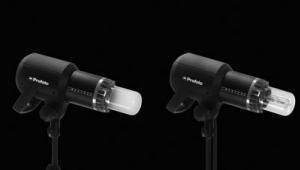
new items in their Profoto electronic flash line. A pair of compact but
heavy-duty flash generators (power packs) are the Profoto Acute 12 (1200
ws) and Acute 24 (2400 ws). Accepting three flash heads, power can be
distributed symmetrically or asymmetrically for various lighting ratios.
The head connections are arc-proof, and the packs can be plugged in to
any worldwide voltage from 90-260v. Regulated voltage assures constant
color temperature. The packs also feature a unique variable rate recharge
dial, allowing the photographer to steplessly adjust the voltage draw
and thereby avoid blowing fuses and circuit breakers when on location
with inadequate or old wiring. The units are also well sealed. The Acute
Head Special lamphead is fan cooled and comes with a zoom reflector.
The AcuteRing is a lens-surrounding ringlight designed for small and medium
format cameras. It can accept up to 2400 ws from an appropriate power
pack, and comes with a horizontally and vertically adjustable camera mounting
bracket. A Softlight Reflector and Close-up Reflector further increase
the AcuteRing's versatility. It comes with a 12' lamp cord.
|
| |
Privett
International Soft-Jaw clips.
|
|
For those occasions when a
direct window lighting effect is sought (sans window), Profoto has a unique
tool: the Profoto ProBig, a portable, folding, parabolic, focusable reflector.
With "Big" underlined, the reflector measures 7'2"
(86") in diameter when opened; it weighs 17.5 lbs, or 22.5 lbs in
a transport bag with an accessory diffuser and swivel mount. An adjustable
lamphead mount allows focusing the light for different effects and spreads.
It accepts Acute and other Profoto heads. When trying to create soft,
natural light there's no substitute for size, which makes the ProBig
just the ticket.
While in the process of covering our assigned equipment categories, Shutter-bug's
writers inevitably run across a few non-directly related items that we
feel worthy of inclusion anyway. My three candidates follow.
Most photographers, myself included, have long suffered with what I call
a "Will Rogers" battery tester--it never met a battery it
didn't like. By that I'm referring to batteries that won't
operate a camera, yet test just fine. That's because many cameras,
especially medium format models with motor drives, will only function
when the batteries are at absolute peak power. If your battery tester
doesn't test the batteries under load, they'll likely test
as nearly new. The ZTS booth had a quite reasonably priced solution, the
ZTS Multi-Battery Tester. Measuring 7.5x4x1.3", the tester can handle
more than 25 different batteries. It provides an accurate power load test
for alkaline, lithium, silver oxide, and zinc-air types, indicating the
remaining capacity of the test battery in percentages. The tester is simple
to use, with no settings or switches to ponder. Finally.
|
| |
ZTS
Multi-Battery Tester.
|
|
It was in the area of the show
devoted to industrial film and print processing equipment that I stumbled
upon the Privett International booth. Their display featured a large selection
of beautifully made film clips designed for "dip-and-dunk"
film processors. While they have models with traditional teeth for grasping
film leaders, it was a line dubbed "soft-jaw" that caught
my eye. Anyone interested in them for their intended purpose will be more
than pleased, but another use came to mind. When adjusting muslin and
other fabric backgrounds for portrait shoots, I often need to clip one
or more heavy fabrics into position relative to one another. My previous
solution was the orange- handled, chrome "pony clamps" available
at hardware stores. However, the Privett Soft Jaw clips are available
in single, double, and quadruple clip models in several different configurations,
which would let me clamp several fabrics or folds at a common spot. There's
also a single model with a hook that could hang from a support rod or
line. Tension is very firm, yet the silicone rubber roller jaw faces won't
tear the fabrics. This type of rubber will even survive Los Angeles'
industrial strength air without disintegrating. You can probably think
of more possibilities in your own work.
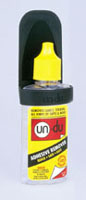
Lastly, there's un-du. A creation of Doumar Products, it is an adhesive
remover with a difference. No matter what dastardly sticky label or price
tag (not glued labels such as applied to jars and bottles) is clinging
to something you wish it wasn't, un-du will probably make short
work of it. It is photo-safe and acid-free, and leaves no residue. It
tackles masking tape, duct tape, cellophane, and "invisible"
tape, even chewing gum, tar, and candle wax. Its unique characteristic
is that it only temporarily neutralizes the offending adhesive; after
it dries, the "stickum" is good as new. The applicator bottle
has an attached scraper, which directs the liquid underneath the target
subject and makes lifting it away intact easy. Un-du has garnered several
awards, and will be a welcome discovery to many photographers. |