| |
Not
really a candid, but a little different bridal portrait.
I loved the light and used the veil and open space as
design elements.
Photos © 1998, Steve Bedell, All Rights Reserved
|
|
What started as a trickle
has become a full-fledged stream. Just a few years back, black and white
candids were unheard of at weddings. Then, as the visually sophisticated
public began seeing how distinctive black and white photos looked in
the ads in lifestyle magazines, we started getting a few requests. Each
year, we had more clients requesting black and white coverage in addition
to the color photography. Now, we shoot black and white at almost every
wedding. My experience is mirrored by other photographers across the
country.
Now you see music videos completely in black and white. Some of the
slickest car ads on TV are monotone. Martha Stewart likes it. Face it,
black and white is the "cool" thing right now and if you're
not offering it in your wedding and portrait work, you're missing
the boat. Clients perceive, correctly I think, that black and white
requires a higher level of artistic and technical ability than color
negative.
I wrote several months ago that I had been conducting business the past
seven years without a darkroom. Because of the much greater demand now
for black and white, I am in the process of setting up my first darkroom
in years. I still intend to have as many of the routine chores as possible
outsourced since I believe photographers make the best use of their
time by shooting. But there are times when you just have to do things
yourself. Maybe you need it in a hurry, need it cropped just right,
need a special paper surface, or just want the pleasure of printing
it "just right." There are labs and printers who specialize
in quality black and white work, but expect to pay a premium for the
good ones.
|
| |
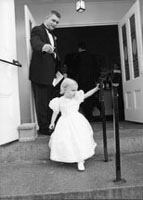
This
is the kind of shot you must be able to take instantaneously.
I like the way it captures the little girl lost in her own
thoughts just before the wedding is to take place. (Taken
with a Nikon 6006N; 28mm lens; Kodak T400CN.)
|
|
If you're rather new
to shooting and have cut your teeth on color negative films, go out and
shoot a few rolls of black and white for practice before trying it on
a client. While it may seem obvious to most of us, shooting in black and
white requires a whole new mindset. You have to learn to "previsualize"
a scene in shades of gray, and you've got to do it in a hurry. This
ain't Ansel Adams here. By the time you've set up the 8x10
camera, metered the scene, determined the filtration, figured the exposure
and development times, and loaded the film, the wedding is over. You've
got to shoot fast, like you were covering a news event or maybe Sharon
Stone's shirt opened for half a second and you got it. Think "decisive
moment" vs. pristine landscape. Be more concerned with capturing
emotion than perfect light. Forget posing and capture people how they
really are. Go for the three Es--Expression, Emotion, and Excitement.
Shoot the "formals" and groups in color so Grandma can get
her 5x7. Shoot the candids and "artsy" stuff in black and
white.
Now let's talk a little about equipment. While I know some photographers
who shoot the black and whites on the spare Hasselblad, I prefer using
35mm. The reasons are because the main advantages of the 35mm format make
it the perfect marriage for photojournalistic shooting. These advantages
include lightweight, fast lenses, zooms of all focal lengths, great film
selection, long rolls, motor drives, autofocus, and autoexposure. Plus
you don't need top of the line models or lenses in most cases, so
cost savings are significant. The disadvantages of the smaller format,
such as apparent grain and print quality, are not really factors here
since most clients like the grain and usually the print sizes are 8x10
and smaller.
With that in mind, at the risk of shocking you, let me tell you about
my decidedly low-end equipment. Remember, this is in addition to my extensive
collection of medium format gear and lighting equipment. I use a Nikon
6006N camera with Nikon 28 and 50mm lenses. I have an adapter to connect
a PC cord to the camera, bypassing the built-in flash. I also have a 70-300mm
Sigma zoom lens. That's it. I usually put it on Program and just
shoot it. We're talking about a total investment of maybe $1200,
and it's all stuff I had lying around anyway. Most pros probably
have an even better selection of equipment hanging around if they've
been in business a few years. The point is it works for me and I'll
probably continue to use it and maybe add another body. As in all photography,
your eyeball is the most important piece of equipment.
|
| |
Linda
Delaney Snyder at a candid moment before the reception.
(Nikon 6006N; 50mm lens; Kodak T400CN.)
|
|
As far as films, my current
favorites are Kodak T400CN film, a cousin to Ilford's XP2 chromogenic
film, and Kodak TMZ3200. I like the CN film because I can bring it to
my local lab and they can run it through their C-41 processor right next
to Aunt Millie's color pictures of her cat--only mine won't
have the horrendous redeye. Then they can print it on color paper as black
and white or dial in a "browntone" or sepia look to it. Kodak
even makes a special Ektamax paper for proofing purposes for this film.
I used to have my prints made with a toned look, but I found the labs
I was using to be very inconsistent, so I now just stick to black and
white.
Of course, that's the only choice you get with the 3200 speed champ.
I love this film because you almost never run out of light using it. Clients
like it as well because they're used to seeing the grain effects
in Town And Country, so if it's OK for the magazine, it works for
them, too. But the other big reason I like this film is because I don't
like to use flash with my black and whites--the existing light look is
so much more artistic looking than a direct flash. I'm experimenting
now with using bare-bulb flash, if I really need it, but I really prefer
not to use anything because then I need brackets, battery packs, and other
obstacles to picture taking.
By now, I hope my sharp-eyed readers will be wondering a couple of things.
First, how do I decide which pictures to take in black and white, and
second, how can I carry medium format and 35mm gear at the same time?
The answer to both questions is--it ain't easy. When I first started
shooting with both formats, it wasn't so tough because I'd
usually just take a roll of candids when my "necessary" pictures
weren't occupying my time. Things are different now. I may shoot
3 to 4 rolls of 36 exposure film and the photos must reflect the whole
day, not just Uncle Joe headfirst in the punch bowl. Plus, every year
my clients expect more photos--color and black and white. What's
a wedding photographer to do?
I'll tell you what I do and what I think it's coming to. I
ain't Superman. I wear my Nikon on a strap hitched up higher than
Pee Wee Herman's pants, so it won't hit the "big"
camera. I carry my Bronica SQ-Ai by the flash bracket and have a battery
pack clipped to my belt. I try to do my amazing "man with four hands"
trick to be able to shoot both cameras at the same time, but I can't
do it. That's not usually a problem, since I won't shoot the
same shot in black and white and color, but sometimes I want them mighty
close or I'd like a different angle of the same scene. The solution?
While I shoot most of the candids, there are times when I'd like
to have black and white shots taken while I'm doing the color work.
Not being able to be in a parallel universe at the same time with myself,
I have my assistant shoot at those times when it's physically impossible
for me to. I do this as little as possible, since my clients pay for me,
not my assistant. And since I often travel quite a distance for my weddings,
my assistant is usually my wife, Lorraine, who's not really a photographer.
See why I try to keep that shooting to a minimum?
Of course, the real solution is going to now be to add at least another
$500 to my fees so that there are really two photographers at the wedding.
Even then, I'll have to increase sales substantially to cover additional
costs.
Which brings us to our next consideration--selling it. I'm not really
fond of mixing color and black and white prints in the same album, I find
it jarring. So what do you do? I know of some photographers who market
the black and whites as a completely separate album, so I'm going
to start doing the same. I think a plain, black album of 4x6s or 5x7s
is very elegant looking. Another option is the Art Leather photo box.
You can even "window box" a print on the cover for a nice
touch.
I know some photographers who are even shooting black and white infrared
films at weddings for a unique look. I like it and may add it to my repertoire
later, but now I have my hands quite full. I also know a photographer
who is "cheating" on his black and whites. He shoots everything
in color, then picks out about 20 or so he thinks will look good and has
them converted to black and white before showing them to the client. If
you want to add black and white to your services, but don't have
anything to show prospective clients and it's out of season, you
may want to consider doing the same thing for some samples before you
can add the "real" thing.
Black and white at weddings is not going away. It's getting more
popular each year and if you don't offer it, it's going to
cost you jobs. It's not easy to offer both at the same job, but
hey, who said weddings are easy anyway?
|