| |
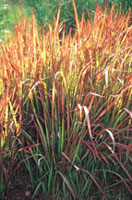
This
cluster of tall grass at a local flower garden was strongly
backlit with shade in front, so I put the camera on auto
bracketing. The normal exposure turned out the best, but
the bracketing feature assured me of having one really
good exposure. (Maxxum XTsi, 28-80mm lens at about 70mm,
program automatic on Agfachrome RSX 100.)
Photos © 1999, Robert E. Mayer, All Rights Reserved
|
|
The Minolta AF SLR cameras
are aimed toward the entry photographer just purchasing their first
SLR as well as more experienced individuals already owning some Maxxum
equipment who need an additional camera body. Actually there are two
practically identical lightweight models, the Maxxum XTsi and HTsi.
The first thing you notice about these cameras is how small and lightweight
they are when compared to the previous "si" models.
Both of these cameras combine the user-friendly features found in the
Maxxum 500si base model with the more sophisticated capabilities found
in the advanced Maxxum 800si. Both feature smooth autofocusing using
a three-point Crosscut AF sensor that uses two sensors for better reading
of contrast information for more accurate autofocusing.
The operating controls have been separated according to their functions.
More basic operations of subject program modes and automatic functions
are found on the right, or grip side, of the camera. More advanced functions
are all accessed by a dial on the left side plus two buttons beside
the lens. This intuitive control layout provides quick, easy operation
for any skill level.
Both cameras offer rapid subject-program mode selection by accessing
one of the five well-marked pictographs (icons) found along the top
edge of the large LCD data panel. These include: portrait, landscape,
close-up, sports action, and night portrait. By simply pressing a small
button beside the LCD an arrow moves from one icon to the next. Once
the appropriate icon is selected, the camera will automatically select
the best shutter speed and lens aperture for the situation, leaving
the photographer to only have to decide upon the subject composition
within the viewfinder. If you ever want to return to the default basic
program mode, simply press a large button labeled "P" just
above the LCD which resets everything instantly.
|
| |
The
way the setting sun briefly struck my granddaughter Amy's
face looked like she was in a spotlight. The nice smile
makes her look like she felt she was on stage. The cameras
metering compensated for the small bright sunlit face against
the dark clothing and background to produce an excellent
exposure on this quick grab shot. (Maxxum XTsi, 28-80mm
lens at about 70mm, program automatic on Kodak Ektachrome
Elite 200.)
|
|
Each camera has a sophisticated
14-segment honeycomb-metering pattern normally only found on higher priced
AF SLR models. Logic technology continuously adjusts the metering pattern;
weighing each segment according to the scene, subject's position
in the frame, and the lighting conditions.
For rapid, practically instantaneous, response after switching on, the
XTsi model includes eye-start automation. This cancelable feature informs
the camera to activate both the autofocus and autoexposure systems immediately
when it detects that the photographer's eye is close to the viewfinder.
Then everything is ready to operate the instant the user frames the subject
in the finder and decides to make an exposure. This can be a very helpful
feature for fast-paced action or similar situations when you want to rapidly
capture a fleeting image before it disappears.
Having a more powerful motor drive than found in previous entry-level
models, these cameras feature an improved maximum continuous drive speed
from one to two frames per sec.
Nine easily set custom functions permit each photographer to tailor the
camera to conform to his or her shooting preferences.
The XTsi model also offers an user selectable grip/eyepiece sensor-start
feature. It even includes a date back so you can imprint the date or time
onto the lower right corner of the film image. A switch on the end lets
you shift a film-plane mask inside the camera and the viewfinder for panorama
cropping of the image. An electronic remote control socket and flash compensation
round out the additional features found only on the more advanced model.
It's rather nice having the date function and panorama built-in
so you can use these optional features when dictated by the subject, or
the need to record the date permanently on any frame of film.
|
| |
Another
part of a local public garden provided an excellent situation
when the panorama format could be used to capture this mass
of red blossoms. (Maxxum XTsi, 28-80mm lens at about 50mm,
program automatic on Agfachrome RSX 100.)
|
|
Merely turning the left control
dial to the Multiple Exposure (ME) and exposure bracketing symbols does
not immediately bring these handy features into use. You also have to
press in on the central Func button in the middle of this dial, then turn
the knurled dial in front of the shutter release. The LCD panel will then
show both icons with either Off or one or the other of the two icons indicating
that feature is in use. As a reminder, the active icon will still remain
visible on the LCD until it is canceled after use. The only exposure bracketing
offered is by 1/2 stop increments, but this is more than adequate for
most conventional lighting situations. I found it effective and simple
to access when I purposely selected some severely backlit subjects, which
I felt, might challenge even the sophisticated 14-segment honeycomb patterning
metering on sensitive color slide film.
If you want to be selective in the autofocusing area and not use the standard
wide area, three sensor system, simply press in and hold down a large
button on the back labeled "AF" to engage the center circle
focus area focusing. This will lock and hold the focus and exposure and
you can recompose the subject off-center.
Sometimes you want to use selective metering found in the center spot
of the viewfinder without also locking the focus. To do this, just press
your thumb on a button labeled "Spot" located just below the
LCD. Now the spot metered reading is retained until you make an exposure,
or release the button.
|
| |
My
brother takes in stray animals until the owners can be found.
This black cat kept a wary eye on me for several pictures,
then decided I was no threat to his tranquillity. The program
automatic flash exposure brought out his whiskers and fur
detail vividly. (Maxxum XTsi, 28-80mm lens at about 70mm,
program automatic on Kodak Ektachrome 400X.)
|
|
Exposure compensation is available
for bright scenes such as those encountered at the beach or in snow, which
can bias any camera's metering system. To activate this feature,
press in on a button beside the lens labeled "+/-" then turn
the control dial below the shutter release until the desired compensation
value appears in the LCD panel. Up to three stops plus or minus is available
in 1/2 stop increments.
Most photographers use their flash as the main and dominant light source
for taking pictures in low-light situations. But this is normally combined
with a faster synch shutter speed, which does not take the background
illumination into consideration resulting in a properly exposed person
in the foreground against a darkened background. For more realistic pictures
you should first meter the background then provide the proper amount of
fill light for the foreground subject. To accomplish this quickly, simply
press in and hold the "Spot" button for slow synch flash fill
balanced to ambient light. The camera will select the proper shutter speed
to record the background, then fire the flash to balance with the background
for a far more pleasing picture.
As is the situation with many of today's cameras having a tiny pop-up,
built-in flash unit that's not much above the camera body, when
used with some zoom lenses at their wider focal lengths the lens can cast
an arched shadow in the lower portion of the image. This is more likely
to occur when the lens hood is left on the lens. The instruction book
even lists several lenses with hoods that should be removed when using
the built-in flash. The 28-80mm lens with this camera did cast a shadow
when the hood was left on at the 28mm focal length.
Practical Test Results. During a month's testing of the Maxxum XTsi
I was provided a 28-80mm f/3.5-5.6 zoom lens. I exposed many rolls of
sensitive color slide films including Agfachrome RS 50; Fujichrome Velvia
50; Kodak Ektachrome E100S; Ektachrome Elite 100; new Elite Chrome 200
Select; and Ektachrome 400. All of the color slide film was processed
by Accu-Color Lab Inc., Fort Wayne, Indiana. In addition, I exposed several
rolls of Kodak Gold 100 color negative material since this will be the
prime film many typical customers will expose. I also used some older
Maxxum mount lenses I have including an MC 70-210mm f/4.5-5.6 Vivitar
to be sure this new camera operated properly with older lenses, too. In
addition, I used my Metz 45CT-4 handle mount flash when additional flash
intensity was needed.
Rudimentary brick wall testing with the camera on a sturdy tripod, with
autofocusing of the lens wide open on aperture priority automatic exposure
showed excellent detail across the image area at 28, 50, and 80mm. There
was a bit of barrel distortion at the 28mm setting and a slight bit of
darkening on the corners. Stopped down to f/11 the detail was also excellent.
At 28mm the flash produced slightly darkened corners, but this is an extremely
severe test photographing a flat, blank subject, something that would
seldom be done in actual routine shooting. As the instructions warned,
there was a dark rounded area in the lower portion of the image when the
flash was used at 28mm with the lens hood on. When the lens hood was removed,
there was no shading at this focal length. The lens hood does not cast
a shadow into the lower portion of the image frame at any other focal
length.
All of my test images were consistently sharply detailed across the film
frame and precisely on target when the standard three-point autofocusing
was used. For unusually positioned off-center subjects the handy focus
hold feature was employed. Exposures were proper under all types of lighting
conditions outdoors in sunlight or cloudy bright conditions, or inside
using only existing light with the automatic flash canceled. The autofocusing
was rapid and accurate and I did not encounter any unusual condition that
challenged it even though I purposely took a lot of low-light level interior
situations using fast ISO 400 film with the flash canceled. The autofocusing
speed and accuracy was impressive with the standard zoom lens and my older
Vivitar lens to say the least.
The tiny, pop-up built-in flash was convenient to have immediately available
when some fill light was needed for strongly backlit outdoor portrait
or flower close-up subjects. Often when this type of situation is encountered
and you only have an auxiliary shoe mount or PC cord flash, the flash
is not nearby, or it's too much bother to pull it out of the gadget
bag and connect it to properly illuminate the backlit subject. So you
just shoot and don't bother with the extra illumination. Having
a built-in flash eliminates this dilemma. The camera's metering
was so smart, the flash would pop-up by itself when exceptionally strong
backlighting was detected. If this did not happen, I could simply press
the flash button, turn the knurled control dial, and the flash pops up
to produce proportionally balanced fill suitable for the dominant light.
In every one of the dozens of situations when I used this synchro sunlight
feature, the exposure was excellent with just the proper amount of fill
light to balance with the prevailing existing light.
The tiny flash also did a respectable job when it was the only light source
for interior subjects, or outdoors at night, but the usable range with
ISO 100 film and a f/4 lens was a rather limiting 3.3-9.8'. I also
used my powerful SCA 333/2 AF dedicated Metz 45CT-4 handle mount flash
when brighter or off-the-camera flash was needed and as was anticipated,
it worked perfectly in TTL automatic mode again producing excellent exposures.
It was even possible to use the camera with AC powered studio flash units
by jury rigging a peanut slave sensor inside a white shield taped around
the built-in flash which was used to trigger the other units.
The XTsi which we tested has a less expensive kissin' cousin HTsi
model which is all black, does not have the eye-start automation; panorama
capability; built-in data back; and it does not offer remote operation.
Otherwise it is nearly identical in size and weight to the more full-featured
XTsi model.
|
|
The suggested list price for
the Minolta Maxxum XTsi with 28-80mm f/3.5-5.6 zoom lens is $880; body
only is $598. The similar black HTsi model, with the same zoom lens, lists
for $770. Contact Minolta Corporation, 101 Williams Dr., Ramsey, NJ 07446;
(201) 825-4000; accessing their Photofax at (800) 528-4767; or their web
site at: www.minoltausa.com.
Technical Specifications
Minolta Maxxum XTsi
Lens Mount: Minolta A-type bayonet mount
Autofocus Type: Minolta's TTL phase-detection system
with three-point CCD sensors AF Sensitivity (ISO 100): EV-1 to 18
AF Illuminator: When raised, flash fires to aid focusing
in low-light situations
Exposure Modes: Programmed AE (P mode); Aperture-priority
AE (A mode); Shutter-priority AE (S mode); Manual (M mode); plus bulb
setting with metering index
Metering Modes: 14-segment honeycomb-pattern metering
with spot metering available
Film Speed Range: Automatic setting for DX-coded films
ISO 25-5000
AE Lock: Exposure locked automatically with focus lock.
Spot AE locks with Spot button
Flash Compensation: +/- 3 EV in 1/2 stop increments
Shutter Type: Electronically controlled, vertical-traverse,
focal-plane shutter
Shutter Speed Range: 1/4000 to 30 sec, bulb
Flash Synch: 1/125 sec or slower
Flash: Built-in pop-up; GN 39 (in feet ISO 100); coverage
28mm lens; recycle time three sec; pre-flash for redeye reduction available
Viewfinder Type: Roof mirror with built-in LCD panel
on left side
Focusing Screen: Acute-matte, non-interchangeable
Field Of View: 90 percent of film frame
Drive Modes: Single-frame advance; continuous advance
(up to approximately 2 fps); multiple-exposures
Self-Timer: Electronic with approximately 10 sec delayed
release
Displays In Viewfinder: Panorama format internal mask
in viewfinder
Power: Two 3v CR-2 lithium batteries
Dimensions: 5.3x3.5x2.4"
Weight: 13.6 oz (without battery)
|