


- REVIEWS
Camera Reviews 
More Reviews Mobile Reviews Photography Reviews - GALLERIES
- VIDEOS
- BUYER'S GUIDES

The Lowdown On Inkjet Paper; What You Need To Know, But Probably Never Asked
In the decade or so since I purchased my first inkjet photo printer, and in all the years I have been writing about digital photography, the one topic I have seen the least written about, and received the fewest questions about, is inkjet paper. I often wonder why photographers are so incurious about the one item that has now very likely replaced film as the one, true hard copy of their image. Perhaps photographers think that "paper is paper" and that it matters little what kind you print on, or perhaps photographers assume they have to use the printer manufacturer's brand, and leave it at that. Or it might be that paper is so thoroughly a part of the world we know, a part of our culture for centuries, that it's not something that needs questioning.
Perhaps these reasons make little sense to me because I have been doing photography for a long time with much of it in black and white, which I always processed and printed in my own darkroom. That experience taught me that the choice of which kind, surface, and brand of paper I printed on made a significant difference in the character and quality of my prints. I find the same to be true since I have been making prints, now mostly in color, with inkjet printers. And although the web and other virtual means of reproducing a photographic image have become significant, I think a large, high-quality print, like in the analog days of film,
is still the ultimate, pinnacle result of a photographer's use of the photographic process.
|
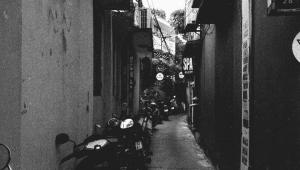
Back Street
|
|
 |
|
|
All this means that I continue to take a keen interest in the paper I print on. And I must add that paper for inkjet printing today offers more latitude for varying the way a print looks than any other options available. Unlike most consumer photo products, inkjet paper selection is large and diverse, and not at all dominated by large, indifferent, faceless international corporations--although there are a few involved, mostly behind the scenes.
My goal in this article is to encourage you to understand more about inkjet paper so that you can select the best paper to create the most satisfying prints possible. I also expect that I may rock a few boats by revealing some little known aspects of what inkjet papers are and what they are made of, and how some achieve extraordinary print performance and others do not.
What Is Paper And What Is Not
The word paper comes from its first form used for writing made from an Egyptian reed plant called papyrus, which is estimated to have been first used around 4000 B.C. Papyrus scrolls and codices, besides giving archeologists invaluable insights through ancient documents into the distant past history of Western civilization, very likely contributed significantly to our civilization's progress more than most historians will admit. Papyrus was surely a part of Rome's interest in Egypt as it remained the primary source for writing materials and communications for centuries. And possibly a shortage of papyrus supply may have contributed to the fall of the Roman Empire by making the administrative regulation of it more difficult, or so some have suggested.
Writing material remained important to civilized life as papyrus was replaced by parchment and vellum made from sheepskins and goatskins by means of a roughly related process. Parchment and vellum was the mainstay for the Church in medieval times; it was used by monks to copy what we now refer to as illuminated manuscripts that recorded and preserved the scriptures and commentaries of religious scholars as well as the knowledge of those times.
Paper made from plant pulp, the basis of which is now a familiar medium, was invented in China about A.D. 200 and was first introduced farther west by the expanding Muslim world about 500 years later. The knowledge of pulp paper making using a variety of plant sources, including rice, hemp, jute, cotton, linen, and wood, gradually traveled west and eventually into Europe, providing a physical basis for the dissemination of knowledge; a social and cultural revolution was set off by the invention of interchangeable type and the modern printing press.
|
Detroit
|
|
 |
|
|
That paper manufacture was mechanized and industrialized in the early stages of that revolution is attested to by the fact that some current mills in Europe have been in continuous production since the 16th century, the best known to digital photo printers being Hahnemühle, in Germany. In addition, mills in France and Italy as well as Asia, some with similarly long histories, continue to make fine, handmade papers by traditional methods, as well as more modern processes, for use primarily by artists and specialty book publishers. Even though the papers made today are manufactured in ways somewhat similar to their ancient antecedents, and the end product has a familiar character like papers made long ago, modern technology has also been applied to the process.
Resin-Coated Paper
My first encounter with a polyethylene (resin)-coated printing paper was in 1952 as a US Air Force enlisted technician on my first assignment. I was the sole photographer in a small engineering group attached to a maintenance squadron with diverse responsibilities. The first thing I did on this assignment was familiarize myself with the small darkroom I had to use to complete my assignments. In doing so I discovered a very large stock of 10x10" paper made by the Haloid Corporation, which had a typically long military nomenclature, indicating it was water-resistant, rapid-processing paper for contact and enlargement printing.
I tried printing on this rather strange, rubbery-feeling paper, and after reading about it in the official manual came to understand it was expressly made for reproducing aerial photographs in wartime, when reconnaissance of the enemy had to be accessed as quickly as possible. Although it did process, wash, and dry rapidly as the manual suggested, the print results, optimized for maximum aerial photo detail (flat), did not impress me nor did I like the feel of the paper. I was used to making single-weight paper prints that were glossed dry on a ferrotype drum.
|
Lake Powell
|
|
 |
|
|
After finishing my four years in the service, and then college and photography school, I pretty much forgot about RC (Resin-Coated) paper until it became available as a standard product from Kodak, Ilford, and Agfa. However, as a practicing photographer, and doing all of my black and white processing and printing personally, I found my clients preferred fiber-based, double-weight, air-dried prints. By then, on the other hand, whenever I had a color assignment that involved prints, they were lab made on RC paper that was machine processed. RC dominated color for the simple fact that RC paper could be automatically and rapidly processed by machines. That led to the ubiquitous minilab offering almost instant results at low cost; this secured a place for RC papers with many photographers to the point where they assumed that RC was the correct look and feel for their prints.
Then, with the advent of digital computer-driven photo inkjet printers, many, if not most, photographers wanted the resulting prints to have the look and feel of those familiar RC prints. This was their taste and choice, despite the fact that there is no practical advantage because the paper printed with an inkjet requires no development and processing by a machine. Simply put, RC paper is offered by inkjet printer companies and paper suppliers because it has the look and feel of a "photograph."
Today many companies list their inkjet offerings under two categories: "photo paper" for all of the varieties of RC paper, including premium high gloss, semigloss, and luster, or some finely textured variation; and "art paper," including all of the better grade fiber-based papers. Even though polyethylene RC papers have no functional, practical advantage used with inkjets, the popularity of their look and feel is made more so by the fact they are generally less costly than fiber-based papers. This may change, considering polyethylene plastic is made from petroleum and crude oil prices keep rising and are likely to keep rising. But prices for natural fibers from wood, cotton rag, and other sources also continue to rise due to raw material scarcity.
|
Trollies
|
|
 |
|
|
How Long Will They Last?
Photographers have come to question how long inkjet images will last (although this was not always the case). Specifically, they should be asking how long polyethylene RC paper supporting those images will last. Unfortunately, there is no test (like that used by Wilhelm Imaging Research to test the life of an inkjet image) that can be applied to paper to simulate, on a highly accelerated scale, all of the factors that affect paper aging and deterioration. However, if anyone wants to look, there is a large body of expert witness data to the conclusion that RC paper is not stable and can be quite short lived. In fact, one of the largest collections of this information is stored in the Wilhelm Imaging Research archives on The Permanence and Care of Color Photographs, beginning on page 575, Chapter 17: "Display and Illumination of Color and Black-And-White Prints--The Alarming Light-Induced Image Discoloration and Base Cracking of B&W RC Prints on Long Term Display" (online at: www.wilhelm-research.com/pdf/HW_Book_17_of_20_HiRes_v1a.pdf). This 50-page chapter contains some enlightening quotes from David Vestal, Ansel Adams, and W. Eugene Smith.
| |||||||||
|

| ||||||||





































 FEATURED VIDEO


Get the Latest Photo Tips, News & Reviews from Shutterbug!






| Camera Reviews Other Reviews | |
Mobile Reviews Photography Reviews Columns | |
News | |
Features | |
How-To | |
Resources |
 © 2025 Shutterbug
AVTech Media Americas Inc., USA
All rights reserved