| |
Ruby-throated
hummingbird in Nashville, Tennessee.
Photos © 2004, John Isaac, All Rights Reserved
|
|
John Isaac has lived more
than one lifetime and in his new incarnation he may just be one of the
happiest guys in the world. After 20 years traveling as chief photographer
for the United Nations (UN), Isaac has left behind the sadness and violence
he saw in places like Bosnia and Rwanda that brought him to the edge
of a serious mental breakdown. Since he retired in 1998 he has been
sampling and documenting the basic pleasures of nature and our environment.
On one day he negotiates with a brilliantly colored kingfisher, cajoling
the bird to please wait before he downs his freshly caught little fish
so Isaac can grab his picture. "Sashimi in Kashmir" is one
of the many bird photographs in Isaac's latest body of work.
|
| |
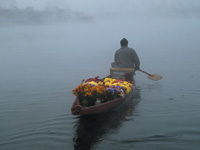
A
flower vendor during the early morning hours in the mist,
Kashmir.
|
|
The next day, alerted by the
evocative warning call of a peacock, he quietly tracks a tiger in the
jungle of Ranthambore, coming up on the sleeping cub who opens his eyes
as he is alerted to Isaac's presence. Isaac grabs his shot from
15 ft away, catching a reflection of the animal's eyelashes on his
half open eye as he lies in the bush.
Crouching a few feet away from a sleeping tiger may not be everyone's
first choice on their "what I want to do today" list but for
Isaac it is Nirvana.
|
| |
Women
and children waiting to get on a boat after shopping in
Dal Lake, Kashmir.
|
|
A Long Road Well Traveled
He has traveled a long road from the day he left India 35 years ago and
landed in the US with a guitar and 75 cents in his pocket, his head brimming
with dreams of becoming a folk singer. At a local concert in New York,
an onlooker who worked at the UN liked his rich baritone and suggested
he audition for the UN chorus. She also offered him a job to work as a
messenger at the UN. Isaac took the job and joined the chorus. The rest
is history.
When his brother sent him a Pentax camera in '72 Isaac learned the
art of photography and six months later he submitted his first portfolio
to an international photography contest at the UN and won first prize,
a Leica M5 camera. "I couldn't afford to buy a lens for it,"
he recalls, "so I sold it, bought a little Minolta and three lenses,
and there was still money left over." Promoted to training and printing
in the darkroom, Isaac achieved the grand status of washer-dryer of prints
at the UN. He also took a three-day seminar with Ansel Adams and a printing
course with George Tice.
|
| |
Moonrise
in Srinagar, Kashmir.
|
|
Winning a gold medal at the
photokina International Photography Contest in Germany in '78 prompted
the UN to send Isaac to the Middle East to cover the Israel-Lebanon conflict,
his first assignment. Stories documenting the Vietnamese boat people,
the crisis in Ethiopia, and other trouble zones around the world followed.
A Personal Journey
Isaac's latest project is a personal journey back to India where
he has photographed many times since he left 35 years ago. "Kashmir
will be the theme for my new book," he says. "It is a unique
place, one of sheer beauty. Its capital, Srinagar, is like Venice--90
percent is water and people live in their boats. Almost all of my photographs
are taken from a boat where I have rigged up a tripod. I can sit down
and photograph the beautiful bird life and the floating markets that have
been there for hundreds of years. I go often in the early morning fog
as the sun rises over Kashmir and when the boatmen are heading for the
common location. People come in their floating homes to buy their wares
and flowers there on the water."
|
| |
The
Gujar family, outskirts of Srinagar, Kashmir.
|
|
In one image, while the mist
rises, a merchant, his boat loaded with orange, yellow, and lavender flowers,
paddles to market. One of Isaac's most striking images shows a group
of women and children as they stand at the edge of a lake surrounded by
a majestic mountain range, waiting for a boat to take them home. A personal
favorite is of a family surrounded by their earthly possessions, posing
for Isaac's camera, their donkey standing patiently behind them.
They are nomads who have come south with their cattle for the winter and
who will return when the glaciers thaw. The scene is biblical. Isaac has
also captured beautiful images of the children and, in "Little Shepherd,"
the face of a small boy holding onto his baby sheep is fixed in time with
its intensity.
|
| |
"Sashimi
in Kashmir." Common kingfisher with a catch on a dried
lotus flower.
|
|
Digital Convert
A true digital convert, Isaac shot all of the images with his new Olympus
E-1 and its 300mm f/2.8 Zuiko lens. "Zuiko translated from Japanese
means `light of the Gods,'" he says, "and that
is the light and the color I captured when I recently used the lens in
the gorgeous canyons in Arizona as well as in India. The huge 300 lens
is almost equal to a 600 in 35mm, and the CCD chip is almost 1/2 the size
of a 35mm frame. It's great for bird and wildlife photography, too.
"With my digital camera I can push my ISO up to 800 when I shoot
the market because there is so little light and so much fog in the early
morning, and at midday I can switch the ISO to 100. Then, if I am photographing
at dusk, I can adjust it again."
When Isaac got a call this fall to come and shoot the saffron before it
had gone he flew back to India, this time carrying his new Giottos tripod.
The tripod has a center pole that he could make into a low crossbar to
which he could mount his camera, thus allowing him to crouch and capture
the low growing flowers.
|
| |
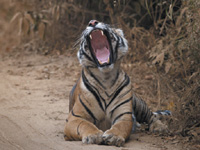
Yawning
tiger in Ranthambore National Tiger Park, Rajasthan, India.
|
|
During this trip Isaac waited
to shoot the full moon coming up over the mountains in Kashmir. He says,
"There was still a little bit of daylight left and I rigged my tripod
to a Jeep with weights at the bottom and just waited..."
Moving on to Ranthambore to shoot the 500 lb tigers in the wild, he joined
the trackers in the morning, his heavy-duty carbon-fiber tripod now mounted
in a Jeep. "We looked for paw prints in the sand or dust and listened
for the shrill cry of the peacock or the Langur monkey that warns the
jungle of a tiger presence. You have to be very quick with tiger photography,"
he warns. "They give you about 10 seconds before they move--it's
not an easy shot."
Hummingbird Tech Tips
Staying closer to home last October, Isaac decided he wanted to shoot
the smallest and fastest bird in America. He went to a friend's
home in Nashville, Tennessee, where the man has been nurturing hummingbirds
for 12 years. "These birds flutter their wings 55 times in a second
and I had never been able to catch them with film," he says. "This
time I put on a pink shirt and decorated my hat with flowers so the birds
would see me as part of their environment. It took a whole day for me
to figure how to shoot them.
|
| |
Little
Shepherd." A Gujar boy with a sheep.
|
|
"I rigged a radio transmitter
with a flash hooked up close to where the birds came to drink the nectar
from the flowers every half hour and I observed them quietly for a few
hours. After a while they would come right up to my nose and check me
out. At 1/250 sec sync to the flash I was getting a nice blur to the wing
and I didn't want to freeze the motion. I had tried shooting at
1/4000 sec and then at 1/2000 but the high shutter speeds froze the wings
and the birds looked like little helicopters. Finally I figured that at
1/250 sec the flash was still syncing, so I shot the whole series in manual
mode or in autofocus where I could manually tweak it and I outsmarted
the little guys."
For bird photographs and with other animal projects Isaac uses what he
calls his "Zen" philosophy. "I wait, look and listen
and try to become part of the environment. Once you blend into the background,
they accept you," he says. "There's a lot to be learned
from animals. The closer I draw to nature, the more I grow to understand
myself. Through my nature photography I am aware of the presence of something
that is bigger than what we are and I am inspired. I am at peace and doing
what I love."
Isaac's website is www.johnisaac.com.
However, you can find other sites about him at: www.google.com.
|