


- REVIEWS
Camera Reviews 
More Reviews Mobile Reviews Photography Reviews - GALLERIES
- VIDEOS
- BUYER'S GUIDES
An Insider's Look At Food Photography
"If You Can Shoot Food, You Can Shoot Anything!"
All Photos © 2004, Dennis Davis, All Rights Reserved
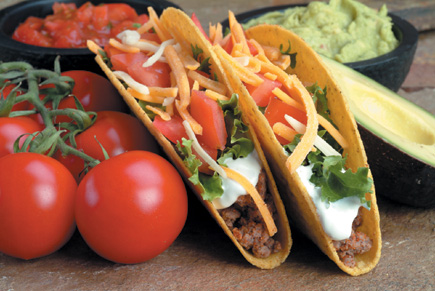
Food photography is considered one of the most difficult specialties for professional photographers. There is a saying in the industry, "If you can shoot food, you can shoot anything." The primary reason for this difficulty is how little time you have to shoot before the food looks like garbage. Within 1-3 minutes after putting a beautiful plate on a table to shoot, whip cream runs, wet food dries, fried food becomes greasy, ice cream melts, and steaming food doesn't. Sometimes you only have time to get off 2-3 shots before the food is no longer at its photographic best.
 |
|
|
So how do you achieve perfect composition and lighting with food that only looks good for a few moments? You use a stand-in. Set up all the real props on the table that are stable, such as napkins, glasses, silverware, flowers, etc. Then put in a substitute for the real food that looks as much like it as practical. If possible, place the stand-in food on the same color and style plate or bowl as the "hero," or real food item. This way you can finalize your lighting, place your reflectors, and check your exposure. If you are shooting digital or have a Polaroid back you can look at test images with the stand-in, and make adjustments to the arrangement and lighting then get approval from your client. When everything is perfect, bring in the hero dish and place it exactly where the stand-in dish was and shoot.
Food Styling Tips
My larger food clients always have a budget for a professional food stylist,
and I have learned a lot from these food artists over the years. The food stylist
creates the "hero" plate and often helps arrange props on the table,
so that I can concentrate on my photography. However, many cookbook, magazine,
and smaller corporate clients do not have the budget for a stylist, and so the
photographer's skills are called upon.
 |
|
|
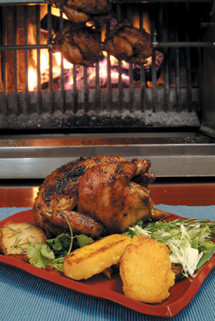
One thing I always take to a food shoot is a bottle of glycerin and several
sizes of artist's paintbrushes. Glycerin can be purchased from larger
pharmacies. Food dries out quickly sitting on a table under 500-1000w of modeling
lights, and the glycerin makes it look wet, shiny, and fresh. I use glycerin
on meat, fish, fresh and cooked cut fruit, and cooked vegetables--almost
anything that should look wet and have lots of highlights. I have also seen
stylists use vegetable oil or corn syrup for the same purpose, but neither of
them last as long. Glycerin mixed with water and put in a spray bottle is also
good for salads, salsas, and other large areas where you would like long-lasting
water droplets.
Steam makes food look hot and appetizing, and can be created in a variety of
ways. Cotton balls soaked in water and microwaved will give you up to one minute
of steam. Dry ice placed behind the food item works well, but gives off more
vapors if you place the dry ice in water. A cigarette or piece of incense is
another option, but you must blow on the smoke to make it look like steam, and
not smoke. Some photographers have an assistant blow cigarette smoke through
a straw placed behind the food. Movie prop and special effects supply houses
sell smoke pellets that some food stylists use, but once again you must blow
on it so that it is not so strongly directional. I have used all of these options,
but have found dry ice and smoke pellets the most useful.
 |
|
|
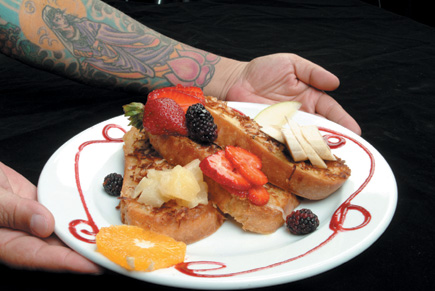
A small propane blowtorch can be used for quickly melting butter on waffles, creating grill marks on meat, or reheating a skillet or wok without returning it to the stove. I once requested a turkey prepared for a photo shoot and the food stylist painted the turkey with kitchen bouquet--a brown gravy base sold in grocery stores--and brown shoe polish, then browned the legs with a blowtorch, and varnished it. It was photographed raw, but looked beautifully cooked and glossy, ready for Thanksgiving dinner!
 |
|
|
Fake Food
There is a law in the U.S.A. regarding truth in advertising. It requires that
advertisements about food show the actual food item that a consumer would be
able to buy and eat. However, the food surrounding the item being advertised
can be artificial, and food used to illustrate cookbooks or magazine articles
can be bogus as well. It is often easier to work with imitation food than with
the real thing.
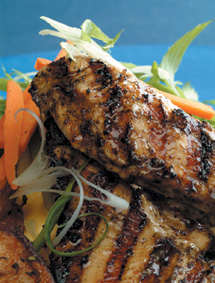
For example, ice cream base is often made with mashed potatoes, or with Crisco
and powdered sugar. Fruit pieces, chocolate chips, and food coloring are added
to make various flavors. Cereal can be photographed with white glue instead
of milk, because the cereal does not get soggy quickly and the flakes stay where
they are placed. Whipped cream might have thickener added, pies have glue holding
them together, and vegetables that appear to be cooked are raw and touched with
a blowtorch and coated with glycerin to make them appear cooked.
 |
|
|


 FEATURED VIDEO


Get the Latest Photo Tips, News & Reviews from Shutterbug!






| Camera Reviews Other Reviews | |
Mobile Reviews Photography Reviews Columns | |
News | |
Features | |
How-To | |
Resources |
 © 2026 Shutterbug
AVTech Media Americas Inc., USA
All rights reserved