| |
If you want to shoot without a tripod or flash in low
light, an image stabilizer will allow you to make sharper
images. (Canon EF 28-135mm USM IS zoom at 135mm; HOYA
polarizing filter; f/8 at 1/30 sec; Kodak Elite Chrome
100 film.)
Photos © 2004, Peter K. Burian, All Rights Reserved
|
|
Regardless of the type of
equipment that we use, image blur caused by hand and body motion is
one of the principal causes of unsatisfactory photos. It's especially
difficult to make razor-sharp images when shooting with a handheld camera
in low light and when using long lenses that magnify the least camera
shake. Although most advanced photographers use a tripod when possible,
a handheld camera allows for greater mobility. Of course, there area
also situations where carrying a tripod is less than practical, during
cycling or backpacking trips, for instance. Finally, a tripod is useless
when shooting from watercraft or aircraft because the accessory transmits
movement to the camera.
No photographer can hold a camera perfectly still. Shake--upward
and downward, and side to side--always occurs, caused by natural
motion. Under modest enlargement, as in a 4x6" print, a lack of
critical sharpness may not be noticeable. However, by 8.5x11"
it becomes evident and in an 11x14" print, even minor blurring
is noticeable.
|
| |
Some
subjects and situations call for maximum mobility. When
following these geese at a discreet distance, a tripod would
have been impractical, particularly while trying to capture
their quick movement toward the water. With a stabilized
zoom lens, I managed to shoot six frames before they swam
out of range. (Canon EF 75-300mm zoom at 280mm; HOYA polarizer;
f/5.6 at 1/125 sec; Fujichrome Sensia 100 film.)
|
|
Tripod Alternatives
The traditional alternatives to a tripod are simple. Use flash with nearby
subjects or switch to an ISO 400, 800, or even 1600 film, or a similar
ISO setting with a digital camera, for faster shutter speeds. Both options
work well, effectively "freezing" camera movement. Problem
is, image quality suffers at high ISO, particularly with digital cameras;
the images exhibit more visible noise, colored specks resembling coarse
film grain but more objectionable. And flash is often impractical, particularly
with distant subjects or in situations where it would spoil the atmosphere.
High-Tech Solutions
The technical solution, provided by several manufacturers, can be more
useful: an optical stabilizer in a lens, or an Anti-Shake system in a
camera. Both compensate for camera movement, allowing us to make sharp
images at surprisingly long shutter speeds. That's great news for
anyone who enjoys working in low ambient light or often shoots sports,
wildlife, or any distant subject with a long lens.
But should you pay extra for a lens or a camera with a built-in stabilizer?
How successful is the technology? Will it solve all of the problems that
cause blurry pictures? Before considering those issues, let's review
the camera shake compensating technology, how it works and why you might
want to pay extra for a camera or lens with a stabilizing device.
|
| |
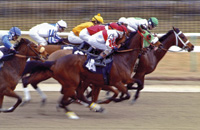
When
the Vibration Reduction system in the Nikon 80-400mm VR
zoom detects only horizontal motion, it switches automatically
to the panning mode. Pan this lens at exactly the same speed
as the subject motion and you can make razor-sharp photographs
that exhibit a sense of motion in a still image. (At 400mm;
1/60 sec at f/5.6.)
|
|
Optical And Other Stabilizers
Until recently, an optical image stabilizer was the only built-in Anti-Shake
device for still photography. Many Canon lenses with IS (Image Stabilizer)
are available; Nikon currently offers four VR (Vibration Reduction) lenses;
and Sigma recently introduced the AF 80-400mm f/4.5-5.6 EX APO OS (Optical
Stabilizer) zoom in most popular lens mounts. Although the proprietary
technology used by each of these companies differs, the principle is similar.
It also applies to the optical stabilizer available in some digital cameras'
built-in zoom lenses; current models are listed in the sidebar below.
When a conventional lens is shaking at the moment of exposure, the image
projected to the film or digital sensor also shakes. Unless we use a fast
shutter speed--"one over the reciprocal of the focal length,"
1/125 sec at a zoom's 125mm setting, for example--the image
will probably be blurred. In a lens with a stabilizer, shake-detecting
gyro sensors measure the angle and speed of lens movement and send an
electronic signal to a high-speed microcomputer. In response, a signal
is sent to a special motor to
shift a group of lens elements in the appropriate direction to counteract
the effect of lens shake. The incoming light rays are refracted and the
projected image is returned to the center of the frame, allowing for a
sharper picture.
|
| |
An
image stabilizer compensates for camera shake but cannot
freeze the movement of a performer, an active animal, a
competing athlete, or flowing water. When shooting at long
shutter speeds, take advantage of the system to produce
interesting motion effects while maintaining sharpness in
surrounding areas. (Panasonic Lumix DMC-FZ10; at ISO 100;
f/2.8 at 1/10 sec handheld; stabilizer panning mode 2; image
cropped.)
|
|
Panning Allowance
In addition to conventional stabilization, many of the latest Canon IS
and Nikon VR lenses, as well as the Sigma OS zoom, include another option.
The first is intended for use when panning horizontally with a moving
subject and compensates only for vertical (up/down) shake. The system
does not try to compensate for the intentional horizontal movement. Pan
at just the right speed and the subject should be fairly sharply rendered,
while the background will be streaked--but smoothly--for a convincing
effect of motion. Another mode available only with Nikon VR and many Canon
IS lenses activates the stabilizer only an instant before an exposure
is made. This prevents a shaky viewfinder image, a typical problem that
some photographers find annoying.
Note: All current Canon L-series IS lenses also include
a mode intended for use when a lens is mounted on a tripod. This feature
can be useful with super telephotos that magnify the least internal vibration
caused by shutter movement or reflex mirror slap. If you use a Nikon VR
lens or the Sigma OS zoom, note that both manufacturers recommend turning
the stabilizer off when using a tripod, unless the camera is being moved:
when panning or when the equipment is buffeted by gusts on a very windy
day.
CCD Shift
An entirely new type of Anti-Shake device is now available in two Konica
Minolta digital cameras with built-in
28-200mm (equivalent) zoom lens. The DiMAGE A1 and A2 incorporate a CCD
shift device that moves the camera's image sensor (instead of lens
elements) to minimize the effects of camera shake. Konica Minolta plans
to employ similar technology in the Maxxum 7 Digital SLR, to be available
in late 2004, in order to extend the Anti-Shake feature to all Maxxum
lenses. Unlike the "electronic" image stabilizer (actually
an image processing function) in some digital video camcorders, CCD shift
does not adversely affect picture quality.
|
| |
Even
a short focal length benefits from stabilization, particularly
when shooting in dark locations where flash and a tripod
are either impractical or prohibited. In spite of the long
1/8 sec shutter speed required to make this image, even
the finest lettering in this image is crisply defined. (Canon
EF 28-135mm IS zoom at 28mm; Kodak Elite Chrome 100 at EI
200.)
|
|
Stabilizer System Evaluation
Any type of shake compensating device is most useful with telephoto lenses,
as mentioned earlier. Nonetheless, a stabilizer is available with some
fairly short lenses, such as Canon's EF 28-135mm and Nikon's
VR AF 24-120mm f/3.5-5.6D IF zooms. These lenses are particularly useful
for those who often shoot indoors, as I did during a trip to Europe, while
recording the interiors of chateaus, castles, museums, and cathedrals
where tripods and flash were either prohibited or impractical.
Because I was shooting for stock, I was restricted to using low ISO slide
film, for images with ultra-fine grain, maximum sharpness, and rich color
saturation. While a "fast" f/2.8 zoom lens would have been
useful as well (at maximum aperture), I often needed to stop down to f/8
for greater depth of field. Consequently, I worked with the Canon EF 28-135mm
IS zoom using the IS to make razor-sharp images at 28mm during 1/15 sec
exposures. I could even extend exposure time when I was able to brace
the camera on something solid. Outdoors, the IS came in handy during dark,
overcast days, particularly when I used a polarizer; useful for wiping
glare from subject surfaces, this filter reduces light transmission calling
for longer shutter speeds.
|
| |
 |
In
order to clearly illustrate the value of the DiMAGE A2's
Anti-Shake system in very long exposures, I took these shots
in the low light of a shopping mall at a 200mm (equivalent)
focal length. As expected, the non-stabilized image is significantly
blurred (bottom) from camera shake while the stabilized
(top) image is surprisingly sharp for a 1-second exposure.
(At ISO 64; f/8 at 1 sec; camera handheld; images cropped.)
|
|
Two Or Three Stop Gain
I have also tested most of the other Canon lenses with IS, up to and including
the EF 500mm f/4L IS USM, the latter usually on a monopod. Test subjects
included competitors during a water skiing championship and a rowing competition,
a rodeo, a soccer game, as well as people, architecture, flying birds,
and various travel subjects in Florida. Like the Nikon VR lenses, all
of the Canon L-series IS lenses provide roughly a three-shutter speed
step advantage for sharp images, when compared to conventional lenses.
The more affordable EF 28-135mm and EF 75-300mm IS zooms offer only a
two-step advantage, but even that was useful in many situations.
Here is a specific example of the value of a shake-compensating device
in a telephoto lens. When working with the Nikon VR AF 80-400mm f/4.5-5.6D
ED in Zion National Park, I needed to shoot at 1/500 sec without Vibration
Reduction for consistently sharp images at 400mm. With the VR system activated,
most of my images were sharp at 1/125 sec and many were equally sharp
at 1/60 sec shutter speed. Bracing my elbows on a rock or the hood of
my car--or using a monopod--produced even more impressive results:
many sharp slides even at 1/30 sec at 400mm.
Digital IS And Anti-Shake
More recently, I have tested two digital cameras with built-in zoom and
stabilizer, the Panasonic Lumix DMC-FZ10 with 35-420mm (equivalent) zoom
with optical stabilizer and the new Konica Minolta Dimage A2 with 28-200mm
(equivalent) zoom with the CCD shift system. Both were highly effective,
and I particularly appreciated the stabilizer when shooting at super telephoto
settings with the Lumix camera. Many of my 400mm images, made at 1/100
sec during an indoor powwow competition, are razor sharp.
Final Recommendations
Although a stabilizer system can be a blessing in many situations, the
technology is not perfect in every respect. First, an optical stabilizer
adds $200-$300 to the price of a lens, though only a few dollars to the
price of a digital camera. Secondly, an optical system increases power
drain by roughly 30 percent when used constantly, reducing battery life.
Finally, any type of stabilizer can lead to some unsharp images because
it's deactivated after a few seconds of nonuse to conserve battery
power. Consequently, the system is not available instantly, so the first
couple of frames of a new series may not be sharp. If you often need to
shoot quickly, maintain light pressure on the shutter button to keep the
mechanism activated.
With any camera shake compensating system, it's important to remember
another fact: it cannot stop the motion of a moving subject. Hence, a
wide aperture and fast film (or high ISO setting) are often necessary
for "freezing" a high jumper in midair or an eagle or motorcycle
speeding toward you. A stabilizer with a panning mode can be more useful,
at least with an action subject moving across your line of vision; the
system will produce smoother motion streaks but will not guarantee sharpness.
Unless you develop some skill in
moving the camera at exactly the same speed as the subject, it will appear
blurred in your images.
Based on my extensive experience, the pros outweigh the cons. In addition
to the benefits mentioned earlier, a stabilizer offers another advantage.
It reduces the need for a heavy/ expensive/large lens of wide aperture
(f/2.8) frequently required for fast shutter speeds. The ability to stop
down to small apertures--with less risk of blur from camera shake--is
often useful. In scenic and travel photography this tactic produces expanded
depth of field to render an entire scene within the zone of acceptably
sharp focus. Finally, the ability to frequently shoot at f/8 or f/11 is
also important with consumer grade zooms that produce the best image quality
in the mid range of apertures.
In spite of the higher price, I can recommend lenses (and cameras) with
a shake-compensating device, particularly with zooms that will often be
used handheld. Any such system pays dividends. It offers serious photographers
greater versatility in selecting the most appropriate aperture and shutter
speed for many subject types. These technical and creative problem solving
aspects are definitely worthwhile, helping photographers of all levels
to increase their success ratio of excellent images.
Peter K. Burian, a free-lancer
stock photographer and long-time "Shutterbug" and eDigitalPHOTO" contributor,
is the author of a new book, "Mastering Digital Photography and
Imaging" (Sybex, March 2004). Covering all aspects of the topic--the
technology, equipment, and techniques--this book provides 300 pages
of practical advice for photo enthusiasts.
(Sidebar) Digital Cameras With Stabilizer
The following digital
cameras with image stabilizer were available at the time of this writing
and we expect additional models to be announced this year. The Canon and
Panasonic cameras incorporate an optical system, shifting a lens element
to compensate for camera movement. The Minolta cameras move the CCD sensor
instead, to achieve a similar Anti-Shake effect. With all models, the
stabilizer feature can be switched off when desired.
Canon PowerShot S1 IS:
A 3-megapixel, 38-380mm f/2.8-3.1 lens.
Panasonic Lumix DMC-FZ1:
A 2-megapixel, Leica 35-420mm (equivalent) f/2.8 (equivalent) lens.
Panasonic Lumix DMC-FZ10:
A 4-megapixel, Leica 35-420mm (equivalent) f/2.8 lens.
Panasonic Lumix DMC-FX5:
A 4-megapixel, Leica 35-105mm (equivalent) f/2.8 lens.
Konica Minolta DiMAGE A1:
A 5-megapixel, 28-200mm (equivalent) f/2.8-3.5 lens.
Konica Minolta DiMAGE A2:
An 8-megapixel camera with high definition 28-200mm f/2.8-3.5 lens.
Konica Minolta Maxxum 7 Digital: Not yet available; 6-megapixel digital
SLR with CCD shift Anti-Shake device that should stabilize any Maxxum
lens.
|