Curious how it compares to metallic paper. This might look gorgeous mounted to aluminum.
Bumblejax Photo Mounting
Ilford Multigrade Art 300: A New & Exciting Multigrade Silver Paper

Texture and “feel” may sound like a strange place to start to sing a paper’s praises, but when someone hands you a print on MGA 300, it’s like being handed an 18th-century engraving. The secret is a very heavy (300 gsm) pure cotton rag paper base, especially made by Ilford’s partner Hahnemühle, without a baryta coating. Baryta is the barium sulphate layer between the paper base and the gelatin. To quote the 1965 Focal Encyclopedia of Photography, “Its main purpose is to provide a smooth white chemically inert base.” It provides a barrier between the paper base (with its possible impurities) and the emulsion, as well as stopping “poke-through,” where the fibers of the paper literally poke through the emulsion.
All Photos © Roger Hicks Ltd.
If you are good enough at making paper (Hahnemühle is), you can however make a chemically neutral paper with no poke-through. This is what MGA 300 is coated on. The surface texture is described by Ilford as “eggshell.” This is as good a description as any, but it is effectively impossible to communicate the sheer tactile pleasure of handling prints on this paper.
None of this would matter if the tonality were unremarkable, but again, it is a joy. It reminds me of platinum prints. As measured with a densitometer, the maximum density is surprisingly low (under 1.6, largely because of the “eggshell” surface), but the subtlety of tone between maximum black and paper-base white is incredible.
The new paper is fully compatible with all other Multigrade papers in filtration and development. Grades run from 00 to 5, corresponding to ISO(R) values of 170 (00) to 50 (5). But although it shares the same genes, it doesn’t look the same. Somehow, it’s just better. In the 1980s, Multigrade quality caught up with graded paper. With MGA 300, it has decisively overtaken any graded paper I have ever tried. It’s that good. Again, it is impossible to communicate in reproduction what I mean: photomechanical reproduction will never do it justice. You have to try it for yourself.
Before you do, though, it is worth entering three warnings. First, it does not scan well. It is superb for exhibition prints, but the texture picks up on most scanners as a “speckle” or “sparkle,” especially in the dark areas. It probably won’t show in repro here, but for maximum-quality art repro, you would need to photograph MGA 300 as carefully as if you were photographing an oil painting, right down to using crossed polarizers.
Second, this is not a paper for the novice. If you are learning (or plan to scan the prints), stick with Multigrade RC. MGA 300 needs careful handling when wet—neither the emulsion nor the base are as tough as conventional paper and the cotton rag base needs more washing than RC paper, though less than most FB papers. I use the Ilford-recommended sequence of (at least) five minutes first wash, 10 minutes in Ilford Wash Aid with occasional agitation, and (at least) five minutes final wash. Then I dry it between photographic blotters.
The “at least” is because a few minutes extra will not matter, but equally, you do not want to leave it in the water too long or it will get soggy: it is, after all, made of cotton. For wash times, therefore, Ilford takes the unusual step of specifying both a minimum (30 minutes) and a maximum (45 minutes) in running water above 5˚C, 41˚F. Also, because the paper tends to float, you need to make sure that it is (a) actually under water and (b) not sticking together.
Other notes on processing are pretty minor. You get maximum image warmth with Ilford Multigrade or Bromophen developers (recommended times: 90 seconds to three minutes); a stop bath is highly recommended, because carry-over of developer is quite high; and then all you need is one minute in film strength (1+3) Ilford Rapid Fixer or Hypam. Film strength fixer is all but essential because this is a paper designed for minimum wet time: it’s the cotton fibers getting soggy again. This is why lith processing is a bad idea, too: with 20-minute development times, the paper is wet for too long. Besides, the only time I tried it, I got quite bad fogging.
Hardening fixers are specifically discouraged, partly for washing efficiency, partly because of possible reductions in toner performance, and partly because of a probable cooling of image tone. Light selenium or other archival toning is recommended for display prints. Processing information is available on a PDF file downloadable from www.ilfordphoto.com.
On a purely personal note, I found myself pre-flashing more than usual, but this is probably because I like long tonal ranges and “plucky” (generously developed) negatives. Trying the paper with a wide range of negatives I found it incredibly forgiving and flexible. I won’t say it’s impossible to get a bad print, because that is always easy, but I found it to be one of the best papers I have ever used for getting good prints, easily.
To sum up, therefore, MGA 300 is a remarkable blend of old and new technologies, though the old technologies are so highly refined as to be all but unrecognizable as compared with even 50 years ago. Better still, it is only slightly more expensive than Multigrade FB Warmtone, which until now has been the paper against which I judged all others. Arguably, Multigrade FB Warmtone and MGA 300 are sufficiently different so that you can’t really compare them; but I do, and MGA 300 wins.
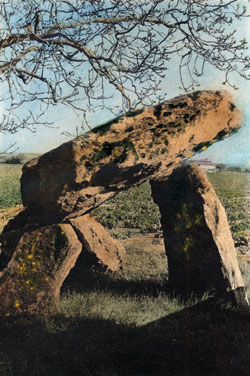
There is, however, an (almost literal) icing on the cake. As I said at the beginning, it is perfect for handcoloring. The eggshell finish provides a perfect tooth for all the media I have tried so far. It is particularly suitable for my current favorite colored pencils, but I’ve also tried it with SpotPens and Marshall’s Transparent Photo Oils. If you are into handcoloring, this has to be one of the finest papers ever made. And if you’re not: well, it’s still one of the finest papers ever made. In fact, I’d go further and say that it is the finest.
For more information, contact Ilford Photo at: www.ilfordphoto.com.
- Login or register to post comments


Curious how it compares to metallic paper. This might look gorgeous mounted to aluminum.
Bumblejax Photo Mounting
--------
nespresso

Interesting post and thanks for sharing. Some things in here I have not thought about before.Thanks for making such a cool post which is really very well written. Will be referring a lot of friends about this. Keep blogging http://www.thefreecamping.com

Excellent article. Very interesting to read. I really love to read such a nice article. Thanks! keep rocking.
pure garcinia

I cannot hang on to talk to your types of how your handwriting features evolved! I'm keen about various kinds in which palm crafting normally takes. I like amassing old post cards in order to begin to see the creating. click here

I don't agree with the extensive utilization of computer worms in Africa. The continent is defined by its spontaneous and wild image and I think ultra-industrialization could only kill diversity and authenticity and bring more foreign customs and a sense of a western way of being. This is very bad news on the long run...

What a wonderful textile of entropy Admiring the bar and labor you put into your journal and judicious grouping you bid ! I commit marker your book and hominine my children kibosh up here oftentimes. Thumbs up
birthday wishes website

Hi-------- this is a great site.i like it very much. 143 friends

I guess it should be a good quality paper. It can be used in retro photography. I wanted to create a blog with different retro photo, but I need to make a decision modeling. But this is a big challange for me.

What a wonderful textile of entropy Admiring the bar and labor you put into your journal and judicious grouping you bid !
spss online help

i like this blog!thank u!! dialogue essay

Pretty nice post. I just stumbled upon your weblog and wanted to say that I have really enjoyed browsing your blog posts. storage box with lid

Feels so good, how can I get this into a cell directory? Is it published or a landline? You can check it here: http://yellowphonesearch.com/anonymous-calls.htm

The fact is, we really can't afford to help both. One needs help, the other (oil companies) are doing really, really well all by themselves.Schoenht Toy Piano

free online shooting games completely agree with the above comment, the internet is with a doubt growing into the most important medium of communication across the globe and its due to sites like this that ideas are spreading so quickly.

free online shooting games I could tell how great you are in your field of interest. You could relate in each detail very well

Thank you very much for posting and sharing this great article. It is so interesting. I want to know some other information about this site. So please give me this news quickly. I always will be aware of you. research paper editing

Awesome and interesting article. Great things you've always shared with us. Thanks. Just continue composing this kind of post. cliquez ici

I would like to say that this blog really convinced me to do it! Thanks, very good post.
grezed

Most of the time I don’t make comments on websites, but I'd like to say that this article really forced me to do so. Really nice post!
read more

Thanks for sharing nice information with us. i like your post and all you share with us is uptodate and quite informative, i would like to bookmark the page so i can come here again to read you, as you have done a wonderful job.
tulsa web design

startaid | slashdotbookmarks | mylinkvault | mister-wongbookmarks | jumptags | buddymarks | blogcatalog | dmozbookmarks
I found myself pre-flashing more than usual, but this is probably because I like long tonal ranges and “plucky” (generously developed) negatives. Trying the paper with a wide range of negatives I found it incredibly forgiving and flexible. I won’t say it’s impossible to get a bad print, because that is always easy, but I found it to be one of the best papers I have ever used for getting good prints, easily.

Pretty good post. I just stumbled upon your blog and wanted to say that I have really enjoyed reading your blog posts. Any way I'll be subscribing to your feed and I hope you post again soon. Big thanks for the useful info.
videos production company

As part of an assignment for research I have to find an article with relevant information on this topic and give the teacher our opinion and the article. Your article helped me a lot.
Membership Software

Wonderful site and I wanted to post a note to let you know, ""Good job""! I’m glad I found this website. Brilliant and wonderful job ! Your website site has presented me most of the strategies which I like. Thanks for sharing this
Tv Odds

But that is how it should be. They are part of the story too. They reveal the path we took toward our new selves, our new creation, what needed to be rejected so that today could be born. download music from computer to ipad

he first part of the novel is set in Florence, Italy, and describes a young Englishwoman's confusion over her feelings for an Englishman staying at the same hotel. Lucy Honeychurch is touring Italy with her overbearing older cousin and chaperone, Charlotte Bartlett, and the novel opens with their complaints about the hotel,'The Pension Bertolini'. Their primary concern is that although a "room with a view" has been promised to each of them, their rooms instead look over a courtyard. A Mr Emerson interrupts their "peevish wrangling", offering to swap rooms as he and his son, George Emerson, look over the Arno. This causes Miss Bartlett some consternation, this behaviour being seen as impolite. Without letting Lucy speak, Miss Bartlett refuses the offer, looking down on the Emersons because of their unconventional behaviour and thinking it would place her under an "unseemly obligation" towards them. However, another guest at the pension, an Anglican clergyman named Mr Beebe, persuades the pair to accept the offer, assuring Miss Bartlett that Mr Emerson only meant to be kind. The next day, Lucy embarks on a tour of Florence with another guest, Miss Eleanor Lavish, a novelist who shows Lucy the back streets of Florence, takes her Baedeker guidebook and subsequently loses her in Santa Croce, where Lucy meets the Emersons again. Although their manners are awkward and they are deemed socially unacceptable by the other guests, Lucy likes them and continues to run into them in Florence. One afternoon Lucy witnesses a murder in Florence. George Emerson happens to be nearby and catches her when she faints. As they make their way back to the hotel, they have an intimate conversation. After this, Lucy decides to avoid George, partly because she is confused by her feelings and partly to keep her cousin happy – Miss Bartlett is wary of the eccentric Emersons, particularly after a comment made by another clergyman, Mr Eager, that Mr Emerson "murdered his wife in the sight of God". However, when a party made up of Beebe, Eager, the Emersons, Miss Lavish, Miss Bartlett and Lucy Honeychurch drive to Fiesole, Lucy and George accidentally meet alone on a hillside. George is overcome by Lucy's beauty among the violets and kisses her, but they are interrupted by Lucy's cousin, who is outraged. Lucy promises Miss Bartlett that she will not tell her mother of the "insult" George has paid her because Miss Bartlett fears she will be blamed. The two women leave for Rome the next day before Lucy is able to say goodbye to George.
Sexuality is another key theme in Forster's works, and it has been argued that a general shift from heterosexual love to homosexual love can be detected over the course of his writing career. The foreword to Maurice describes his struggle with his own homosexuality, while similar issues are explored in several volumes of homosexually charged short stories. Forster's explicitly homosexual writings, the novel Maurice and the short-story collection The Life to Come, were published shortly after his death. Forster is noted for his use of symbolism as a technique in his novels, and he has been criticised (as by his friend Roger Fry) for his attachment to mysticism. One example of his symbolism is the wych elm tree in Howards End; the characters of Mrs Wilcox in that novel and Mrs Moore in A Passage to India have a mystical link with the past and a striking ability to connect with people from beyond their own circles.
a room with a view - e.m. forster - audiobook cd

I discovered your blog site on google and check a few of your early posts. Continue to keep up the very good operate. I just additional up your RSS feed to my MSN News Reader. Seeking forward to reading more from you later on.

Youre so cool! I dont suppose Ive read anything like this before. So nice to find somebody with some original thoughts on this subject. realy thank you for starting this up. this website is something that is needed on the web, someone with a little originality. useful job for bringing something new to the internet!
Shop Vac Parts

its magnificent, my friend likes to design on his wall using different type of papers and always makes a masterpiece, i gonna recommend this one to him for making an extraordinary of work.blog-promo
| Cameras Other | Techniques Site Features | Blogs Archived Blogs Refreshers | More Articles | Columns eCommerce | News Resources |


.jpg)

.jpg)