


- REVIEWS
Camera Reviews 
More Reviews Mobile Reviews Photography Reviews - GALLERIES
- VIDEOS
- BUYER'S GUIDES

Fujifilm X-Pro1 Mirrorless Camera Review
The new Fujifilm X-Pro1 has a stylish, retro design with many interesting features. It is Fujifilm’s first compact system camera with Fujifilm’s new lens mount system. Fujifilm currently offers three lenses for the “X mount”: the XF18mm f/2 R, the XF35mm f/1.4 R, and the XF60mm f/2.4 R Macro. We used the 35mm lens for all our test images and the 60mm lens for the portrait test shot.


The most remarkable feature of the camera is the “hybrid viewfinder.” It is a very large and bright optical viewfinder that also displays a lot of additional image information. This information is mirrored into the viewfinder by an LCD screen with very high resolution (1.44 million RGB dots). In addition, the camera can show a complete high-resolution image in the viewfinder. The camera also offers a viewfinder zoom function for manual focusing. Using the “VIEW MODE” button on the back and the small hand gear on the front, the photographer can change between an electronic viewfinder image on the LCD on the back or the different viewfinder modes in the “optical” viewfinder.

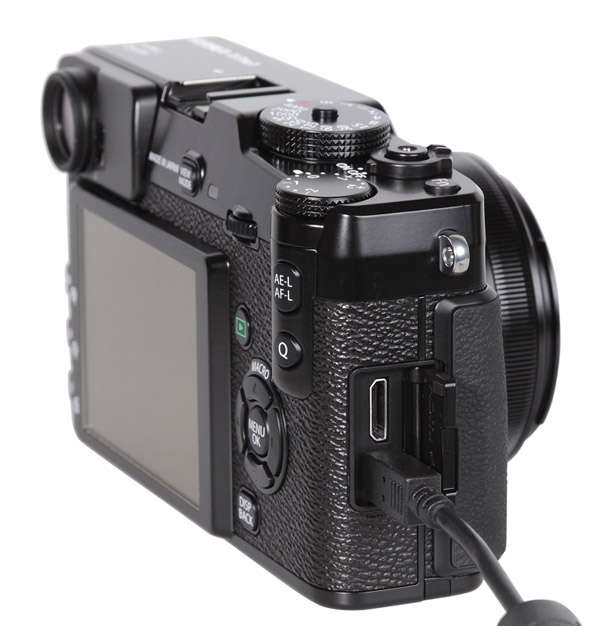
The camera offers all the standard exposure modes like P, S, A, and M. If the aperture ring on the lens and the shutter speed dial on the top are positioned to the red “A” (for automatic) it will work in Program mode. If one of the settings is changed to a user-defined value the camera will work in Shutter- or Aperture-Priority mode. The photographer can change both settings for manual exposure control.
The camera has numerous functions that can be used to change parameters quickly and easily. An additional dial on the top allows users to compensate the automatic exposure settings by +/- 2 EV stops. The “Q” button on the back provides access to many other controls. This precludes the need to open the full Menu for many settings, and all the options are displayed clearly on the LCD screen. The camera also offers Full HD video at 24 frames per second.

Image Quality
Color: The GretagMacbeth test chart was shot in Auto White Balance mode and displays a slight shift into the yellow and green direction. Nevertheless, skin tones are reproduced nearly perfectly, with only brighter skin tones displaying a slightly high magenta rate. The skin tones in the portrait test shot are quite natural.
The camera showed a slight degree of oversaturation (106.9 percent) although it should be noted that this is lower than in images taken with professional SLR systems like Canon’s 1D X or Nikon’s D800.

Sharpness: The camera showed very crisp and clean images without any moiré effects. The APS-C X-Trans CMOS sensor uses a special RGB array which virtually eliminates aliasing effects or moiré. (Note: moiré and aliasing effects are often seen in fine detail in standard Bayer pattern sensors.) Tested with the 35mm lens, the X-Pro1 reproduced the test chart with 3080 lines per picture height, which is nearly the nominal sensor resolution of 3264 lines in picture height. The standard test box image shows the high quality and high sharpness. Every detail is reproduced clearly and crisply. The structure of the hair and the eyelashes in the portrait shot are very natural, even though they are reproduced with high sharpness.
Noise: The noise results in our tests are extremely good. The luminance noise level is very low and stays way below the y-factor of 1.0 percent. Color noise is nearly invisible in images taken at ISO 200 to 1600, although it is noticeable in images at ISO 3200 and 6400. Noise artifacts become annoying only in the Hi-ISO modes up to 25,600.
The results of the dynamic range tests are excellent: the camera showed a maximum of 12 f/stops and keeps a high level of about 11 f/stops even up to ISO mode 3200.
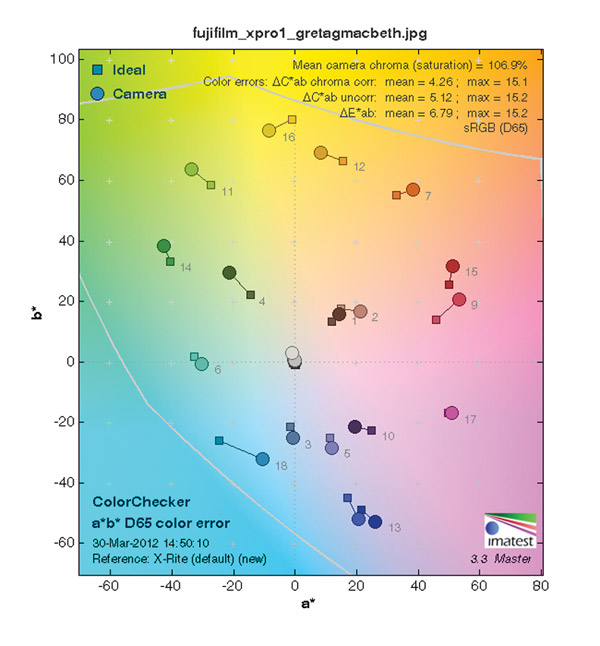
Image Tech
Image Tech is where we publish web-exclusive lab reports on cameras. To read the reports please go to the Shutterbug homepage at www.shutterbug.com and click on the Image Tech tab on the top navigation bar. New reports are published
frequently, so check Image Tech for updates.
Scorecard
Pro
• Very sharp and clean images due to the special RGB pattern and missing low-pass filter
• Realistic colors (with a slight shift in the yellow direction)
• Superb optical viewfinder; a combination of optical and high-resolution electronic viewfinder
• Massive, robust, and stylish body
Con
• No diopter compensation/dioptric adjustment for optical viewfinder
• Lacks an articulating monitor
Lab results and test images by BetterNet, our TIPA-affiliated testing lab. Edited by George Schaub.
| ||
|
||






 FEATURED VIDEO


Get the Latest Photo Tips, News & Reviews from Shutterbug!






| Camera Reviews Other Reviews | |
Mobile Reviews Photography Reviews Columns | |
News | |
Features | |
How-To | |
Resources |
 © 2026 Shutterbug
AVTech Media Americas Inc., USA
All rights reserved