| |
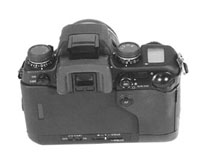
Minolta's
autofocus Maxxum 9 SLR is the first professional model
offered in this camera line in many years. It has a solid
appearance and handles extremely well while taking all
of the lenses and flash units and many other accessories
currently offered for this popular line of SLR cameras.
Photos © 1998, Robert E. Mayer, All Rights Reserved
|
|
When I first saw the Maxxum
9 at a private showing inside the Minolta display booth at the 1998
photokina I was impressed with this camera's capabilities and
was anxious to obtain one for review--but they were not expected until
sometime in the spring of '99. That's a long wait for something
as radical and interesting as this new professional-caliber SLR. But
a call from Minolta's public relations firm said they would have
a few preproduction samples of the camera to send out for a quick look.
In a mere two weeks hands-on period we could not do a really thorough
testing, besides this is not a finished camera sample. Therefore, these
are preliminary first impressions derived over a very short time with
little practical use testing.
Just the appearance of this hefty SLR is impressive. All of the controls
are laid out logically and are large and very legible so it's
easy to pick up and start shooting with minimal review of the controls.
That's all to the good since there was no instruction book ready
yet.
Some of the controls are a bit different from conventional. The main
power switch on the left side is labeled On and Lock, not on and off
you normally see. The lever that opens the back must be first lifted
up then turned counterclockwise before the back will open. There won't
be any accidental opening of this camera's back. The frame counter
remains visible even when the camera is switched off, a decided convenience
in my opinion. The bright white lettering on the exposure-related dials
even has a phosphorescent material so they glow in the dark, a nice
extra touch for low-light shooting situations. Important dials are rubber-coated
and oversized for a more positive grip. All of the dials, buttons, and
body seams were specifically designed to guard against unwanted dust
and moisture typically encountered in rugged professional usage. It
appears to be designed for hard use by ardent photographers.
|
| |
Operating
controls are all clustered for rapid, convenient use on
the top and back of the camera body. Since they are large
and rubber-covered, they are easily grasped when any adjustment
or deviation from the norm is required.
|
|
A solid, durable, stainless
steel and zinc die-cast metal body encloses a host of desirable features.
The more important features include: 5.5 fps rate without requiring a
separate battery pack; 1/12,000 top shutter speed and 1/300 sec top flash
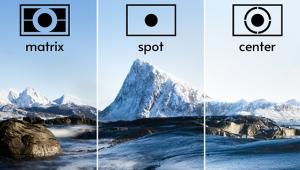
synch speed; four-segment flash metering; 14-segment honeycomb pattern
metering; 100 percent visible viewfinder field; and 21 custom functions.
The built-in computerization includes extensive built-in data memory,
which records all exposure information for up to seven rolls of 36-exposure
film. Changing the drive mode, engaging automatic bracketing, or making
multiple exposures are all controlled by a dial nestled just below the
simplified main mode setting dial beside the data panel where it's
easily accessible.
Two unique new features are mid roll reload and delayed shutter mirror
lockup. The former automatically advances a partially exposed roll of
film to a frame selected by the photographer; it's said to drastically
reduce the time consumed when attempting this technique. The delayed shutter
mirror lockup provides a two second delayed automatic shutter-release
to allow the mirror to lockup before the shutter fires when using the
self-timer mechanism. This brief delay helps reduce the problem of unwanted
vibrations when taking long exposures while the camera is on a tripod.
A large vertically oriented data panel on the top right of the body contains
pertinent information about the camera settings. It can be lit for easier
viewing in low-light situations. Controls that are used less often (data
memory, mid roll rewind, and ISO setting) are all concealed under a flap
on the right end of the body.
|
| |
The
leaves of our dogwood tree always produces interesting color
combinations in the fall such as this unusual combination
of yellow and purple. There was strong midday sunlight streaming
across from the right, but the camera's multi-pattern
metering was not fooled so the exposure was just right to
see into the shadows and to accentuate the green pine bush
below. (Fujichrome Velvia film; 28-105mm zoom at about 80mm;
program automatic exposure.)
|
|
A three-point cross hair type
autofocusing sensor uses a built-in three-target AF illuminator for accuracy
even in low-light or low-contrast situations. A touch-sensor system in
the grip speeds up autofocusing operation by activating everything including
an eyestart system when the camera is first picked up so it's immediately
ready to work as you raise the camera to your eye. Vivid red rectangles
on the ends or a central square illuminate on the viewfinder screen to
inform you exactly where the autofocusing sensor selected its prime focus
point for easier focus tracking. The intensity of these LED indicators
even changes with different light levels making them less obtrusive. The
autofocusing was extraordinarily fast and accurate under every different
lighting situation I used for my brief film testing.
Unusual for a high-end professional SLR is a built-in, pop-up flash which
has a GN of 39 for providing flash fill illumination outdoors or indoors
when a regular flash is not handy. More important, the small flash also
provides coded signals for Minolta's wireless extension flash units
for entirely wireless TTL operation with multiple flash units. On the
top of the prism there is the usual Minolta split-rail hot shoe for their
dedicated shoe-mount flash units. Naturally there is a PC contact for
using studio flash units, which is hidden under a screw off cap on the
left end of the body.
Working in manual mode with most AF Slurs can be a pain since each adjustment
in the shutter speed requires a similar adjustment in the aperture, or
vice versa. With the Maxxum 9, after an exposure is set, pressing the
AE lock button on the back, while turning the front dial, changes the
aperture and shutter speed together without changing the original exposure.
This allows you to make changes quickly without having to make any other
readjustment.
Optional accessories to come when the Minolta Maxxum 9 camera is introduced
in '99 include a vertical control grip, data memory back, and four
new acute matte focusing screens. The Data Memory Back DM-9 has the usual
data imprinting capability for shutter speed, aperture, date, or numerical
information. On each frame one such item can be selected for imprinting
between film frames. It can also store up to 18 items of photographic
memory from each of 400 rolls of 36-exposure film on a 2MB SmartMedia
card. This information can be accessed later on a personal computer for
organized review. If you merely need to imprint the date or time on the
pictures there is the Quartz Data Back QD-9. The Vertical Control Grip
VC-9 will improve handling the camera when holding the camera vertically.
It accepts a variety of battery types to augment the batteries in the
camera body resulting in approximately three times longer operation. Key
controls have been duplicated on the grip for easier operation. The new
camera is fully compatible with the existing Maxxum system of more than
40 interchangeable lenses, dedicated electronic flash units, and related
accessories.
|
| |
These
burning bush leaves were just starting to turn red. Synchro-sunlight
balance fill flash brought out the subtle colors on a cloudy
bright afternoon. (Kodak Ektachrome Elite 200 film; 28-105mm
zoom at about 50mm; program automatic exposure.)
|
|
Although we did not have samples
to test, two new Maxxum lenses were introduced with this new SLR. The
Minolta AF 200mm f/4 Macro APO G telephoto lens has macro focusing capabilities
down to 19.7" for 1:1 life size images; focus-hold button and focus-range
limiter. Unique is the only way to describe the Minolta Smooth Trans Focus
(STF) 135mm f/2.8 (T4.5) which is a manual focusing, special-purpose lens,
the only such lens offered for the Maxxum autofocus cameras. The lens
construction includes an apodization filter to produce a natural visual
shift from focused to defocused areas so the original subject outline
remains clear while there is a smooth transition rendering the background
more out of focus. To fully appreciate what this lens can do you really
have to see sample images made with it.
Preliminary Test Results. For this brief First Look overview
we obtained a preproduction prototype Maxxum 9 SLR with a Maxxum AF Zoom
xi 28-105mm f/3.5-4.5 lens. Like the earlier Maxxum xi lenses, this one
has a power zoom feature that zooms the lens as you turn the main knurled
ring on the front of the lens. If you lightly touch this ring, the lens
zooms slowly so you can let it stop and remain at just the composition
you like, but if you twist the ring harder the lens zooms rapidly from
the present focal length to one extreme or the other. Once you get used
to this action, the power zoom function is very efficient.
In the two weeks this camera was available I only had time to expose five
rolls of color transparency film (Agfachrome RS 50 Plus, Fuji Velvia,
and Kodak Ektachrome Elite 200) as a quick test of this prototype. All
of this E-6 film was processed at Accu-Color Lab., Inc., Fort Wayne, Indiana.
Although this is not a finished production camera, the results were impressive.
Exposures were accurate under varied lighting conditions, focusing was
accurate, and the images were all crisply detailed and very sharp. The
built-in flash when used as the prime light source was even in its coverage
at 28-105mm focal lengths and points in between. The automatic bracketing
worked efficiently when unusual lighting challenged the normal honeycomb
pattern metering.
In 1985 Minolta introduced the first 35mm autofocusing SLR camera. The
new Maxxum 9 camera joins six other models currently available in this
outstanding line. It's a welcome addition made during the firm's
70th anniversary. Check your local Minolta dealer or contact Minolta Corporation,
101 Williams Dr., Ramsey, NY 07446; (201) 825-4000; web site at: www.minoltausa.com.
|