| |
|
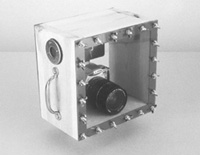
Because of its fast and easy operation, and multiple autoexposure
modes, a modern autofocus SLR is the camera of choice for
our DIY underwater housing. The only requirements are that
it pass the "bathtub test" and accept an electric remote
release. Use a zoom or fixed focal length lens no shorter
than 35mm.
Photos © 2001, Tom Fuller, All Rights Reserved |
|
I've been thinking about
this month's project for years, but its complexity kept me from
presenting it until now. The features of current AF SLR cameras allow
the design to be greatly simplified and made practical for the home workshop
but, because a high degree of accuracy is required in construction and
a drill press is needed, I'm declaring it a Level 4 project. For
those who just joined us, Level 1 takes only everyday items and the ability
to assemble, say, a plastic model kit. Level 2 requires basic hand tools
and the skill to perhaps build a small birdhouse from scratch. Level 3
uses home improvement tools and the hands-on savvy to install a wall thermostat,
with Levels 4 and 5 reserved for mechanically nimble readers who might
enjoy putting in their own car sound system or overhauling their brakes.
Disclaimer: Please Read
The project is intended as a design starting point, rather than a housing
for a specific camera, and as such can be adapted to fit your needs.
|
| |
|
With an AF SLR, the only required control is the AF/shutter
release button. Control exits are frequent leakers on underwater
housings, but our simple push-to-focus, push-harder-to-release
button solves the problem. A large flat washer holds a rubber
gasket disk over a hole in the side, beneath which is mounted
the remote release. |
|
However, the many variables
involved in materials, construction, and use prevent the author and/or
Shutterbug from accepting any responsibility for water or other damage
to your equipment should the project fail in any way. Please read the
entire article carefully before beginning, and test the finished housing
as described before taking it underwater with your camera inside. As these
variables also make a maximum safe operating depth impossible to determine,
consider it a shallow-water (20 ft or less) housing unless your tests
prove otherwise.
Project Setup
The housing is basically a box made from common boards, covered on both
sides with 3/16"-1/4" clear acrylic. Sealing is provided by gaskets made
from sheets of 1/16" red rubber, used for a variety of plumbing tasks
and found in well-stocked hardware stores. Hanger bolts, screwed into
the edge of the frame, receive wing nuts and flat washers that hold each
"port" tightly in place. A parts list is not provided because your housing
is likely to differ in size and shape, but all items are inexpensive and
easy to find. I highly recommend stainless steel or brass hardware, as
even plated steel will soon rust.
|
| |
|
Drill the holes for the #10 hanger bolts with a drill press,
rather than a handheld power drill, so that they will run
straight into the housing. The wing nuts and washers that
hold the ports in place will not seat properly against the
acrylic if the hanger bolts are not straight, and the housing
may leak. |
|
Tub Test
Before engaging in any tool play, use your bathtub to make sure the autofocus
system of your camera functions underwater. Set up the test as shown in
Diagram A, being careful that nothing tips, overflows, or otherwise goes
awry and dunks the unprotected camera. The test container must have a
flat clear side that will be parallel to the front of the lens. Use a
lens no wider than 35mm (or a zoom set to 35mm), and load the camera with
a 12-exposure roll of C-41 film. Be sure that the container is heavily
weighted with bricks or other objects so that it does not capsize when
the tub is filled.
The first test is done with
the tub dry. Place a folded washcloth in the container so that the camera
and lens rest evenly against the bottom. Set the camera to aperture-priority
auto mode, open the aperture all the way, turn autofocus on and connect
the remote release. Take a picture of the test target by existing light,
not flash. (Program mode is likely to activate the built-in flash of many
cameras.) Be sure not to jar the camera or container during exposure and
blur the image.
The second test is done with
the tub filled. Keeping everything as before, make another exposure of
the target. Run the film to a minilab and examine the prints. Both should
be in sharp focus and correctly exposed, although the target in the underwater
shot will appear closer, as if taken with a 50mm lens. (This is caused
by refraction differences between air and water.) If the underwater image
made with a zoom lens is out of focus, add a +4 close-up lens and repeat
the underwater test.
|
| |
|
Sand the front and rear edges of the housing before varnishing.
As both are gasket surfaces, they must be flat, smooth,
and even to prevent leakage. Tape sheets of medium-grit
sandpaper to a hard work surface and apply even hand pressure
to all four sides. |
|
The Housing
If your camera passes, measure it carefully and construct the housing
as shown in Diagram B. Be sure it is deep enough so that the end of the
lens does not extend beyond the front edge when focused at its closest
distance. With the rubber eyecup removed, the viewfinder eyepiece must
be very close to the rear edge but not protruding. Allow room on the side
of the camera for attaching and removing the remote control plug, as well
as space on top for the pop-up flash.
Build the housing from sound,
unwarped wood. Carefully cut and fit the pieces so that the joints are
without gaps, and glue them thoroughly keeping all edges even. Drill a
5/8" hole for the remote release and, being mindful of the earlier positioning
considerations, a 5/16" hole for the camera fastening screw. These are
the only holes that go all the way through--all others (handle screw holes,
etc.) must not penetrate the housing as in Diagram C.
|
| |
|
Because it is difficult to see the corners of the camera
viewing screen through the eyepiece when wearing a mask,
lock subject focus using the AF target zone in the center
of the screen, then quickly move your eye to an external
viewfinder (here a 35mm finder for Nikonos) for composition.
As object size is skewed underwater, some trial-and-error
shots will be needed for accurate "eyeballing" of the subject
within the finder. This housing design can be modified as
desired, with the finder mounted inside or out. Be sure
the camera is turned on and that program (or one of its
other automatic modes) has been selected before tightening
the wing nuts evenly. A weight may have to be attached to
the bottom for neutral buoyancy. |
|
Acrylic Sheets
Without removing the protective paper from the acrylic, cut two sheets
to fit the outside dimensions of the housing. Using one as a template,
mark the hole positions for the evenly spaced #10 hanger bolts. Mark a
hole in each corner, then space the others no more than 2" apart. However,
before drilling a 1/4" hole at each mark, check to see that all are located
such that the hanger bolts, when installed, will be in the center of the
housing edge.
Using a drill press, drill
the acrylic with a sharp bit. (A scrap of board beneath it minimizes the
chance of cracking.) Align the sheets on their respective sides of the
housing and trace the hole pattern onto the wood. Drill the proper size
hole for the wood screw thread of the hanger bolts. The hardness of the
wood will dictate the exact drill bit size for a tightly threaded fit,
but it will definitely be smaller than the 1/4" acrylic clearance holes.
The Gaskets
Cut the gaskets from 1/16" rubber with a sharp art knife. Each must be
a continuous square or rectangle, not made from individual strips, to
seal properly. Using the acrylic again as a template, mark the holes on
the rubber and punch each cleanly through with a paper punch. Make a spare
set of gaskets while you're at it, and save a 4x4" piece of rubber for
the AF/shutter release seal.
Marine Varnish
Give the housing several coats of marine varnish inside and out. Follow
the label directions, as some manufacturers recommend a thinned base coat
followed by full-strength top coats. Temperature and humidity affect drying
time considerably, so be sure each coat is dry before applying the next.
Cover the joints thoroughly, and use a cotton swab to saturate the inside
surface of the camera mounting and remote release holes. Sand the housing
edges gently between coats to maintain the smooth, flat gasket surface.
Leak Test
Before using your housing with the camera inside, try this simple-but-effective
leak test. With everything dry--housing, hardware, and hands--stuff the
housing with loosely crumpled toilet tissue. Place a flat washer and wing
nut on the inside end of the camera fastening screw to hold the neoprene
washer tightly in place, and attach both ports securely, applying a light
coat of silicone grease to the acrylic/gasket joint. Take the housing
down about 20 ft for at least 10 minutes, bring it back up, rinse with
fresh water and let it dry completely. Back in a dry environment, remove
the tissue and examine it inch by inch for water damage.
After Use
In regular use, rinse the housing with fresh water immediately after each
dive and let it dry before opening. Examine the gaskets, camera fastening
screw washer, and ports for cracks, wear, and/or deterioration, and replace
as needed. Remove the gaskets at the end of the day to prevent moisture
from softening the varnish beneath, and touchup deteriorated varnish spots
promptly. Apply silicone grease sparingly to keep it from spreading onto
the lens/viewfinder area of the ports. Remember, the performance and dependability
of this do-it-yourself project is entirely up to you, so proceed with
common sense. Enjoy!
|