| |

|
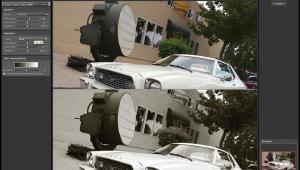
Applied Science Fiction's powerful Digital GEM (Grain
Equalization Management) is available as a Photoshop compatible
plug-in for the Mac OS and Windows. Images, such as this
portrait of model Anna Lieb, made with a Canon EOS D60 at
a high ISO setting, can have both shadow and highlight noise
minimized by adjustment of the three slider controls.
|
|
When I photographed events
on film, all of the negatives were stored along with a set of contact
sheets in a job folder. The sheath of negatives didn't take much
space in a file drawer and all the storage materials cost maybe 50 cents.
Along comes digital and that event now grabs 4GB on a hard disk, so what's
a thrifty photographer do? Edit. Don't do it! After a shoot, I first
copy every image onto my hard drive, and then make a copy of everything
onto CD-R. Over time, the only images remaining on the hard drive are
those that have been edited in some way, while the original files are
stored on one or two CDs. I plan to move on to DVD storage real soon now,
and will let you know how it goes.
At a recent Colorado ASMP meeting a young photographer who only shoots
digital explained the great lengths he goes to to back-up his images.
On each assignment he takes one or two 120GB external FireWire hard drives,
and after copying all the image files onto his laptop downloads them to
one of the drives. Back in the studio, all of the images on the drive
are copied to CD or DVD for additional back-up. When a drive is full he
leaves it alone, stores it as an archive, buys a new big hard drive and
starts all over again. He likes to have "three copies of everything."
This photographer would have had Jerry's photograph.
|
| |
|
Why do I like Microdrives for image capture? Not! This is
an example of an image made with my second and last-ever
IBM Microdrive. All during this particular shoot, the camera
continually produced error messages, corrupt data files,
and images that looked like this. |
|
Infrared Digital Or
Digital Infrared?
Capturing infrared images used to be a hassle: Loading film in the dark,
shooting through opaque filters, guessing at exposure, unloading in the
dark, and then processing with chemicals while sniffing noxious odors.
Not anymore. Making digital infrared images was never easier. All you
need is a digital camera that works with filters such as the Hoya R72
(www.thkphoto.com)
and you can capture them directly. Not all digicams have this capability.
My Canon EOS D60 won't work with this filter at all, but the Fuji
FinePix 3800 not only captures digital IR images, but also has a 55mm
threaded front element that accepts filters, such as the R72. Another
even simpler method is just to capture them any old way--digital
or film--and convert them to infrared using the Plug-in of the Month
from SilverOxide.
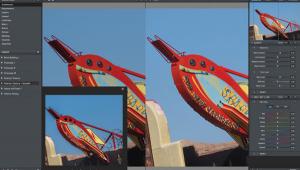
SilverOxide's (www.silveroxide.com)
Silver IR filter simulates an infrared image from any color photograph.
The filter uses a proprietary algorithm that separates parts of the image
based on spectral signature. The control panel's interface lets
you separately manipulate heavily IR saturated components, such as grass,
trees, shrubs, or non-IR components, such as skin tones, brick, and sky.
The process allows photographers to give portrait subjects a pleasing
tonality that contrasts with the image's more IR-heavy components.
The complex filter algorithm used by the Silver IR filter won't
produce perfect results with every image. It cannot, for example, differentiate
between deciduous and evergreen trees. Infrared film renders the former
as glowing while the later does not. Silver IR analyzes the subject's
color to determine if it should glow in the final picture. Any portions
that aren't included can then be rendered as if they were photographed
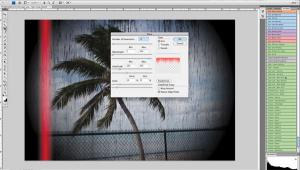
with Tri-X, or through a deep red filter. As a final touch, SilverOxide's
Bill Dusterwald suggests using Photoshop's Filters>Distort>
Diffuse Glow filter to produce the traditional haloing characteristics
of film-based infrared images. SilverOxide has plans for a Color IR filter
in the near future.
A Chip Off The Old
Ice Cube
One of Applied Science Fiction's (www.asf.com)
most useful inventions is the Digital ICE3 technology for color and defect
correction that companies such as Acer, Minolta, and Nikon build into
film scanners. Last year's introduction of Digital ROC (Reconstruction
Of Color) as a Photoshop compatible plug-in is followed by making Digital
GEM (Grain Equalization Management) available as software, too. Digital
GEM uses a set of proprietary algorithms that reads film grain and digital
image noise and extracts data related to image quality, color, and sharpness,
in much the same way the company's Digital ICE3 corrects surface
defects. The corrected image is sharp and clear, without apparent graininess.
Digital GEM can also be configured to allow users to control the specific
amount of grain left in images for aesthetic purposes. Three sliders are
provided: Highlight Noise Reduction, Shadow Noise Reduction, and Clarity.
Unlike previous ASF plug-ins, this one is blessed with a large preview
window. You can toggle back and forth between original and manipulated
images by clicking "before" and "after" buttons
and adjust the sliders to produce the final image.
Microdrive Me Crazy
Here's the big news: IBM Storage Technology has merged with Hitachi
Storage forming Hitachi Global Storage Technologies for the purpose of,
among other things, creating a super-sized Microdrive by the end of the
year. This 4GB Microdrive is made possible by a five-layer version of
Hitachi's patented "Pixie Dust" technology that uses
a three atom-thick layer of ruthenium, a precious metal similar to platinum,
and sandwiching it between three magnetic layers. Hitachi claims the 4GB
Microdrive will have a 50 percent improvement in data transfer over existing
Microdrives, which the company believes will be faster than "all
competitive solid-state data storage products available today."
I don't want to sound like a curmudgeon (OK, maybe I do) but if
the overall reliability of Microdrives isn't improved I don't
care how fast, large, or cheap they are. After two failures with two different
Microdrives with light usage, I'm sorry I didn't listen to
my colleagues that warned me that they're nothin' but trouble.
The buzz is that IBM drives were the most troublesome, and that's
been my experience, too. The mail-order company I purchased the drive
from (www.d-store.com)
kindly replaced the Microdrive with two, albeit smaller, capacity Microtech
CompactFlash cards but at least they work. It's gonna take more
than Tinker Bell to convince me that this new technology is ready for
prime time, but if the new Hitachi Global Storage Technologies is still
talking to me after they see this, I'll try one and let you know
if it really works.
Take Your Camera To
Work Day
May 21st is Take Your Camera To Work Day 2003. Take your film or digital
camera to work and make photographs of your colleagues and show the world
what your day is really like along with the time of day you made it on
www.takeyourcameratoworkday.com.
When finished the site will show the world a snapshot of itself at work.
While images may appear on the site you retain all ownership and copyright.
|