| |
|
Model Tasha Halcomb was photographed in the loft outside
my home office, with strong backlight coming from a large
North-facing window behind her. A Canon EOS D60 was used
in Program setting (with a shutter speed less than 1/15
sec) with 28-105mm zoom lens and fill light from an on-camera
Canon 420EX flash with Sto-Fen white diffuser attached.
Flash was pointed at a white wall, and exposure compensation
was set at +1/3 stop.
© 2002, Joe Farace, All Rights Reserved

|
|
"In
the right light, at the right time, everything is extraordinary."--

Aaron Rose
A Shutterbug reader, noticing
I've been shooting with a Canon EOS D60 wrote, "I have the
same camera but never quite hit the right exposure using flash. I have
tried just going TTL in program, with exposure compensation, or in manual
but the results are typically over or underexposed."
The obvious answer is that there might be some kind of mechanical or
electrical problem that's producing exposure problems with the
camera. Some independent brand lenses, for example, are known to be
incompatible with Canon Elan 7 and 7E cameras and can create exposure
problems and that could be happening with his D60. If everything is
working the way it should, exposure problems may be caused by that fact
that the camera is designed to work perfectly under a given set of circumstances,
but if you shoot under different ones then you need to adjust the camera's
controls to make them work the way you want.
For what it's worth, here is how I use the D60 with the Canon
420EX: I only use the flash for fill, rarely as the main light, and
most often only in low or backlit situations. I check the LCD screen
on the back of the camera after the first few shots and apply plus or
minus exposure compensation to get the look I want. Who cares about
histograms? The "proper" exposure is one I like.
|
| |
|
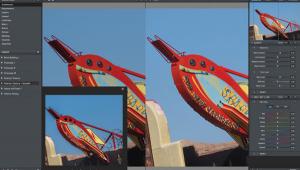
Adobe's Photoshop Camera raw plug-in lets you directly
manipulate the original data captured by a digital camera
sensor. Adobe claims the Mac OS version will only work in
OS X 10.2, but this screen shot was made under OS X 10.1.5
from an image captured with a Canon EOS D60 on a nice spring
day in Colorado.
|
|
When making portraits, I typically shoot in Program mode (sometimes shifting
aperture or shutter speeds) and almost always--indoors and out--use
a Sto-Fen (www.stofen.com)
diffuser on the flash to soften the direction and intensity of the light.
The flash head itself is often tilted in some oddball direction to avoid
that dreaded, flat "flash-on-camera look." All of this is
true when working with the 420EX, but when I was teaching a workshop at
FOTOfusion (www.fotofusion.org)
I borrowed a student's 550EX (he also had a Sto-Fen diffuser) and
it produced similar if not identical results.
The Raw Truth
Another recent e-mail was from a reader who just bought a new Canon EOS
10D and asked: "I'm only shooting raw and it's a pain
to convert and download. Please help." Using an uncompressed raw
image, sometimes nauseatingly called a "digital negative,"
does provide more precise control over an image's tonal range and
detail, but I've always used the largest JPEG setting because I
simply couldn't tell the difference. Large raw files take longer
to capture, so you can't shoot fast action such as motorsports,
and eat up more CompactFlash card space, and I never seem to have enough
of them as it is. |
| |
|
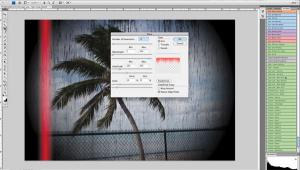
(Below) The original image was made with a Hasselblad Xpan
and Kodak Portra 400BW film. The film was digitized with
an Epson Perfection 3200 Photo scanner and opened in Adobe
Photoshop. A duplicate layer was created, a selection made
around the mailbox, and Xenofex 2's Rip Open filter
was applied to let the background layer show through. To
create some interest and contrast the background layer was
toned using Photoshop's built-in Sepia action. |
|
|
Two new Photoshop compatible
plug-ins have changed my mind--a little anyway--about using
raw capture. The first is LaserSoft Imaging's (www.lasersoft.com)
SilverFast DC 6 that supports raw formats from Nikon D1; Canon; Kodak
DCS, DCR, ProBack; Fuji; Olympus; Minolta; and Sigma. It will be available
for Mac OS 9/OS X and Microsoft Windows. You can read more about SilverFast
DC 6 in my PMA report in the June 2003 Shutterbug. The other is Adobe's
Camera raw plug-in that lets you open Canon, Fuji, Minolta, Nikon, and
Olympus raw image files from within Photoshop instead of using the lame
software that's included with the camera and sometimes available
only at extra cost.
Adobe's Camera raw lets you preview raw files within Photoshop's
File Browser in 16-bit mode and allows you to directly manipulate the
original data captured by a camera's sensor. For each supported
camera, default and custom raw image settings can be adjusted and saved
between sessions. Bundled with Camera raw is a JPEG 2000 plug-in that
supports this new format that uses wavelet technology for greater data
compression while offering better image quality than JPEG. Wavelet algorithms
process data at different scales or resolutions. (For more information
about wavelets, visit www.amara.com/current/wavelet.html.)
Often less than 1 percent of the original data size is sufficient for
"very good" representation. The Photoshop Camera raw package
costs $99 and can be downloaded from www.adobe.com.
There were still two things that bothered me about Camera raw. The list
of supported cameras, as posted on www.adobe.com/products/photoshop/cameraraw.html,
does not include the EOS 10D that I just bought. Check the web page to
see if it supports your favorite digital camera. But I got to wondering,
since the 10D has the same chip as the D60, which is supported, how much
difference could it be? In addition, both Adobe Systems and the Camera
raw installer say the Mac OS version is only compatible with OS X 10.2,
the so-called Jaguar. With OS X 10.1.5 installed, it shouldn't work
until I upgrade but...just for the heck of it, I shot a raw file with
my Canon EOS D60 and stuck the CompactFlash card in my card reader. The
file appeared in File Browser, showed in the OS X Open dialog and I opened
it using Camera raw. When I tried the same thing with an EOS 10D file,
no dice. I checked with an Adobe spokesperson and asked when the plug-in
would be updated for new cameras: "The plug-in will not be updated.
The technology will be incorporated into the next version of Photoshop,
at which time more cameras will be supported." So naturally I asked
when that next version would appear. The short answer is "no comment,"
so I guess we 10D owners are out of luck...or not. This same spokesperson
once told me that when, the as-yet unnamed, Camera raw plug-in was first
shown at a trade show that is was just a "technology demonstration,"
not a product, so who knows.
Plug-In Of The Month
Alien Skin Software's (www.alienskin.com)
Xenofex 2 is an update to this popular package of plug-ins that simulates
natural phenomena such as clouds and lightning. Improved controls allow
users to "aim" lightning bolts by specifying beginning and
end points. In addition, photographers can age their photographs using
the Stain, Cracks, and Burnt Edges filters.
Xenofex 2 also offers distortion effects that let you warp images using
Television, Crumple, and other filters. The 3D effects, such as Flag,
Shatter, and Rip Open, expand your creative palette. Xenofex 2 can transform
images into jigsaw puzzles, constellations, and mosaics with a single
click. The advanced edge detection of Constellation and Classic Mosaic
properly matches colors and aligns tiles/stars for the best effect. All
of the plug-ins have a simple, uncluttered interface that let you tweak
their effects in a huge preview window. It also includes layers and command
menus. Built-in presets provide hundreds of one-click effects. Download
a demo from their web site and give it a try.
How Compatible Are
Your Plug-Ins?
Not all Photoshop compatible plug-ins are, well, compatible with one another.
The most common problem is identification number conflicts. Every plug-in
has a unique identification number but--get this--nobody polices
how these numbers are assigned, so it's possible that different
companies' plug-ins can have the same ID number. When that happens,
the first one to load (in alphabetical order) captures that slot and any
plug-ins trying to use that number won't load. And that, dear friends,
is what's happening with some Auto FX (www.autofx.com)
and nik Multimedia (www.nikmultimedia.com)
plug-ins. At PMA, I urged the creation of a Plug-In Council that would
maintain an official registry of ID numbers, but nobody seemed interested.
Both Auto FX and nik Multimedia are aware of compatibility problems and
are trying to solve it. In the meantime, if you want to use all of the
50+ plug-ins that are part of nik Color Efex Pro!, you have to temporarily
(or permanently) uninstall any Auto FX plug-ins that you have installed.
|