


- REVIEWS
Camera Reviews 
More Reviews Mobile Reviews Photography Reviews - GALLERIES
- VIDEOS
- BUYER'S GUIDES

Canon’s EF-S 60mm f/2.8 Macro USM Lens; An APS-C Lens That Lets You Get Closer
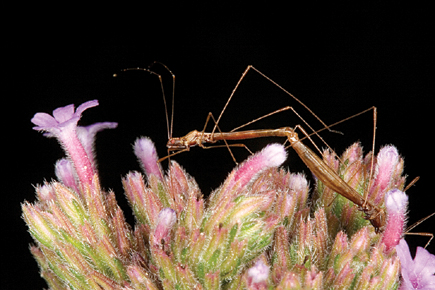
If I could, I'd spend all my time hunting down bugs and lizards and any other critters small enough to fit inside a macro lens. Simply stated, I love macro. So I couldn't wait to put the new EF-S 60mm f/2.8 Macro lens through its paces on my Canon EOS 20D digital SLR.
 |
As you may already know, EF-S is Canon's designation for APS-C-dedicated lenses (meaning they can only be fitted to Digital Rebels, the EOS 20D, and future generations in this format). APS-C is here for the long haul, so don't let that stop you from investing in these lenses.
Compared To Canon's Other Macro Lenses For The EOS
Before Canon addressed the APS-C format digital SLR, you had a choice of several optics. The first was the 50mm Macro, which only went to half life-size, with optional life-size adapter. In addition to slow autofocus, owing to an antiquated drive mechanism, that lens had to physically extend outward to focus close, which proved awkward, especially with skittish bees, butterflies, and the like.
|
Prime Macro Subject
|
|
 |
|
|
When I purchased the EF 100mm f/2.8, I put aside the 50mm. You can't beat a lens that goes all the way to life-size, especially when you add internal focusing and much faster and quieter autofocus. I also worked with the extraordinary MP-E 65mm f/2.8 1-5x Macro--this is a macro lens with completely different stripes--much like working with a bellows but without all the hassle. Missing in my macro arsenal is the 180mm f/3.5L--and for good reason: it's a long, heavy lens. I prefer lenses light enough to hand hold. Which is why the new 60mm f/2.8 is a welcome addition to the Canon line-up.
|
Macro Ring Lite
|
|
 |
|
|
This compact lens measures a mere 3" long and weighs less than 12 oz. I mounted it to an EOS 20D and it balanced nicely, and I suspect it will handle just as comfortably with a Digital Rebel. Equally important if you want to save money on glass filters, the lens features a 52mm filter thread, just like the old 50mm Macro.
The maximum f/2.8 aperture makes this lens a tad slower than the 50mm, but still usable as an all-around normal lens--just not for photojournalism, which gains an edge with fast optics. This glass also benefits from a circular aperture, now popular in an increasing number of Canon lenses, for circular out-of-focus highlights and smoother out-of-focus backgrounds (down to two stops from maximum aperture). The lens is said to offer true flat-field recording, meaning you should be able to get corner-to-corner sharpness across the imaging field.
|
Side Lighting
|
|
 |
|
|
In general, macro imaging benefits from the use of floating lens elements to help you achieve sharper results in camera. Also of utmost importance for speed, convenience, and a better shot at getting those elusive tight close-ups, the lens focuses all the way to life-size without adapters, akin to the 100mm Macro. Both lenses also share Canon's proprietary UltraSonic Motor (USM) drive autofocusing. And focusing on these lenses is internal, so nothing pops out at my subjects unexpectedly.
It is possible to override autofocus by turning the focusing ring, which gives you full manual focusing control--if only for the moment. As soon as you hit the shutter button again, the lens reverts to autofocus.
|
High Color Saturation
|
|
 |
|
|
The Reality Of A 60mm Macro Lens
One problem specific to a short focal-length macro lens (meaning 50-60mm) is that it gives you little breathing room between you and skittish subjects. Unfortunately, that doesn't change when mounting the 60mm Macro on an APS-C format camera, even though the effective focal length is 96mm (60 x 1.6x conversion factor). The minimum focusing distance for life-size image capture with this lens is 20cm/8" (from film plane to subject). On the 100mm Macro (160mm in APS-C format), that distance is 31cm/12" (whether on an APS-C format or full-frame sensor Canon digital SLR or 35mm SLR--the minimum focusing distance and magnification values do not change). One foot is a considerable distance when it comes to wary subjects.
| |||||||||
|

| ||||||||








 FEATURED VIDEO


Get the Latest Photo Tips, News & Reviews from Shutterbug!






| Camera Reviews Other Reviews | |
Mobile Reviews Photography Reviews Columns | |
News | |
Features | |
How-To | |
Resources |
 © 2026 Shutterbug
AVTech Media Americas Inc., USA
All rights reserved