


- REVIEWS
Camera Reviews 
More Reviews Mobile Reviews Photography Reviews - GALLERIES
- VIDEOS
- BUYER'S GUIDES
Bowens 9Lite System
Hot Portraits With Cold Lights
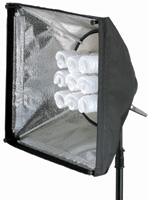
The Bowens 9Lite is designed specifically for digital photography and gets its name from the nine fluorescent pigtail tubes that screw into its main housing. Like Bowens Tri-Lite (see sidebar "Photographing Small Products") these are cold hot lights and each lamp head contains nine 30w flicker-free fluorescent tubes mounted in a housing that can be placed close to a subject for maximum efficiency without generating the kind of skin-melting temperatures found in conventional "hot" or quartz lights. A small 22" square light bank is included with each head and creates the kind of soft lighting appropriate for portraiture, such as headshots where you can bring the light source close to the subject. |
|||
Bits And Pieces |
|||
Use A Sturdy Stand What Color Are These
Things? |
|||
I know, the pundits say you should never use the AWB setting but I'm just here, like Joe Friday, for "the facts." Since AWB on the 10D works between 3000-7000K I was in the ballpark with the 9Lite's output. With the camera in Sunny Daylight mode the image was slightly warm in a Fuji Velvia sort of way. The Shade setting produced warm but not objectionably warm skin tones, while Cloudy produced what might be too intensely warm for a normal portrait, but might make for a nice special effect. The same is true for Fluorescent--even though they are fluorescent tubes--the light is really kinda blue. With the 10D, you can also set an exact K temperature, so I tried one at 6400K and it was slightly cool. Persnickety photographers will probably use the flip side of a Kodak Gray Card (it's white) and their cameras' custom white balance setting to create spot-on color. |
|||
Working With Cold Hot
Lights |
|||
The chrome-plated handle on the back allows positioning the head up and down, but be careful not to pinch your fingers between the light head and light stand bracket like I did. Ouch! One of the 9Lite's heads, the light stand bracket's adjustment handle, was stripped, making it a little more difficult, but not impossible to adjust. Other than that using 9Lite is like using any other hot light--without the heat. Traditional hot light users know that other than heat they typically don't generate that much light output. When used at a distance that I typically use for portraits (about 3 ft), a single 9Lite produced an aperture between f/5.6 and f/8 at 1/60 sec at ISO 400. If you like to work faster or wider, you can do the math. |
|||
Even models appreciated the
soft wraparound light produced by the 9Lite. Some commented on the softness
of the light, while all of them commented on the fact the lights were
much more comfortable than working under conventional hot lights. For
photographers and their subjects who are just tired of the "heat"
in hot lights, the Bowens 9Lite makes for a practical and useful addition
to your lighting arsenal. |
|||
Photographing Small
Products |
|||
Don't worry about the lights being too close and getting the product hot. You can leave the Tri-Lites on for hours and they only get slightly warm (the instructions warn otherwise). Just set the Cocoon on a pair of sawhorses so you can direct light from the bottom and you're ready for any small product a client throws at you. All the kit's components are constructed to a high standard, as befitting a $689.95 manufacturer's advertised price. Technical Specifications |


| ||
|
||


 FEATURED VIDEO


Get the Latest Photo Tips, News & Reviews from Shutterbug!






| Camera Reviews Other Reviews | |
Mobile Reviews Photography Reviews Columns | |
News | |
Features | |
How-To | |
Resources |
 © 2026 Shutterbug
AVTech Media Americas Inc., USA
All rights reserved